For pressureless matter, the cosmological perfect-fluid continuity equation gives . The flat Friedmann equation then gives , and conformal time gives . Choose the initial conformal time to be zero. A galaxy seen at emission time has comoving radius and cosmological redshift .
Two opposite comoving galaxies are separated by . Direct one-way communication between their worldlines before emission requires the particle horizon to cover this separation: . Thus the threshold is , andThe distinction in direct cosmological communication and a shared causal past matters here. If causal contact means that their past light cones overlap, the condition instead is , giving and . These are different operational meanings of the horizon criterion; the boundary corresponds to the limiting initial-time contact.
For radiation in cosmology, by the cosmological perfect-fluid continuity equation. The flat Friedmann equation gives , so in conformal time. Hence .
The opposite galaxies again have separation . Direct communication requires this to be at most , soFor overlap of their past light cones, the criterion is instead , giving . The two notions are precisely those distinguished in direct cosmological communication and a shared causal past.
A fixed comoving volume has physical volume proportional to . The stretched domain walls within it have area proportional to , and their energy per physical area is constant. The cosmological domain wall network therefore has , equivalently a barotropic equation of state with .
The flat Friedmann equation becomes for a positive constant . On the expanding branch, integration gives . Measuring age from the initial time , . Thus
The scale factor of the cosmological domain wall network is , so : the expansion accelerates. Equivalently the Friedmann acceleration equation has for .
Set . The remaining future conformal time isA light ray sent to a comoving reflector at separation and immediately returned consumes of conformal time. The cosmological round-trip communication horizon therefore has supremum physical distanceFinite-time reception requires . Indeed the total travel equation is , giving . At the limiting distance the return time tends to infinity. This round-trip radius is half the current physical cosmological event horizon radius.
Write , so , and let . Contracting the supplied transformed Ricci tensor with givesThe last term contains one trace contribution from and four from the term proportional to .
In the trace subtraction, . Consequently the transformed Einstein tensor isThese derivatives refer to the original metric. This is the tensor identity used in the Einstein-frame representation of metric f(R) gravity.
For the canonical scalar action and the stress-tensor convention in the paper, varying the inverse metric and volume element gives the stress-energy tensor of a canonical scalar fieldThe vacuum f(R) gravity equation, divided by , isInsert this in the transformed Einstein tensor from part (a). Since , its algebraic term becomes . Also gives . The remaining derivative tensor is exactly the kinetic part of : the combination equals . ThusThis establishes the Einstein-frame representation of metric f(R) gravity in the specified normalization. To express the potential as a function of , choose a branch where is locally invertible; the conformal metric already requires .
For the linear function, and . ThereforeThe factor two follows from the paper's conformal transformation . Its vacuum equation is consequently . Here and the scalar is fixed: the Einstein-frame representation of metric f(R) gravity degenerates to ordinary general relativity with a rescaled cosmological constant, and supplies no additional propagating scalar field.
The new neutrino species undergoes thermal decoupling in cosmology when its interaction rate becomes comparable to the Hubble parameter. Equating the given rates givesWith , and ,This is an order-of-magnitude electroweak-scale estimate under the given approximation. The mass in this formula is the unreduced Planck mass, not the reduced Planck mass.
Count one neutrino species as the usual two thermally populated particle-antiparticle helicity states, with negligible chemical potential. Its entropy weight is . In the ideal high-temperature Standard Model, the bosonic count is from gluons, electroweak gauge bosons and the Higgs field. The fermionic count is from quarks, charged leptons and the three ordinary neutrino species. Hence the relativistic entropy content of the Standard Model is for the remaining bath. Before the new species leaves, the total count is ; its separately cooling states are excluded from the subsequent bath count.
Near ordinary neutrino decoupling, the still-coupled bath hasfrom photons, electron-positron pairs and the three ordinary neutrinos. After those neutrinos decouple, the electromagnetic bath falls from to two when the pairs annihilate. Cosmological entropy conservation in that bath gives .
The new species has cooled as since its earlier decoupling, whereas annihilation of Standard Model species heated the remaining bath. The temperature ratio of an early-decoupled neutrino is thusThese are ideal-gas estimates with the high-temperature count implicit in the question; precise electroweak thresholds change them slightly.
Entropy degrees of freedom weight temperature ratios with their cube, while energy degrees of freedom use their fourth power. The remaining Standard Model entropy today, in photon-temperature units, is . The new contribution is . Therefore the fractional entropy of a relativistically decoupled species isAbout 1.6% of the total entropy is in the new species. Separate comoving entropy conservation also derives this fraction directly at decoupling. A model populating four helicity states instead would require the corresponding doubled species count.
Assume the new neutrino is stable and retains the abundance established by relativistic thermal decoupling in cosmology. While it remains relativistic, its contribution to the effective number of neutrino species isThus its effect on the radiation density and expansion during Big Bang nucleosynthesis is reduced relative to a fully heated extra neutrino species.
After it becomes nonrelativistic, its energy density is approximately . A two-state relativistic fermion relic has . The density bound on a relativistically decoupled massive relic then givesHere is the allowed present matter-density fraction and . Choosing the total available matter fraction yields the basic overclosure bound. Its mass cannot be raised freely at a fixed relic number density.
There is also a perturbation constraint. Neutrino free streaming suppresses clustering below the distance traveled before the species becomes nonrelativistic. The ratio controls this distance, and the relic matter fraction controls the strength of the suppression. A significant hot or warm relic component must therefore satisfy the observed structure-formation constraints in addition to the abundance bound. Its allowed dark-matter contribution is limited jointly by these two effects. Numerical observational bounds depend on the chosen matter budget and perturbation data; the temperature and abundance dilution derived here are the factors needed to apply them.
A scalar cosmological perturbation has two scalar gauge freedoms. In Newtonian gauge in cosmology, these remove the scalar shift and spatial shear, leaving the lapse potential and spatial-curvature potential :A perfect fluid has no scalar anisotropic stress. The traceless spatial Einstein field equations therefore set for nonzero spatial Fourier modes, producing the line element in the question. Homogeneous perturbations include background and gauge changes and require separate treatment. The single potential describes the physical scalar perturbation in this gauge.
For constant barotropic equation of state , the cosmological perfect-fluid continuity equation gives . In conformal time the flat Friedmann equation becomes , where . Integration, for , givesChoose the conformal-time origin so that and work on the appropriate expansion branch. Write , so and .
Combining the supplied energy and momentum constraints gives the comoving-gauge density contrast Poisson relationFor this barotropic fluid . Substitute the energy constraint into the pressure equation to obtainso the bracket vanishes and the coefficient of is .
Because , the Poisson relation gives . Apply the same potential equation to : differentiating givesSince is a constant multiple of , the constant-equation-of-state comoving density equation isThe primes here denote conformal-time derivatives, corresponding to the overdots in the question. A pure vacuum fluid has zero enthalpy and no independent fluid velocity or nonzero-wave-number density perturbation; its formal equation should be interpreted with that degeneracy in mind.
For radiation in cosmology, , and the Fourier mode of the comoving-gauge density contrast satisfiesSet , the ratio to the radiation sound horizon scale. The radiation-era comoving density mode has the exact basisDirect differentiation verifies the equation. For , the first function is and the second is , so the outside-horizon solutions grow as or decay as . Regularity at early time removes the second one: . For , the regular solution is , a constant-amplitude acoustic oscillation. A regular mode thus grows while outside the sound horizon and oscillates after entering it.
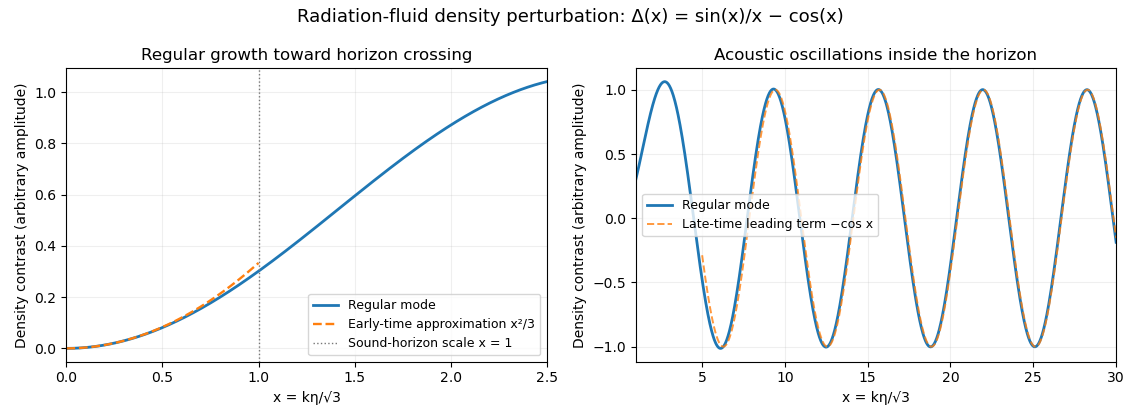

The amplitude is arbitrary; the plotted mode sets . The radiation-era comoving density mode approaches the early-time quadratic growth and the late-time cosine shown alongside it.
For pressureless matter, , the constant-equation-of-state comoving density equation reduces to . Substitution of gives . Since ,In the growing mode, is constant, so the Poisson constraint makes constant for a nonzero Fourier mode. The momentum constraint and the flat Friedmann equation giveThis is the growing-mode velocity potential in matter domination, in the question's convention where the peculiar velocity is .
Differentiate the scalar-field Friedmann equation on the expanding branch :The scalar equation of motion gives . Canceling yieldsThus the Hubble parameter cannot increase for a canonical homogeneous scalar field. The mass scale here is the reduced Planck mass.
The inflaton has quantum fluctuations while their wavelengths are shorter than the Hubble radius. Choosing the Bunch-Davies vacuum fixes the short-wavelength positive-frequency modes. During near-de Sitter slow-roll inflation, expansion carries each mode through , leaving a field fluctuation of amplitude approximately on spatially flat slices.
The inflaton clock-shift origin of curvature perturbations converts this field displacement into a local time shift of magnitude , and hence into a comoving curvature perturbation of magnitude . For the single-field adiabatic growing mode on an attractor, the superhorizon conservation of single-field comoving curvature makes this perturbation approximately constant at . These vacuum-generated perturbations seed the later density fluctuations.
The slow-roll equations give and . Substituting in the stated slow-roll curvature power spectrum yieldsWith the potential slow-roll parameter ,All quantities are evaluated at horizon exit. The two forms have the same normalization because .
At horizon exit , , where is the Hubble slow-roll parameter. To leading slow-roll order,The slow-roll curvature power spectrum is proportional to . Therefore the scalar spectral index in potential slow-roll parameters isUsing the potential slow-roll parameter and the second potential slow-roll parameter givesThe neglected horizon-exit derivative correction contributes at higher slow-roll order.
Apply the horizon-exit derivative from part (d) to the potential slow-roll parameter and the second potential slow-roll parameter. The potential slow-roll flow equations arewhere the third potential slow-roll parameter is . For example, differentiating gives , which is the second expression. Differentiating now gives the running of the scalar spectral indexThis is the leading second-order slow-roll running. The notation denotes a signed derivative combination and does not force its value to be nonnegative.
Articles by others on the same topic
There are currently no matching articles.