Work in geometrized units , with the stationary Killing vector field normalized by at infinity. Put , , and ; is the areal radius. The static spherical Komar mass in reciprocal radial gauge givesIndeed the future and outward unit normals to a round sphere are and , and . The Komar mass integral is therefore . Since and ,Taking the asymptotic limit yieldsThis agrees with . The finite-radius Komar integral need not equal its asymptotic value, because this solution is not vacuum. Restoring divides the mass expression by when has dimensions of length.
For radial null geodesics, the radial metric is . Define the tortoise coordinate byThen the radial metric becomes . Its two null directions have , so in the exterior. The radial null curves are null geodesics up to reparametrization: in the two-dimensional radial metric a null tangent's acceleration is proportional to itself, and spherical symmetry introduces no angular acceleration.
Since , the inverse- radial terms cancel. The ingoing Eddington-Finkelstein coordinates giveAt , . Thus all coefficients are analytic there, and the determinant of the metric block is , not zero. The angular area is also nonzero. This is an analytic extension of a spacetime through the apparent coordinate singularity, into the regular region .
For an asymptotically flat spacetime with future null infinity , its black-hole region iswhere the causal past is understood in the conformal completion. Choose the future orientation in the advanced chart so that is future null. For any future causal tangent , the inequality gives . The causality inequality isIf , it implies . Inside , , so strictly decreases. If , the angular tangent vanishes and future orientation makes a positive multiple of , again decreasing . Thus no future causal curve from can reach the exterior or future null infinity: it is inside the black-hole region.
Conversely, from any point with , the outgoing radial null geodesic has constant and . It continues to arbitrarily large , with , and reaches the corresponding future null infinity. Hence in this advanced exterior chart. This argument concerns the black-hole interior covered by ingoing coordinates; the additional white-hole region of the maximal extension has a different future causal orientation.
In advanced coordinates, is a Killing vector field and . The normal covector to is ; raising it gives , which equals on the horizon. Thus is a null hypersurface normal to , and hence a Killing horizon.
The surface gravity is defined by on this horizon, equivalently . Here , so the radial component gives . Because ,It is positive for all finite real and ; the stationary Killing vector field retains its asymptotic normalization.
Set . Since , the integrand defining the tortoise coordinate has a simple pole:where is analytic near . Define the Kruskal–Szekeres coordinates in the right exterior by and . ThenThe right-hand side has positive nonzero derivative at . Continuing this relation analytically, rather than retaining an absolute value, makes an analytic function of through both signs. The Kruskal extension across a simple static horizon has metricIts radial coefficient tends to , finite and nonzero, while . Therefore both null surfaces and are regular horizon branches, intersecting at a smooth two-sphere .
The stationary Killing vector field becomesIt is null, tangent and normal on each horizon branch and vanishes on their intersection. This proves that is a bifurcate Killing horizon, with bifurcation surface of area . The exponential definitions specify one exterior; allowing all signs of supplies the remaining quadrants of the extension.
There is only one zero of , at , and the Kruskal–Szekeres coordinates give four quadrants. Both exterior quadrants have , while the future and past interior quadrants have . The tortoise coordinate is finite at : for , , and for it is . Throughout each interior , so constant- hypersurfaces are spacelike. The assumed curvature singularity at therefore forms a spacelike future boundary in the black-hole region and a spacelike past boundary in the white-hole region. At infinity, and , giving two standard asymptotically flat ends.
The resulting Penrose diagram is the same four-region causal diagram as the maximal Schwarzschild spacetime:
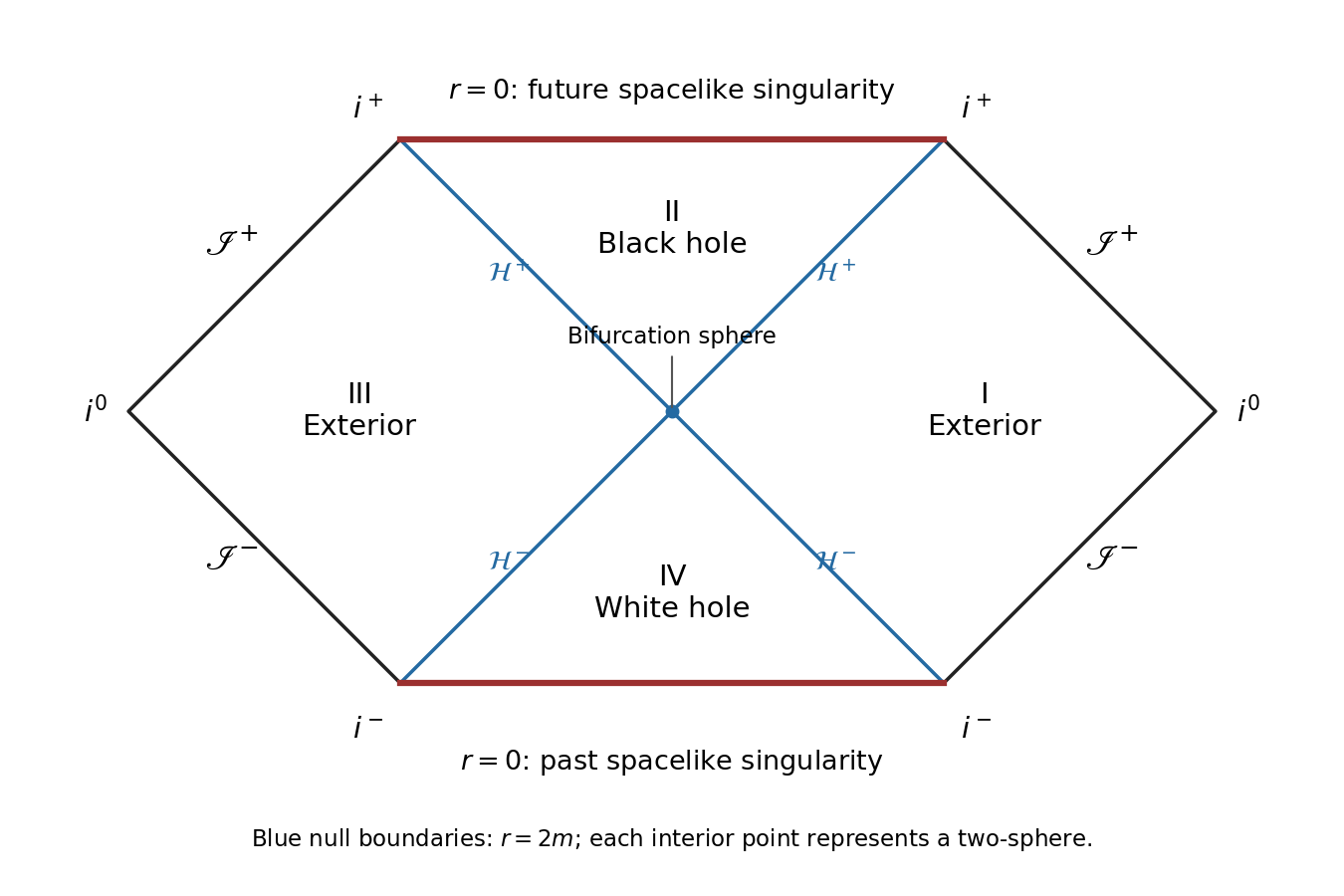
Maximal extension of the charged single-horizon geometry, with two exteriors, a black hole, a white hole and spacelike singularities
. Details. 
Each exterior has its own past null infinity, future null infinity, spatial infinity and timelike infinities. The future and past event horizons intersect on the bifurcation surface. The diagram describes the eternal analytic solution; a spacetime formed by collapse need not contain its white-hole region or second exterior.
Unlike a nonextreme Reissner-Nordstrom black hole, this electrically charged solution has one horizon and spacelike singularities, with no inner Cauchy horizon. A nonextreme Reissner-Nordstrom solution has two distinct horizons, including an inner Cauchy horizon, and a timelike singularity; its ideal maximal extension contains an infinite sequence of exterior and interior blocks. Charge by itself does not determine this causal structure: the metric and field equations of the gravitational theory matter.
Articles by others on the same topic
There are currently no matching articles.