There is only one zero of , at , and the Kruskal–Szekeres coordinates give four quadrants. Both exterior quadrants have , while the future and past interior quadrants have . The tortoise coordinate is finite at : for , , and for it is . Throughout each interior , so constant- hypersurfaces are spacelike. The assumed curvature singularity at therefore forms a spacelike future boundary in the black-hole region and a spacelike past boundary in the white-hole region. At infinity, and , giving two standard asymptotically flat ends.
The resulting Penrose diagram is the same four-region causal diagram as the maximal Schwarzschild spacetime:
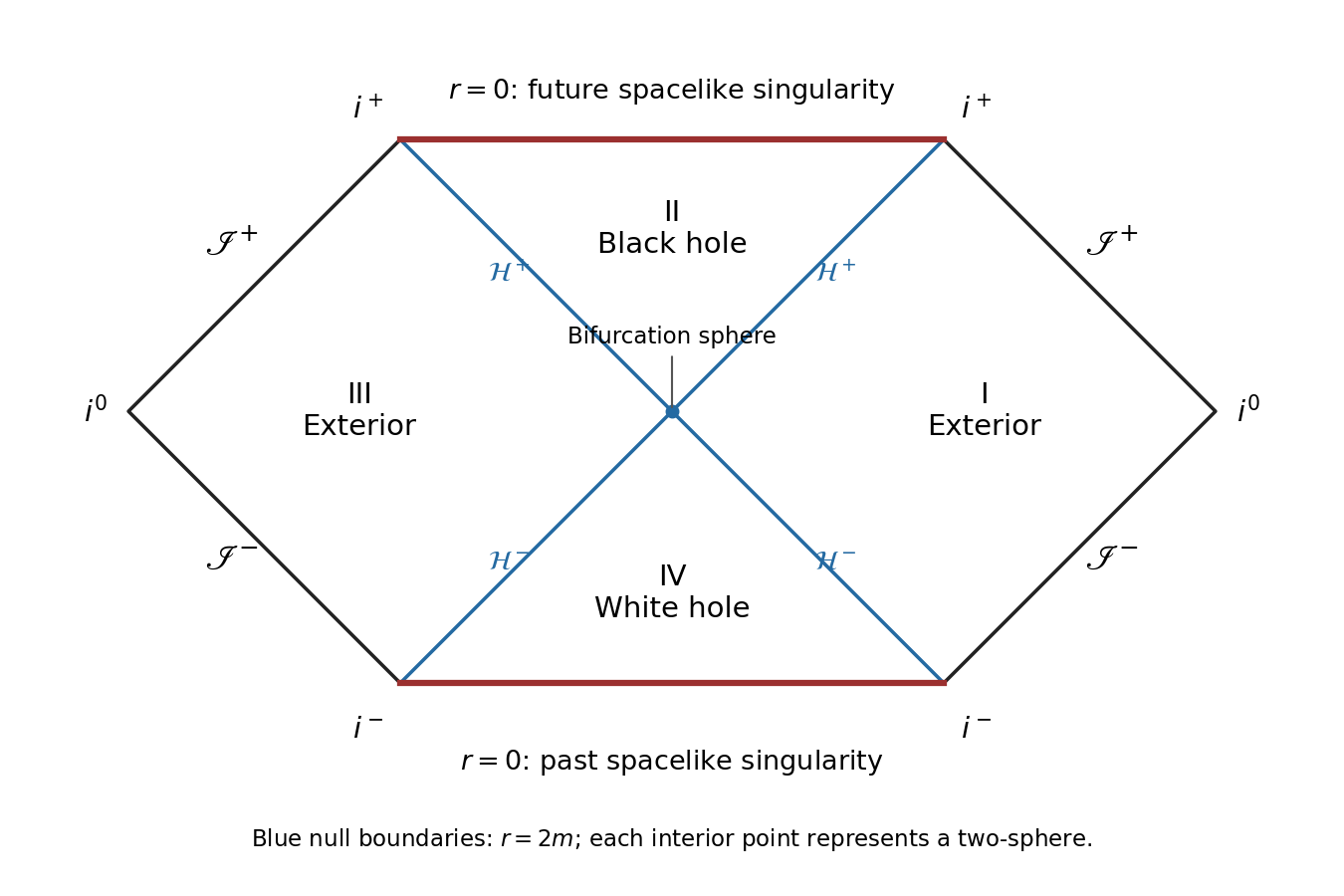
Maximal extension of the charged single-horizon geometry, with two exteriors, a black hole, a white hole and spacelike singularities
. Details. 
Each exterior has its own past null infinity, future null infinity, spatial infinity and timelike infinities. The future and past event horizons intersect on the bifurcation surface. The diagram describes the eternal analytic solution; a spacetime formed by collapse need not contain its white-hole region or second exterior.
Unlike a nonextreme Reissner-Nordstrom black hole, this electrically charged solution has one horizon and spacelike singularities, with no inner Cauchy horizon. A nonextreme Reissner-Nordstrom solution has two distinct horizons, including an inner Cauchy horizon, and a timelike singularity; its ideal maximal extension contains an infinite sequence of exterior and interior blocks. Charge by itself does not determine this causal structure: the metric and field equations of the gravitational theory matter.
Articles by others on the same topic
There are currently no matching articles.