Weak convergence of distributions means for every test function . The distributional derivative is defined byIt is linear and continuous: differentiation preserves compact support and bounds each test-function seminorm by one of higher derivative order, so composing it with the continuous functional again gives a distribution. Finally, for every fixed test function,Thus distributional differentiation preserves the stated convergence.
The function is locally integrable in , so it defines a distribution. The claimed distributional identity means that for every ,Choose a ball containing the support and remove . On the punctured region . Green's second identity givesThe outer boundary contributes zero. On the inner boundary, the outward normal for the punctured region is , so , fixing the sign.
The first term is ; the second equals . Local integrability allows the left side to converge to its full-space integral. Therefore . In this sign convention, is the fundamental solution of the Laplace equation for the operator .
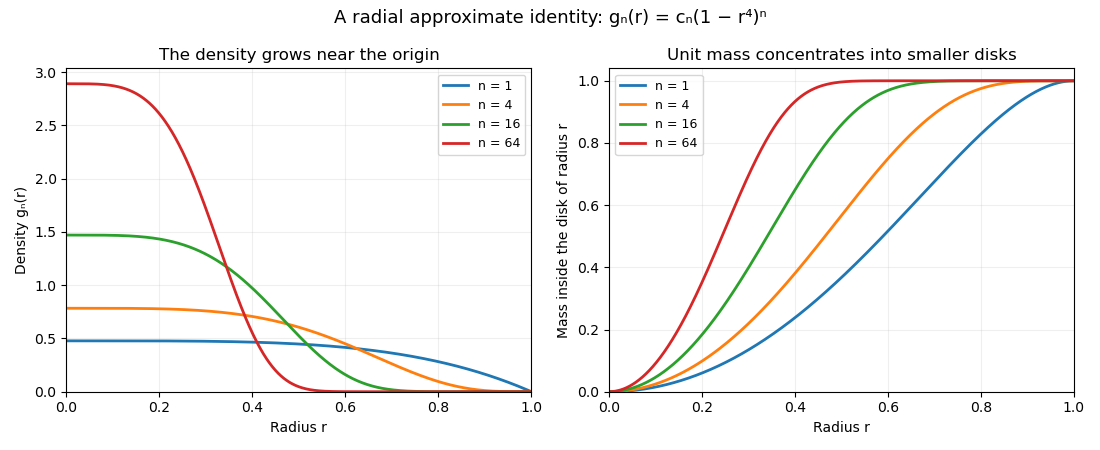
The functions are nonnegative and normalized to have integral one. On the disk , Bernoulli inequality gives . ConsequentlyFor any fixed , the mass outside radius is at mostThis is an approximate identity. For any test function,Let and then to conclude .

Articles by others on the same topic
There are currently no matching articles.