The statement requires ; an empty set is closed and convex but contains no minimizer. Assume this necessary condition and put . Since is closed and , . Choose a minimizing sequence with .
The midpoint lies in the convex set . Applying the stated Clarkson inequality to and givesThe right side tends to zero, so is a Cauchy sequence. By completeness of Lp spaces, proved in Question 2(a), it converges to some . Closedness puts in , and continuity of the norm gives . This is the closest point theorem for a closed convex subset of Lp. The same inequality applied to two minimizers forces their difference to be zero, so the minimizer is also unique.
For , convexity gives for . Thus has a right minimum at and . The derivative of a power of the Lp norm isConsequentlyThe printed hint has coefficient where the general coefficient is . This does not affect the desired sign, since . The complex conjugation is important for complex-valued functions; for real functions it can be omitted.
Use the printed bilinear pairing , which is complex linear in both arguments. For the conjugate exponents , Holder inequality gives , proving well-definedness, continuity, and . Linearity of follows from linearity of integration.
For , takewith the numerator defined as zero where . Since , this has and . Hence ; the same identity holds for . This also proves injectivity.
For surjectivity, let be a nonzero bounded linear functional on . Choose with and let . The closest point theorem for a closed convex subset of Lp supplies the nearest point ; write . For every , the whole line lies in , so the norm derivative at the minimum vanishes for real . Applying this also to shows that the complex linear functionalvanishes on . Since , each is in , giving and . ThereforeMembership follows from . The zero functional is represented by . This proves the asserted Lp duality isometric isomorphism, including surjectivity, without a separate representation theorem.
First let , and take a Cauchy sequence in the Lp space, with functions identified almost everywhere. Choose a subsequence with and put . The triangle inequality givesBy the monotone convergence theorem, belongs to , and is finite almost everywhere. The series therefore converges almost everywhere to an function . Applying the same argument to each absolute tail yieldsThe original sequence is Cauchy, so the triangle inequality extends convergence from this subsequence to the whole sequence.
For , choose the same subsequence in essential supremum norm. Outside one null set, all its difference bounds hold simultaneously:The series then converges uniformly on that full-measure set to a bounded measurable , and . Again the full sequence converges. Thus every , , is a Banach space, proving completeness of Lp spaces.
If either upper norm bound is nonpositive, there are no admissible functions with , and the assertion is vacuous. For positive , chooseSplitting the integral givesFor finite , Holder inequality bounds the last term by . HenceFor , the corresponding bound is . Thus an explicit choice proving the strict inequality isThis is a nonvanishing level-set bound between three Lp norms: the lower- bound prevents diffuse low-amplitude mass, and the higher- bound prevents arbitrarily concentrated spikes.
Work on with Lebesgue measure. Without a uniform bound, useIt has and , with for . Each function still belongs to , but its norm is unbounded. For every fixed , its level set above is eventually empty, defeating any positive uniform .
Without a uniform bound, use insteadNow and , but for any fixed the high-amplitude level set has measure . These give the two distinct failures of the nonvanishing level-set bound between three Lp norms when either control is removed.
Assume the bounded set is measurable, as needed to define its indicator in . Put and choose a smooth cutoff function of compact support equal to one near . Weak convergence in the H1 space gives a uniform bound, by the Uniform boundedness principle, and therefore is uniformly bounded in with fixed compact support.
Here is a direct Fourier proof of the local compactness in the Rellich-Kondrachov compactness theorem. For each frequency , , since integrating against the fixed compactly supported function is a continuous linear functional on . Also uniformly, by Cauchy-Schwarz inequality on the fixed support. The dominated convergence theorem gives, for every fixed ,The uniform derivative bound and the unitary Plancherel theorem control high frequencies:First let , then . This proves , and hence .
Let . The Sobolev embedding theorem bounds uniformly. For , choose with . Interpolation of Lp norms gives . For , Holder inequality on the fixed finite-measure support gives the same conclusion from convergence. ThusThe same integral estimate covers if those spaces are interpreted with their usual quasi-norm. No conclusion at the critical exponent is asserted.
The appropriate Poincare-Wirtinger inequality, with no zero-boundary assumption, isAssume is nonempty, bounded, connected and has the stated cone property. If this failed, after subtracting the mean and normalizing there would be withThe sequence is bounded in . By the permitted Rellich-Kondrachov compactness theorem, a subsequence converges strongly in to . For every compactly supported test function, integration by parts and these two convergences show that each distributional derivative of is zero. A function with zero weak gradient is constant on a connected open set: mollification makes it locally constant, and connectedness identifies the local constants.
Convergence in on a finite-measure set also preserves the integral, so and the constant is zero. But strong convergence preserves , a contradiction. This proves the inequality; connectedness prevents different constants on separate components.
Weak convergence of distributions means for every test function . The distributional derivative is defined byIt is linear and continuous: differentiation preserves compact support and bounds each test-function seminorm by one of higher derivative order, so composing it with the continuous functional again gives a distribution. Finally, for every fixed test function,Thus distributional differentiation preserves the stated convergence.
The function is locally integrable in , so it defines a distribution. The claimed distributional identity means that for every ,Choose a ball containing the support and remove . On the punctured region . Green's second identity givesThe outer boundary contributes zero. On the inner boundary, the outward normal for the punctured region is , so , fixing the sign.
The first term is ; the second equals . Local integrability allows the left side to converge to its full-space integral. Therefore . In this sign convention, is the fundamental solution of the Laplace equation for the operator .
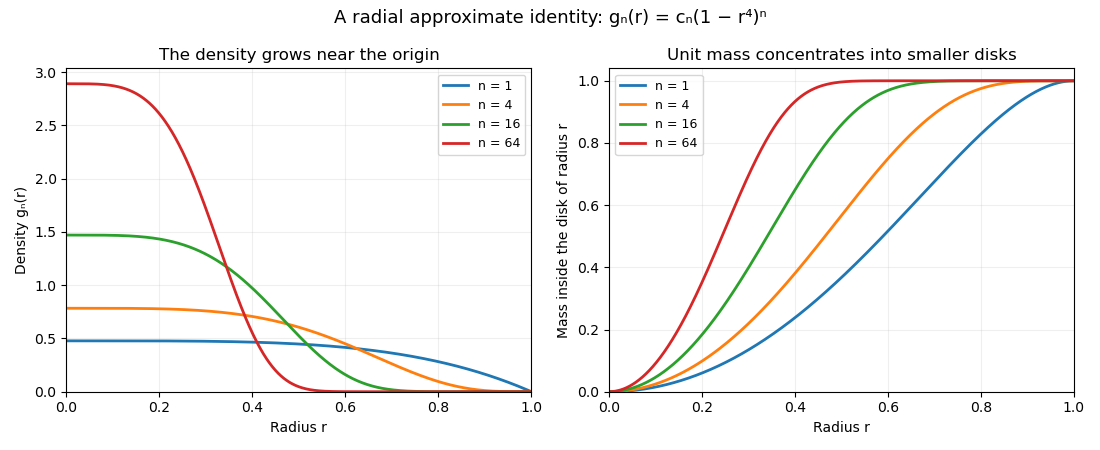
The functions are nonnegative and normalized to have integral one. On the disk , Bernoulli inequality gives . ConsequentlyFor any fixed , the mass outside radius is at mostThis is an approximate identity. For any test function,Let and then to conclude .

For a real locally integrable function , the distributional definition of a subharmonic function is : for every nonnegative ,A superharmonic function has the opposite inequality, equivalently is subharmonic. A harmonic function has distributionally, equivalently equality for every test function. These definitions concern almost-everywhere classes; the given upper semicontinuous representative supplies the pointwise version for subharmonic functions.
The statement as printed is false without an integrability condition. On any nonempty open set, the constant functions are harmonic and therefore subharmonic, but their supremum is , which is not locally integrable.
A valid version assumes . First, the maximum of finitely many subharmonic functions is subharmonic. For a distributional proof, mollify two functions on smaller interior domains and replace their maximum byThis is smooth, convex, and nondecreasing in each argument. The chain rule shows that its Laplacian applied to two smooth subharmonic functions is nonnegative: the first-derivative terms multiply their nonnegative Laplacians, and the Hessian term is nonnegative by convexity. Mollifier convergence in and the uniform bound allow both regularizations to be removed. Continuity of distributional derivatives under this convergence proves the finite-maximum assertion.
Now increases to and satisfies almost everywhere. The dominated convergence theorem gives convergence in . For every nonnegative test function,Thus is subharmonic in the distributional sense. This is the locally integrable supremum theorem for subharmonic functions. For the pointwise upper semicontinuous convention, take its canonical representative; the raw supremum need not already have that regularity.
This is Weyl lemma, with the representative condition needed for pointwise smoothness. Choose a smooth radial nonnegative mollifier of mass one. On interior domains, is smooth and harmonic because .
Fix a smaller interior neighborhood and a radial mollifier whose support stays inside the domain there. The mean value property for harmonic functions implies when is sufficiently small: a radial average is a weighted average of spherical means, all equal to the center value.
As , in , while locally uniformly. The latter follows by bounding the difference by times the local error on a slightly larger compact set. Thus almost everywhere locally. The right side is smooth, and its Laplacian is zero, providing a smooth harmonic representative. These representatives agree on overlapping neighborhoods since continuous functions agreeing almost everywhere agree everywhere.
The given uniqueness of the canonical upper semicontinuous representative identifies this smooth function with . Since the question assumes , it follows that pointwise. An arbitrary null-set modification of a harmonic distribution would not have that conclusion.
The strong maximum principle for subharmonic functions states that an upper semicontinuous subharmonic function on a connected open set which attains its finite global maximum at an interior point is constant. In particular this holds for a harmonic function; negating the function gives the corresponding minimum principle for superharmonic functions.
Let the maximum be , attained at . For every sufficiently small ball centered at , the mean value inequality givesTherefore its average equals . If some point in the ball had value less than , upper semicontinuity would give an open neighborhood where for some . That positive-measure neighborhood would make the average strictly less than , a contradiction. Thus throughout a neighborhood of .
The same argument at each maximizing point shows that is open; it is also closed relative to the domain by upper semicontinuity. It is nonempty, so connectedness forces it to be the whole domain. Without connectedness, constancy is only guaranteed on the component containing the maximizing point.
Articles by others on the same topic
There are currently no matching articles.