For a nonzero normalized or unnormalized trial function in the Hamiltonian's quadratic-form domain, the Rayleigh-Ritz variational principle gives . Expanding in energy eigenstates, or using the spectral measure, makes the quotient a weighted average of spectral energies, all at least . For an even one-dimensional potential, the ground state is even and the first excited bound state is odd by the nodal ordering theorem. Restricting to odd trial functions therefore gives an upper bound on the lowest odd energy and on when that bound state exists; a negative odd quotient also certifies its existence.
Here . For the Gaussian trial function, integration by parts gives kinetic quotient , and the potential quotient is . ThereforeFor , its zero obeys , giving the unique positive zeroAlso , so its stationary points satisfy . The left side increases strictly from zero to infinity, proving that there is exactly one stationary point, a minimum.
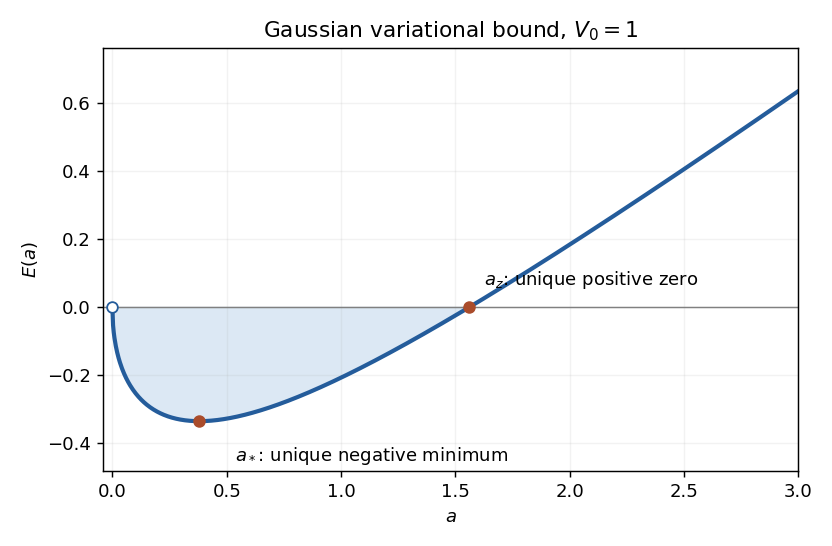

As , approaches zero from below; as , it tends to infinity. The sketch and variational inequality therefore give a negative energy for every . Since this decaying potential has essential spectrum beginning at zero, at least one bound state exists for every positive well depth.
For small , the minimizer is . Substitution gives . Meanwhile the potential is strictly greater than except at a single point and the kinetic energy is nonnegative, so a normalized bound-state expectation is strictly greater than . Thus
Articles by others on the same topic
There are currently no matching articles.