A steady-state bifurcation is a change in the local equilibrium branches or their stability as a parameter varies. At such a bifurcation the Jacobian matrix at the equilibrium has a zero eigenvalue, so the implicit function argument for a unique persistent local equilibrium fails.
For this system,At its eigenvalues are ; at they are . Both have one simple zero eigenvalue at , with the other eigenvalue negative. Interior equilibrium branches, obtained below, meet these boundary equilibria there, establishing the actual bifurcations rather than merely a necessary eigenvalue test.
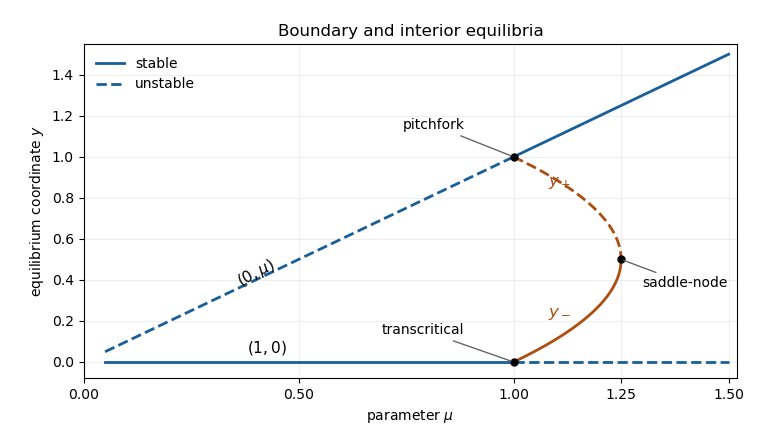
Near put , , , with . The extended system isThe extended centre manifold for a parameter has , , . Its centre-manifold invariance equation is . The left side starts at degree three. At degree two the right side is , so , with no or term. Substitution givesThe leading normal form of a dynamical system has branches and , exchanging stability at : this is a transcritical bifurcation. In the physical quadrant the interior branch is present only for .
The equations extended across are equivariant under , so near the reduced equation is odd in . To verify its nondegenerate pitchfork bifurcation, set and . ThenThe local centre manifold has , obtained by balancing the quadratic terms of its invariance equation. Consequently : the cubic coefficient is nonzero. This is a subcritical pitchfork, with the two symmetry-related interior branches existing for in the extended plane; only the branch belongs to the physical quadrant.
At an interior equilibrium point, , soFor both values satisfy , giving two physical equilibria. At such an equilibrium,The branch is asymptotically stable by the trace-determinant stability criterion; is a saddle equilibrium. In fact is symmetric, so the stable branch has two negative real eigenvalues.
At the equilibria merge at . Writing , the equilibrium condition is , the characteristic branch geometry of a saddle-node bifurcation. The stable node and saddle annihilate as increases through .
The bifurcation diagram has boundary branches at and at . The former is stable for and a saddle for ; the latter is a saddle for and stable for . The origin is an unstable equilibrium for every ; its branch coincides in this projection with the branch, so it is shown separately in the caption.
The stable interior branch rises from at to at . The unstable interior branch falls from to over the same interval. These meet at the saddle-node bifurcation; at they meet the transcritical and pitchfork points respectively. There is bistability between the lower interior node and for .

Articles by others on the same topic
There are currently no matching articles.