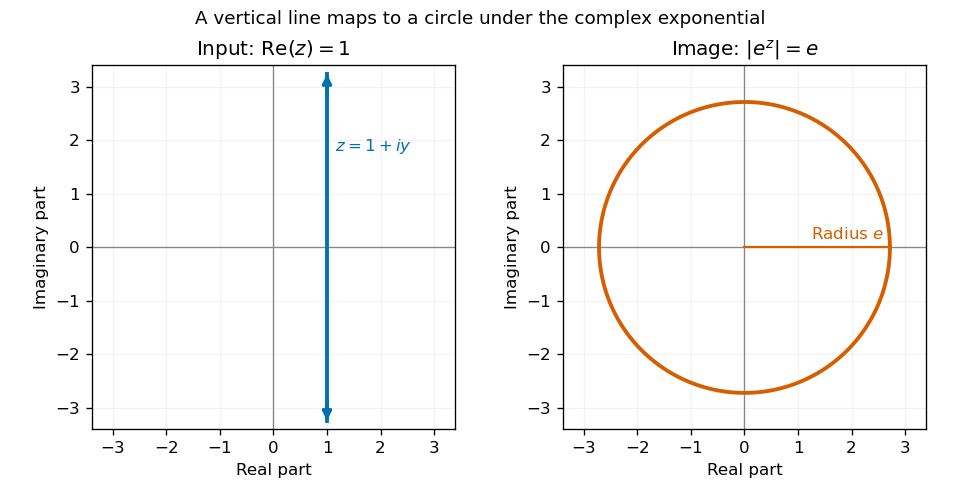
Write with . In the complex plane, this is the vertical line through . The complex exponential gives , so its complex modulus is always . Conversely, every point of that modulus has an complex argument and is obtained in this way. The image is the entire circle centered at zero with radius , traversed repeatedly as varies; it is not a disk.
For , the complex exponential has complex modulus . Equality to the positive real number therefore forces and . The latter holds precisely when is an integer multiple of . Hence all solutions areSubstitution verifies every listed value; the modulus and angle arguments exclude any others.
Let denote the value of the complex logarithm used in the equation. Factoring gives or . Since , the complete answer isThe principal complex logarithm takes exactly these values at and , so both are solutions with that convention. If the complex logarithm is interpreted as multivalued, the same answer holds in the sense that a logarithm value satisfies the equation. The equation is not an assertion that every logarithm value of these numbers has the stated square.
Put . Comparing imaginary parts gives , so . Comparing real parts then gives . The left side is positive, so squaring is legitimate only with , but even then it would give . This contradiction proves there is no solution. Equivalently, with nonzero imaginary part the complex modulus is strictly greater than the real part.
Articles by others on the same topic
There are currently no matching articles.