Label the vertices (left), (upper middle), (lower middle), (upper right), (lower right). Use the flow balance convention outgoing minus incoming equals supply. The printed initial flows, in the order , areThey obey all capacity constraints and the flow balances . The four strictly interior edges form a spanning tree. The remaining edges are at a bound: at zero, and at their upper bounds. Thus this is already a feasible network simplex tree basis; no artificial feasibility phase is needed. Its total cost is .
For a tree, choose network dual potentials with and zero network reduced cost on each tree edge. InitiallyThe nonbasic lower-bound edge has network reduced cost . Increase its flow and adjust around the graph cycle , reversing and . The available step is , so leaves at zero. This givesThe tree is now , and the potentials are .
Now is at its upper bound but has network reduced cost , so decreasing it improves cost. Its reverse residual network edge enters along the cycle . The forward edges increase; decrease. The step isThus leaves at its upper bound, andThe new tree has potentials .
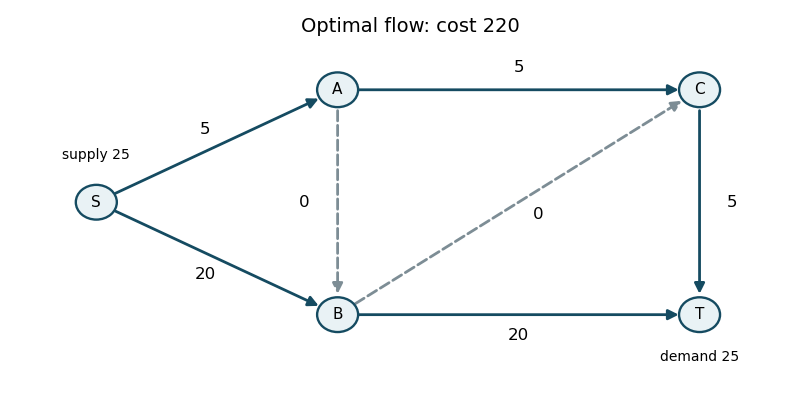
The upper-bound edge now has network reduced cost . Enter its reverse direction along , decreasing and and increasing . The step is , so leaves at zero. The resulting flow isThe tree is , with potentials . The nonbasic edges have network reduced costs at its upper bound, at its lower bound, and at its lower bound. All have the correct signs, so there is no improving network simplex pivot. The next part proves these signs certify optimality.

For a minimum-cost flow with bounds , the capacitated flow optimality conditions consist of primal feasibility and network dual potentials whose network reduced costs obeyFor a zero-capacity edge both bounds coincide and no sign restriction is needed; all capacities here are positive. These are the bound form of complementary slackness. To derive necessity directly, construct the residual network: a possible increase has original cost and a possible decrease has reverse cost . An optimal flow cannot admit a negative-cost directed cycle, since a positive step around it preserves flow balance and lowers cost. If there is no such cycle, connect a new source by zero-cost edges to every vertex and let be shortest-path distances. They exist because no negative cycle is reachable. For every residual edge , . Taking makes every residual network reduced cost nonnegative, exactly the displayed sign conditions: both directions exist for an interior edge.
Conversely, for any other feasible flow , equal flow balances giveEach summand is nonnegative at a lower or upper bound, and zero at an interior edge. Hence the sign conditions suffice for optimality as well.
For the final flow, use in the order . All four tree edges have zero network reduced cost, while have costs . More explicitly, every feasible flow satisfiesOur flow attains equality. This gives a direct cost certificate of 220. The strict signs also force , at any optimum; flow balance then fixes all remaining edges, so this flow is unique.
Articles by others on the same topic
There are currently no matching articles.