The initial table of content was limited to the first level because it is larger than 1000 articles. There are 1924 articles in total. Expand a branch to load its children.
The endomorphisms of the finite-dimensional vector space over the complex numbers form the general linear Lie algebra with the usual addition and scalar multiplication and Lie bracket . This commutator is bilinear and antisymmetric, and expanding the six products verifies the Jacobi identity.
For a Lie subalgebra , being an abelian Lie algebra means . A nilpotent Lie algebra has , eventually zero; a solvable Lie algebra has , eventually zero. These are the lower central series of a Lie algebra and derived series of a Lie algebra, respectively. Nilpotence is a condition on the Lie bracket, and does not require every member to be a nilpotent endomorphism: a nonzero scalar multiple of the identity spans an abelian Lie algebra.
A flag of a vector space is an increasing chain of vector subspaces. The flag we construct is a complete flag, , where , and each is an invariant subspace for . We first prove the common-eigenvector assertion in the Lie theorem, by induction on ; the zero algebra is immediate. For nonzero solvable , its derived algebra is proper, so there is a codimension-one ideal of a Lie algebra containing . Write . By induction there are and a linear functional on such that for every .
Let be the cyclic subspace spanned by . The commutator derivation identity and show inductively thatThus and all its initial cyclic spans are -invariant. If , the first cyclic vectors form a basis, is also -invariant, and . For , the trace of a matrix commutator givesHence , since the field has characteristic zero. The nonzero common weight spaceis -invariant: . The restriction of to has an eigenvector, because is an algebraically closed field. This is a common eigenvector for . Its line is invariant, and repeating the argument on the quotient vector space gives the complete invariant flag. Equivalently, this proves simultaneous triangularization of a Lie algebra representation.
In a basis adapted to this complete flag, every member of is upper triangular, so every member of its derived algebra is strictly upper triangular. Products of strictly upper triangular matrices vanish, and each iterated Lie bracket of such matrices is a sum of these products. Consequently the derived algebra is a nilpotent Lie algebra. We may therefore take : it is an ideal, and the quotient Lie algebra is abelian. This also covers .
A linear map is a nilpotent endomorphism if for some positive integer , and a semisimple endomorphism if it is diagonalizable over . Decompose into its generalized eigenspaces , where . Define on to be , and set . Then is diagonalizable, is nilpotent, and both preserve these vector subspaces and commute. ThusFor uniqueness, suppose with semisimple, nilpotent and . Both commute with , so preserve each . On an eigenspace of of eigenvalue inside , the map is and has only the eigenvalue . Since the same subspace lies in , . Hence on , proving and . This is the additive Jordan–Chevalley decomposition.
We need a polynomial consequence of this decomposition. Hermite interpolation supplies a polynomial with , by prescribing for each eigenvalue. For any endomorphism , its semisimple part can likewise be expressed as a polynomial in with zero constant term: if zero is an eigenvalue, its interpolation condition already forces this; if not, add the independent condition .
On , the maps and commute. The first is diagonalizable, with eigenvalues on . The second is nilpotent, sincewhich vanishes for when . Uniqueness therefore proves adjoint compatibility of additive Jordan decomposition: .
Now assume . The condition implies that both and are invariant under , and every polynomial in with zero constant term maps into . Define to be multiplication by on . It commutes with . On , acts by . Polynomial interpolation on the finite set of differences gives with . The preceding paragraph then expresses as a polynomial in with zero constant term. Consequently , so .
The assumed trace orthogonality nilpotence lemma now follows directly. On , and , while the matrix trace of the nilpotent restriction of is zero. HenceEvery summand is nonnegative, so every eigenvalue of is zero. Its Jordan–Chevalley decomposition therefore has , and is nilpotent. Notice that neither nor was required to be a Lie subalgebra.
A finite-dimensional Lie algebra over the complex numbers is a semisimple Lie algebra when its solvable radical is zero, equivalently when it has no nonzero solvable ideals. Its Killing form isThe cyclic property of the trace makes this bilinear form symmetric and gives its invariance of a bilinear form on a Lie algebra:It follows that is an ideal of a Lie algebra. For , induces the zero map on . Therefore, for , the matrix trace splits over the invariant subspace and the quotient to give . In particular . The Cartan solvability criterion implies that is solvable. Since is semisimple, : the Killing form is nondegenerate.
For completeness, the trace step in the Cartan solvability criterion is precisely the mechanism of the previous solution. For a complex matrix Lie algebra with for , , set and . If and , then , since . Linearity and the trace orthogonality nilpotence lemma show that every member of is nilpotent. The Engel theorem makes nilpotent and hence solvable. Apply this to ; the kernel of this Adjoint representation of a Lie algebra is the abelian center of , so is solvable as claimed.
For an arbitrary complex Lie algebra, a Cartan subalgebra means a nilpotent Lie algebra that is self-normalizing: . This definition does not assume that is abelian. We prove that it is abelian when is semisimple.
Use the generalized-weight decomposition for a nilpotent Lie algebra for the action of on . Its zero generalized weight space isWe have , since is nilpotent. If , the Engel theorem gives a nonzero coset annihilated by every . Its representative satisfies , contradicting . Thus .
For a nonzero generalized weight , choose with . The operator is invertible on and nilpotent on . For , , write with large enough that . Invariance of the Killing form givesOn the other hand, is solvable, so the Lie theorem triangularizes its action on . For , the matrix is strictly upper triangular, while is upper triangular. Thus . Together with , this yields . Nondegeneracy gives .
Finally, if commutes with , it normalizes , hence lies in . Any abelian subalgebra containing consists of such elements. Thus is a maximal abelian subalgebra, indeed .
Here a reduced root system is crystallographic, as appropriate to a semisimple Lie algebra. It is a finite spanning set in a real inner product space of dimension , invariant under each Weyl reflectionwith for every pair of roots and . A base of a root system is a basis such that the coefficients of every root are integers that are either all nonnegative or all nonpositive. These define the positive system of a root system. We use the existing Cartan matrix conventionUsing the alternative denominator transposes all the matrices below.
The classification of rank-two root systems gives , , , and . In orthonormal coordinates we may choose the following simple roots and Cartan matrices:
- For , take , and . The positive roots are .
- For , take , and . The positive roots are .
- For , take the long root and short root , giving . The positive roots are . Interchanging the long and short convention gives type , which is the same rank-two classification up to the usual identification.
- For , take the short root and long root , giving . The positive roots are .
Each complete root system consists of these positive roots and their negatives. To see why the list is exhaustive, the off-diagonal Cartan matrix entries of two distinct simple roots are nonpositive integers, and their product is . Thus the product is or , corresponding to simple-root angles or . These determine the four systems and their length ratios.
The Weyl group of a rank-two root system is generated by the two simple Weyl reflections. Their product is a rotation of order , respectively, so the groups are the dihedral groups of order . The first is also the Klein four-group and the second the symmetric group . The root-orthogonal lines cut the plane into Weyl chambers, each of angle . A chosen fundamental chamber of a root system is , ; its walls are the two root-orthogonal lines. The Weyl group acts simply transitively on these open chambers.
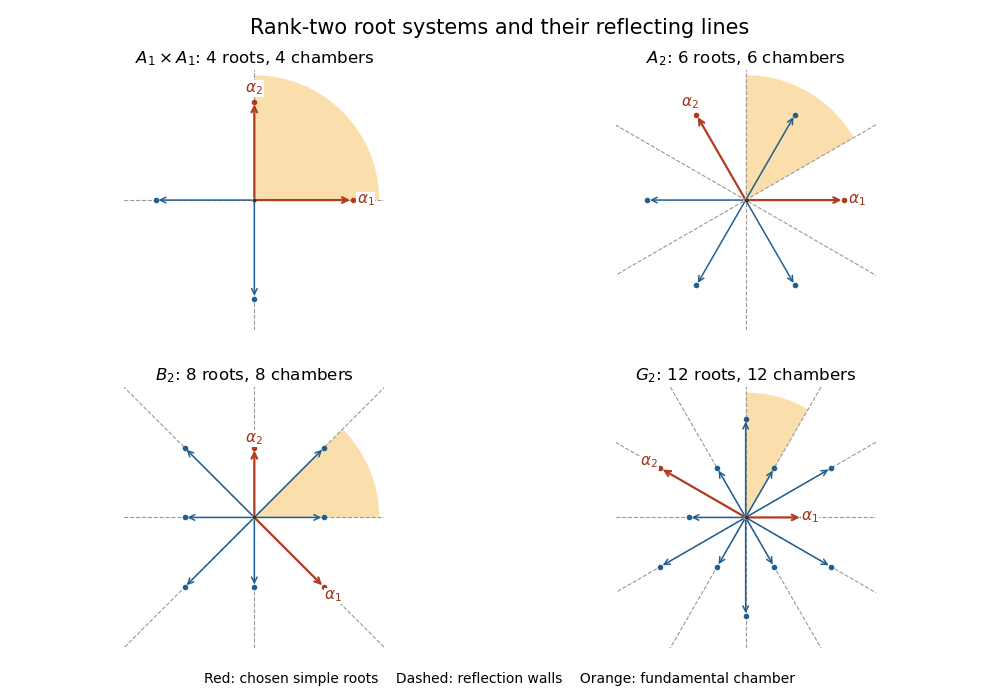
Roots, reflecting lines and a fundamental chamber for the four crystallographic rank-two root systems
. Details. The crystallographic hypothesis matters: if the integer-pairing condition is dropped, reduced noncrystallographic systems of type also occur. They are not additional Lie-algebra root systems.
Choose a positive system of a root system and the corresponding triangular decomposition of a Lie algebra . A primitive element of a Lie algebra representation of weight is a nonzero vector with for every and . Thus it is a highest-weight vector; the choice of positive roots is part of this definition. A highest-weight representation is generated by such a vector.
Let be the corresponding Borel subalgebra. Define its one-dimensional Lie algebra representation by the scalar on and zero on . This respects the Lie bracket, since . The induced Verma moduleis nonzero: the Poincaré-Birkhoff-Witt theorem identifies its underlying vector space with , and is a primitive element of weight . Its weight spaces are finite dimensional, its top weight space is the line , and all other weights are with and at least one positive coefficient.
A proper submodule cannot contain , because generates . More strongly it has no component of weight : any finite sum of distinct weight vectors can be projected onto its individual components by a polynomial in a generic element of . Therefore the sum of all proper submodules still misses the top weight line and is proper. It contains every proper submodule, so the irreducible quotient of a Verma moduleis irreducible and retains the nonzero primitive element . This constructs the requested representation for every . It is not asserted to be finite dimensional for arbitrary .
For the sl2 Lie algebra, use , and , with , , . The classification of finite-dimensional sl2 representations gives one irreducible for every integer . In a basis its action iswhere . These formulas satisfy the three Lie brackets. Any nonzero invariant subspace contains a weight vector by polynomial projection using ; repeated application of gives , and applications of then give the entire basis. Thus is irreducible.
Conversely, in any finite-dimensional irreducible module, start with an eigenvector of and apply until reaching a nonzero vector with . This process terminates because increases the eigenvalue by two and only finitely many eigenvalues occur. Write . The sl2 highest-weight lowering formula givesLet and , which again follows from the finite set of weights. Applying to the latter identity yields , so . The resulting distinct weight vectors span an invariant subspace, hence the entire irreducible module. Therefore and its primitive weight is , with ; its weights are .
The complexification of a Lie algebra is , with the Lie bracket extended complex-bilinearly. Equivalently write , whereComplex conjugation is an antilinear map and a Lie algebra automorphism whose fixed subalgebra is .
If the solvable radical of is nonzero, its complexification is a nonzero solvable ideal of . Conversely the solvable radical of is preserved by complex conjugation, because it is the unique largest solvable ideal. Consequentlyfor , both and belong to . If , is a solvable ideal of . This proves is semisimple if and only if is semisimple. Consistently, the complex Killing form is just the complex-bilinear extension of the real one; its determinant in a real basis is unchanged by extending scalars.
Take the sl2R Lie algebra and the special unitary Lie algebra . Both complexify to . This is immediate for the former; for the latter, the real basis consists of traceless matrices that are skew-Hermitian matrices and is also a complex basis of .
They are not isomorphic as real Lie algebras. Their Killing forms are , but on this is negative definite. On the basis has a diagonal Gram matrix with entries , so the signature of a quadratic form is . A Lie algebra isomorphism preserves the Killing form and therefore its signature.
A real split semisimple Lie algebra has a Cartan subalgebra whose Adjoint representation of a Lie algebra is simultaneously diagonalizable over , so its root-space decomposition is defined over . The example is split: the diagonal Cartan subalgebra has eigenvalues and real root spaces . The example is not split. Invariance makes every skew-adjoint for the positive definite inner product , so its eigenvalues are purely imaginary. If it were diagonalizable over , all these eigenvalues would be zero and . The center is zero, so only has this property; no nonzero split Cartan subalgebra exists. Thus is split and is not.
Put and let be the integral closure of in . We first establish the elementary integral extension machinery, and then use the trace pairing to put inside a finite -module.
An integral element satisfies a monic polynomial over the base ring. If its equation has degree , the powers generate as an -module. More generally, adjoining finitely many integral elements gives a finitely generated module: reduce the exponent of each generator using its monic equation. Conversely, if an -submodule of an extension algebra contains , is finitely generated, and is stable under multiplication by , choose generators and write . Multiplying by its adjugate shows that its monic determinant annihilates every , hence annihilates . This finite-module criterion for integrality is the determinant trick.
If are integral elements, the finite -module is stable under , and . The criterion proves that these are integral elements. Thus the integral closure really is a subring. It also proves integral dependence is transitive: if is integral over an integral -algebra , take the finitely many coefficients of its equation, form their finite -subalgebra , and observe that is finite over and therefore finite over . The criterion applies to . In particular, an algebra generated by finitely many integral elements is a finite integral extension, even though an arbitrary integral extension need not be finite.
Choose a -basis of . Each basis element is algebraic over . Ifchoose a nonzero clearing all coefficient denominators. Then satisfies a monic equation with coefficients . Hence all belong to and still form a -basis. This is integral field basis by denominator clearing.
We next prove the trace of an integral element over a normal domain property. For , its images under all -embeddings of into an algebraic closure are integral elements over , because each satisfies the same monic equation. Their sum is integral by the subring property just proved. Since is a separable field extension, that sum is the field trace and lies in . The normality assumption means that is a normal domain, equivalently an integrally closed domain, soThe same conclusion applies to , since is a ring.
The trace pairing of a finite separable field extension is nondegenerate. One can see this directly using the allowed Galois theory: for a primitive element , the embedding matrix of is a Vandermonde matrix in the distinct conjugates of . Its determinant is nonzero, and the trace Gram matrix is its transpose times itself. Nondegeneracy is unchanged by a change of basis.
Let . Its trace-dual lattice isNondegeneracy supplies a trace-dual -basis , with . The coefficient formula givesEquivalently, the matrix has entries in and nonzero determinant ; if , then and the adjugate formula gives . Thus as well. Both descriptions exhibit a finite free ambient -module.
A finite -module is a Noetherian module when is a Noetherian ring, and every submodule of a Noetherian module is finitely generated. Since is an -submodule of , we obtainThis proves finiteness of integral closure in a finite separable extension. The hypotheses have distinct roles: separability makes the trace pairing nonsingular, normality puts integral traces back in , and Noetherianity makes the contained submodule finite. Also , since the integral basis elements span over , and is itself Noetherian because its ideals are -submodules of a finite -module.
The Noether normalization lemma is valid over every field , including finite fields: a nonzero finitely generated algebra contains elements with algebraic independence over such that is finite as a module over the polynomial ring . We prove it without an infinite-field hypothesis.
Write and induct on . If the generators have algebraic independence, they already give a polynomial ring and the assertion is immediate. Otherwise choose a nonzero relation . Choose an integer larger than every exponent in the monomials of , and setIn , the largest power of has a nonzero coefficient in . Indeed, a monomial with exponents contributes top weight . These weights are distinct by uniqueness of base- expansion, so only one monomial contributes the highest power. After rescaling, the substituted relation is monic in .
Consequently is an integral element over , and is finite over . Apply the induction hypothesis to and compose the finite module extensions. This proves Noether normalization by weighted substitutions. The induction reaches , where . For an integral domain , taking fraction fields makes the resulting extension finite algebraic, so is the transcendence degree of . More generally : integral extensions preserve Krull dimension, and a polynomial algebra in variables has Krull dimension .
A useful bridge to the Hilbert Nullstellensatz is the Zariski lemma. If a field is a finitely generated algebra over , normalization makes it finite and integral over a polynomial ring . A subring over which a field is integral is a field: for nonzero , an integral equation for , multiplied by , expresses as an element of . Therefore must be a field. A polynomial ring in a positive number of variables is not a field, since a variable has no polynomial inverse. Hence and is a finite field extension. This proves the Zariski lemma.
Now let be an algebraically closed field. The Weak Hilbert Nullstellensatz says that every maximal ideal of is uniquely of the formTo prove it, the residue field is a field generated as a -algebra by the images of the variables. The Zariski lemma makes it finite algebraic over , and algebraic closedness makes it . Thus each has an image . The evaluation map has kernel the displayed ideal: subtracting the constant value of a polynomial expresses its difference as a combination of . That kernel is maximal and contained in , so equality holds. Conversely every evaluation kernel is maximal because its quotient is . Uniqueness follows from the variable images. Every proper ideal is contained in a maximal ideal, so it has a common zero; equivalently, an ideal with no common zero is the whole ring.
For an ideal , let be its common-zero set and let be all polynomials vanishing on that set. The Strong Hilbert Nullstellensatz statesThe inclusion follows because a field has no nonzero nilpotent elements. For the other inclusion, take vanishing on , with , and form the Rabinowitsch trick idealIt has no common zero: at a zero of the second generator has value one. The Weak Hilbert Nullstellensatz in variables gives . Hence a finite identity has the form , with . Substitute in the localization of a ring . Clearing the finitely many powers of occurring in denominators gives for some , so . The case is immediate. This completes all three proofs. The algebraically closed hypothesis belongs to the two forms of the Hilbert Nullstellensatz; it was not needed for the Noether normalization lemma or the Zariski lemma.
All rings below are nonzero and commutative with identity; the zero ring is trivially Artinian. A primary ideal is proper. An ideal is primary precisely when every zero divisor of is a nilpotent element. Its radical of an ideal is prime: if and , apply the primary property to to obtain a power of in . In a Noetherian ring, finite generation of gives for some . For generators with , one can take .
We first prove existence of primary decomposition. The ascending chain condition implies that every proper ideal is a finite intersection of irreducible ideals. Otherwise choose a maximal counterexample under inclusion. It is not irreducible, so with both strictly larger; their finite irreducible decompositions give one for , a contradiction.
An irreducible ideal in a Noetherian ring is primary. Pass to the quotient and suppose zero is irreducible. If with , the ascending chain of annihilators of stabilizes, say at . Any element of can be written . Then , so and . Irreducibility of zero implies , since . Thus is nilpotent. This proves irreducible ideals are primary in Noetherian rings, and hence the Lasker–Noether theorem.
An intersection of finitely many primary ideals with the same radical is again primary: if belongs to all of them and , the primary property forces into every component. Combining such components and removing redundant ones yields a minimal primary decompositionThe radicals are uniquely determined, but the components need not all be unique. Here is a proof identifying the invariant radicals as the associated primes of a module .
Every nonzero module over a Noetherian ring has a nonzero element with a prime annihilator: maximize the annihilator of a nonzero element using the ascending chain condition. If and , maximality gives and hence . This is the maximal annihilator of a module element is prime argument. For a -primary quotient , the radical of the annihilator of every nonzero element is : it is contained in by the primary property and contains a power of because . Thus the only possible associated prime is , and it does occur.
The diagonal injection shows that every associated prime of is one of the . Indeed, for an element whose annihilator is prime, that annihilator is the intersection of the finitely many component annihilators, all containing . Their product is contained in , so primality forces one of them to equal ; its component element is nonzero and has associated prime . Conversely, irredundancy gives . The nonzero cyclic submodule generated by embeds in . It has an associated prime, necessarily , which is then an associated prime of . We have proved the first uniqueness theorem for primary decomposition:Also the zero divisors on are exactly . For a scalar killing a nonzero element, extend its element annihilator to a maximal element annihilator containing it; the preceding argument gives an associated prime containing that scalar. The converse is immediate from the definition of an associated prime.
The minimal members of the set are the isolated primes of a primary decomposition. They are exactly the primes minimal over : if a prime contains , it contains one by the product argument. A component belonging to an isolated prime is unique. Localize at . Every other component becomes the whole ring, since its radical contains an element outside whose power lies in that component. A -primary ideal contracts unchanged from this localization, because with implies . Hence the second uniqueness theorem for primary decomposition givesAn embedded primary component can vary. For example, in ,Both second components are -primary, since their quotients are dual-number algebras. For the second equality, reducing modulo makes ; an element vanishes exactly when has zero constant term, giving . The isolated component is and the embedded associated prime is .
The relevance to Artinian rings is particularly sharp in Krull dimension zero. Suppose is Noetherian and all its primes are maximal. Apply a minimal primary decomposition to zero. Its radicals are distinct maximal ideals, so the components are pairwise comaximal ideals: each contains a power of its radical, and expanding for shows that powers of comaximal ideals remain comaximal. The Chinese remainder theorem gives the Artinian decomposition into local factorsEach factor has one maximal ideal, and that ideal is nilpotent. Its finite radical filtration has successive layers finitely generated over its residue field, hence of finite vector-space dimension. It follows that the factor, and therefore , has a finite composition series of a module, so is Artinian. This proves the Noetherian dimension-zero criterion for an Artinian ring in this direction. Applied to , it says that the quotient is Artinian exactly when all primes over are maximal. In that case no primary component is embedded, so all components are unique.
For completeness, the converse does not require initially assuming Noetherianity. In an Artinian ring, an Artinian domain is a field: stabilization of and cancellation gives an inverse to every nonzero . Thus every prime is maximal. There are finitely many maximal ideals, since infinitely many distinct ones would give strictly descending finite intersections; comaximality guarantees strictness by the Chinese remainder theorem. Its nilradical is nilpotent. Indeed, its powers stabilize at , with . If , choose an ideal minimal among those satisfying . Then , since . Choose with ; minimality also gives . Therefore for some . But is a unit, contradicting . Hence .
Now is a finite product of residue fields. Each is an Artinian module over that product, and therefore a finite direct sum of finite-dimensional vector spaces: an infinite-dimensional vector space would have a strictly descending chain of subspaces. The finite filtration by powers of makes a module of finite composition length, in particular Noetherian. Combining both directions yieldsThus primary decomposition separates the local pieces of a zero-dimensional ring, while their nilpotent maximal ideals record the multiplicities that the reduced set of primes alone does not detect.
Let be a map of commutative rings. The Kähler differentials are generated as an -module by symbols , with relationsThese relations make the universal -derivation. Every -derivation into an -module factors uniquely through the map . Thus the universal property of Kähler differentials isThis constructs the module and proves its universal property, rather than merely listing a formal derivative rule.
For the polynomial ring , the Kähler differentials of a polynomial algebra form the free module . The usual formal partial derivatives prove that assigning arbitrary images to defines a derivation, and every polynomial involves only finitely many variables. For , the Conormal exact sequence for Kähler differentials givesThe map is well-defined because vanishes after reduction modulo . Its cokernel has exactly the universal property of derivations on that kill , so is . In a finite polynomial presentation this givesThere need not be injectivity at : in characteristic , the relation has derivative zero.
Localization of Kähler differentials commutes with localization of a ring:The quotient rule follows by differentiating . It extends every derivation uniquely and proves the isomorphism by the universal property. Likewise base change for Kähler differentials gives : a -linear derivation is determined by its values on , and the product rule extends those values to the tensor product.
For a tower , the Transitivity exact sequence for Kähler differentials isQuotienting by the submodule generated by differentials of elements of represents precisely the -derivations, which proves exactness. The first map need not be injective in general. To relate this to a transcendence basis, we need the stronger property supplied by a separable field extension.
If is finite separable and has minimal polynomial , differentiating its equation forcesThe denominator is nonzero by separability. Conversely this formula extends an arbitrary -derivation , for an -module , to ; it kills the relation and hence descends to . A tower of simple separable extensions proves unique extension for all finite separable . Therefore Kähler differentials under a separable field extension satisfyThis proves injectivity in this case, which would not follow from right exactness alone.
A transcendence basis for a finitely generated field extension has algebraic independence over and makes algebraic, hence finite. A separating transcendence basis additionally makes that finite extension separable. Apply the polynomial computation and the quotient rule to the rational function field , and then the separable-extension isomorphism. We obtain the central link:when the basis is separating. The dual statement says that any prescribed values of the extend uniquely to a -derivation of with values in . In characteristic zero every transcendence basis of a finitely generated field extension is separating, so Kähler differentials measure transcendence degree exactly.
There is also a characteristic-zero test for algebraic independence. If are algebraically dependent, choose a nonzero polynomial relation of minimum total degree. Some formal partial derivative is nonzero in characteristic zero, and it cannot also vanish on the tuple, since it has smaller degree. Differentiation therefore gives a nontrivial linear relation among the . Conversely, an algebraically independent tuple extends to a transcendence basis, whose differentials form a basis as just proved. Thus differentials detect algebraic independence in characteristic zero: a finite tuple is algebraically independent exactly when its differentials are linearly independent. Its differentials form a basis of exactly when the tuple is a transcendence basis.
The separability qualification is essential in positive characteristic. For and with , the extension is purely inseparable of degree , with transcendence degree zero. The polynomial presentation yields , because the defining relation has derivative zero. Also, in , the tuple is a transcendence basis but , while is a basis of the one-dimensional differential module. A chosen arbitrary transcendence basis therefore need not give differential coordinates in characteristic .
Finally, the presentation makes the relation useful geometrically. For in characteristic zero,After passage to the fraction field, it has dimension one, the transcendence degree of the curve. At the origin, tensoring with its residue field leaves both independent, so the differential fibre has dimension two. For a -rational point with maximal ideal , that fibre is the cotangent space of a local ring : write elements as their constant value plus an element of , and note that derivations into kill . This explains how Kähler differentials record both generic transcendental parameters and the extra tangent direction at a singular point.
Let be a commutative ring and . The Koszul complex packages these elements and their relations in a finite chain complex of free modules. With and basis , set for , and defineDeleting two distinct basis elements in the two possible orders gives opposite signs and the same coefficient, so . Equivalently is the tensor product of chain complexes of two-term complexes in degrees one and zero. The tensor differential is . This fixes the sign convention. On the exterior algebra, the differential is a graded derivation determined by .
For an -module , define the Koszul complex with module coefficients by . Its degree-zero Koszul homology isIts higher Koszul homology measures the failure of these equations to form a regular sequence on a module. Each annihilates every homology group. Indeed the Koszul homotopy for multiplication by a generator is , and the graded product rule givesFor coefficients in the same identity holds after tensoring. Thus multiplication by is zero on homology, and the homology groups are naturally modules over . If , choose ; then is a contracting homotopy, so the entire complex is contractible. These identities are also useful after localization of a ring: wherever one generator is a unit, the complex has zero homology.
The construction is functorial under a ring homomorphism, and base change gives , since its terms are free with the displayed basis and differential. An invertible change of generators gives a chain isomorphism by sending to and extending to exterior powers. In particular, permuting the generators changes only the exterior signs, not the isomorphism class of the complex.
The essential exactness theorem is that a regular sequence on a module gives zero positive Koszul homology. Recall that must act injectively on , with final quotient nonzero. Put . Adding the final two-term complex identifies with the mapping cone of multiplication by on , with the chosen tensor signs. The long exact sequence in homology consequently has segmentsFor , positive homology is exactly . By induction the preceding homology vanishes above zero. The final injectivity assumption kills , while the exact sequence kills every for . Thereforefor a regular sequence on a module. In particular is a finite free resolution of when is a regular sequence, with ranks and length .
There is a precise converse under local finiteness assumptions. Suppose is a Noetherian local ring, is finitely generated, and all . If positive Koszul homology vanishes, the same exact sequence makes multiplication by surjective on every for . These modules are finitely generated because the ring is Noetherian and the terms of the complex are finite modules. The Nakayama lemma gives . Induction makes regular on , and the degree-one part of the exact sequence makes injective on . The final quotient is nonzero, again by the Nakayama lemma. This proves the Koszul acyclicity criterion in a Noetherian local ring:The hypotheses matter: a unit ideal makes the complex contractible but cannot be a proper regular sequence.
Examples make both sides visible. For and , the Koszul resolution isThe signs agree with . For and , the degree-one cycles are and the boundaries are ; hence , while . The repeated element has exposed a relation that the first element already kills.
The Koszul complex also computes derived functors. If is a regular sequence on , its free resolution givesHere no regularity of on is assumed. For , tensor the Koszul resolution on the variables with . Every differential becomes zero, soThe top group is nonzero, showing that a free resolution of cannot be shorter than .
Finally, wedging complementary exterior degrees gives a perfect pairing . It identifies the dual cochain complex with the degree-reversed Koszul complex, after the appropriate signs. This self-duality of the Koszul complex shows, for a regular sequence, thatThus the same explicit complex simultaneously records quotient equations, regularity, relations, Tor functor computations and Ext functor computations. Its finiteness and exterior structure are what make it especially effective in commutative algebra.
The derived series is , , where the bracket denotes the commutator subgroup. The group is soluble ifEquivalently it has a finite series with abelian factors. The trivial group is included.
If , induction gives , because commutators of elements of a subgroup are also commutators in the larger group. Thus termination of the derived series of forces termination for .
For a normal subgroup , the quotient map sends to the commutator of their images. Surjectivity then givesConsequently subgroups and quotient groups of a soluble group are soluble. The assertion about a quotient uses a normal subgroup; it is not a quotient by an arbitrary subgroup.
Let be a minimal normal subgroup. Its commutator subgroup is characteristic in , hence normal in . Minimality makes or . The latter would prevent the soluble group from having a terminating derived series, so and is abelian.
Choose a prime dividing . In a finite abelian group its Sylow -subgroup is characteristic, so minimal normality makes this subgroup all of . The subgroup is nontrivial, characteristic and hence normal in . Minimality again makes it all of . Thusan elementary abelian p-group. Both abelianness and minimal normality are essential to the two characteristic subgroup arguments.
A Hall subgroup for a prime set is a subgroup whose order has only prime divisors in and whose index has no prime divisor in :Here one is allowed in either class, and is the complementary set of primes. Equivalently contains the complete prime-power contribution to for each prime in .
We prove Hall subgroup existence in soluble groups by induction on . The trivial group is immediate. Choose a nontrivial minimal normal subgroup , elementary abelian of order by part (c). Induction gives a Hall -subgroup of ; let be its full preimage.
If , then itself is the required subgroup. If and , apply induction inside the soluble subgroup to obtain a Hall -subgroup of . Since and are both -numbers, is Hall in too.
It remains to treat and . Then is a -group. If , the subgroup one works. Otherwise choose a minimal normal subgroup of , an elementary abelian -group with . Let be a Sylow -subgroup of . As and , we have . The permitted Frattini argument givesThe last equality uses and the normality of .
If , then is a power of , hence a -number. Apply induction to and multiply indices as before. If , then is a nontrivial normal -subgroup. Induction in gives a Hall -subgroup whose full preimage in is Hall, since its additional factor is a -number. These cases exhaust the possibilities, proving existence for every prime set. No unproved complement theorem or conjugacy theorem for Hall subgroups was inserted into the proof.
Use the Sylow theorems. The number divides and is congruent to one modulo . Since , it is either one or . Suppose . Different subgroups of prime order intersect trivially, so their nonidentity elements occupy places, leaving only nonidentity elements of other prime orders.
If neither the Sylow -subgroup nor the Sylow -subgroup is normal, then and . Indeed divides , and its possible divisor cannot satisfy the Sylow congruence; the smallest remaining nontrivial possibility is at least . Likewise any nontrivial divisor of is at least . Their elements would require at leastplaces, since the excess is . Hence some Sylow subgroup of order is normal.
In the quotient by this normal subgroup, the largest prime has a normal Sylow subgroup: for a group of order with its Sylow count divides and so equals one. Pulling back gives a normal subgroup of order . Inside it, the subgroup of order is again the unique Sylow -subgroup. It is characteristic in that normal subgroup and therefore normal in , contradicting . Thus .
Let be this normal Sylow subgroup. In , of order , its subgroup of order is normal by the same argument. Its preimage is a normal Hall -subgroup. The serieshas factors of orders , hence cyclic and abelian. Therefore This establishes solubility before using any Hall-existence conclusion that itself assumes solubility.
Extend each element of to fix . A one-point extension of a permutation group is a transitive permutation group such thatwith the induced action on equal to the prescribed action. The stabilizer subgroup equality is the substantive condition: merely adjoining an element that moves does not suffice. If , the orbit-stabilizer theorem gives .
Here is the double-coset criterion for a one-point extension. Let , and suppose swaps and . Then is a one-point extension if and only ifFor necessity, in an extension fixes both and , so normalizes it and lies in it. Since is transitive on , the extension has exactly two double cosets relative to : and . For , moves into and is in the latter double coset.
For sufficiency, the displayed conditions make closed under multiplication. Products with middle element in reduce using ; those with middle element outside remain in . A finite nonempty multiplication-closed set of permutations containing the identity is a group. It contains and , hence equals . Every element in moves , while fixes it, giving the required stabilizer subgroup. The group is transitive because is transitive on and moves the additional point.
For , a group is sharply t-transitive when any two ordered -tuples of distinct points are related by exactly one group element. Equivalently its action on the set of such tuples is regular. In the finite caseand the stabilizer subgroup of an ordered -tuple is trivial. The condition includes both existence and uniqueness, not just transitivity.
Put , and let . Sharp two-transitivity gives and . A nonidentity element fixes at most one point. Counting the nonidentity elements in the stabilizer subgroups shows that there are fixed-point-free elements. Let be this set together with the identity. We first prove it is a normal subgroup, rather than presuming that fixed-point-free elements are closed under multiplication.
For , and directly. Otherwise use complex characters of a finite group. Let be the permutation character and , the character of the permutation representation with its constant line removed. For every nontrivial irreducible character of , form the virtual characterIts values are at the identity and at every fixed-point-free element. At an element with one fixed point, conjugate it to ; induction gives , because there is exactly one fixed coset.
The identity and the fixed-point-free elements together contribute to the inner product. The remaining elements are partitioned into the nonidentity parts of the stabilizer subgroups. Hence character orthogonality givesA virtual character of norm one is plus or minus an irreducible character: its coefficients in the irreducible-character basis are integers whose squares sum to one. Its positive degree selects the plus sign. Thus each is an actual irreducible character.
For a group representation, holds exactly on its kernel: make the representation unitary and compare the sum of its unit-modulus eigenvalues with its dimension. All of therefore lies in the intersection of the kernels of the . Conversely, a nonidentity element fixing a point gives in . Some nontrivial irreducible character of has , since otherwise the regular representation of would not vanish at . ConsequentlyThis proves normality and subgroup closure. It has order and no nonidentity element fixing a point, so it is a regular permutation subgroup.
Now acts transitively by conjugation on : identify an element of with its image of and use transitivity of on the remaining points. Thus all nonidentity elements of have the same order. Taking a suitable power of one element shows this common order is a prime . By Cauchy's theorem no other prime divides , so is a -group. Its nontrivial center is -invariant, so transitivity forces the center to be all of . Therefore is elementary abelian of order .
Since is prime to , is the unique Sylow -subgroup of . Uniqueness makes it characteristic under every group automorphism. We have provedThe character argument supplies the regular kernel of a finite sharply two-transitive group; the final Sylow argument establishes the stronger characteristic assertion.
Iwasawa's simplicity lemma states the following. Suppose acts faithfully and primitively on a set, and a stabilizer subgroup has an abelian normal subgroup whose -conjugates generate . Then every nontrivial normal subgroup contains . In particular, if is nontrivial and perfect, then is simple.
Indeed a nontrivial normal subgroup in a faithful primitive action is transitive, so . Since normalizes , all conjugates of have the same image in . Those images generate the quotient, which is therefore abelian. This gives and proves the stated conclusion.
Use the field . The defining polynomial has no root in , hence is irreducible. Label its elements bySince has prime order seven, has order seven. Multiplication by is exactly . The identities , and show that translation by one is exactly .
Conjugating by powers of gives the translations . The translations by generate all eight translations. ConsequentlyFor distinct and distinct target points , the unique affine map has and . Thus the action is sharply two-transitive.
Its regular characteristic subgroup isTranslations act regularly, is normal, and its order eight makes it the unique Sylow two-subgroup, hence characteristic. This identifies the abstract subgroup and explicit generators in the original permutation notation.
Adjoin the label . Inversion on the projective line, with zero and infinity interchanged, isThe label is fixed. Set , where the subscript one denotes the original point label, namely field zero. Then and , so normalizes .
For outside , we have . On the projective line,The equality uses characteristic two and is valid as an equality of fractional linear transformations, including poles and infinity. ThusAll conditions of the double-coset criterion for a one-point extension hold. Therefore is a one-point extension, with . Its stabilizer subgroup is sharply two-transitive, so its action on nine points is sharply three-transitive.
Use the projective-line realization from part (ii). The subgroup of translations is abelian and normal in the stabilizer subgroup of infinity. We verify both remaining conditions of Iwasawa's simplicity lemma, instead of concluding simplicity from transitivity alone.
Let be generated by all conjugates of in . It contains the matricesHere matrices act by fractional linear transformations. For ,In particular , and acts as multiplication by . Squaring is a bijection of , so every belongs to . Hence contains and , and .
Choose . The commutator, with convention , isAs varies, this gives all translations. Thus contains , and normality makes it contain every conjugate of . Since those generate , the group is a perfect group.
A sharply three-transitive action on nine points is a primitive group action, and this permutation action is a faithful group action. All Iwasawa hypotheses now hold, soIt may be identified with : the generators are fractional linear transformations and , while all nonzero field elements are squares. The simplicity proof above does not rely on assuming simplicity of that named family.
The symplectic group consists of the invertible linear maps preserving the alternating bilinear form:We use row-vector action in this question, which is the convention compatible with its printed upper-triangular flag stabilizer subgroup. Thus matrices preserve a form matrix by .
Count ordered symplectic bases. There are choices for the first nonzero vector . Nondegeneracy makes the equation a nonzero linear-functional equation, with solutions. Their span is a nondegenerate plane; its orthogonal complement is symplectic of dimension . Repeating there givesEach symplectic basis is the image of a fixed one under exactly one form-preserving map, justifying the count as a group order. If , every factor is prime to , so the exact -part is .
For the block computation only, place the -vectors in the order after the -vectors. This temporary reversal of the second block changes no transformations. The form matrix becomes .
Let be upper unitriangular of size , and let be symmetric. The matricessatisfy by direct block multiplication. The generator is , because the inverse transpose adds to . The generators and are respectively and . This proves all of them preserve the form, in every characteristic.
The -generators generate every upper unitriangular , by elimination of off-diagonal entries. The generators add all elementary symmetric entries, so they generate every . Moreoverwhich keeps symmetry. Therefore the generated group is exactlyThe two factors are uniquely determined by its diagonal and off-diagonal blocks. Their counts are and , givingIt is a -group, and this equals the full -part found in part (a); hence is a Sylow -subgroup. In the original reversed- ordering, these matrices are upper unitriangular throughout, exactly as the prescribed generators suggest. This is consistent with the finite symplectic group order. No factor of two was divided out, so characteristic two is included.
Keep row-vector action and the block order . Let be the reversal matrix of size , arising from the original reversed order of , and let be the alternating bilinear form matrix on . ThenFor an element of , the equation givesThus , a matrix, is arbitrary and uniquely determines . The right side of the second equation is alternating, including in characteristic two: its diagonal entries vanish because represents an alternating bilinear form.
For any alternating matrix , the equation has exactly solutions. For each pair , choose one entry freely and solve for the opposite entry; each diagonal entry is free. This works in characteristic two as well as odd characteristic. Taking therefore givesThis is the unipotent radical count for a symplectic parabolic subgroup. It does not incorrectly replace the alternating constraint by division by two.
For a block-diagonal element, form preservation saysGiven any , the first equation uniquely determinesWith dual bases ordered in matching rather than reversed order, the same relation is simply . This is the contragredient action on the paired space .
The second equation independently allows every . The map taking a block-diagonal element to is a group isomorphism, with inverse . Thus
Taking diagonal blocks is a homomorphism . Its kernel is , and block-diagonal inclusion is a section. For any , remove its diagonal element by . Also . ThusUsing and part (a), the product simplifies toThe exponent simplification is .
For an independent orbit-stabilizer theorem count, choose an ordered independent isotropic tuple . After choices, their span has elements and its orthogonal complement has dimension . The next choice therefore has possibilities. The number of tuples isEvery totally isotropic -space has ordered bases, so the number of such spaces isEach tuple extends to a symplectic basis by successively choosing paired partners and taking orthogonal complements. Consequently the symplectic group is transitive on these spaces. The stabilizer subgroup of also preserves , and so is exactly . Dividing by reproduces the boxed answer. Dividing by instead would count the pointwise stabilizer subgroup of the ordered tuple, a different subgroup.
A point is an element of . A duad is an unordered two-element subset. A syntheme is a partition of into three duads, and a total of synthemes is a collection of five synthemes whose duads partition all fifteen duads. In graph terms these are vertices, edges, perfect matchings and one-factorization of .
The first counts are , , andsynthemes. To count totals, first observe that two edge-disjoint synthemes have union a six-cycle. Its complement in is a triangular prism: two triangles on alternate cycle vertices, joined by the three remaining cross edges. Its perfect matchings are the matching using all three cross edges and three matchings using one cross edge each. The all-cross matching cannot be used in a factorization, because the remaining two odd triangles cannot be matched. The other three matchings partition the prism edges. Therefore every pair of disjoint synthemes extends to a unique total.
Fix a syntheme . Each of its three duads belongs to three synthemes. Inclusion-exclusion shows that synthemes share a duad with , including itself. Thus eight are disjoint from . A total containing uses four of these, and each disjoint syntheme determines exactly one such total. Hence belongs to totals. Counting incidences givesTwo different totals share at most one syntheme, by the unique-completion assertion. There are fifteen pairs of totals and fifteen synthemes each belonging to two totals; consequently each pair of totals has exactly one common syntheme. This incidence property drives the next construction.
Write for the total of assigned to a point . The duad-syntheme duality on six points is constructed entirely from incidence, as follows.
For a duad , define to be the unique syntheme common to and . This is a bijection between the fifteen duads and the fifteen synthemes of , by the last incidence count in part (a).
For a duad of , the three synthemes containing each belong to two totals. Each total contains exactly one of these synthemes, since its five matchings cover every duad exactly once. Their three pairs of totals therefore partition all six totals. Pulling these pairs back to gives a syntheme . Different give different , since two distinct synthemes of containing have intersection exactly that duad. There are fifteen of each, so this construction is bijective. Define by its inverse. Equivalently, the three synthemes for have common duad . In particular,
For a total of , map its five synthemes to five duads of . Any two of the original synthemes are disjoint. Their image duads must intersect: if two image duads were disjoint, the unique syntheme containing both in would give a common duad in the original two synthemes through the pairs-of-totals construction. Conversely intersecting duads cannot lie together in a syntheme and give disjoint original synthemes. Five distinct pairwise-intersecting edges must form the full star at one point. Indeed two edges meeting at a point either force every other edge through that point or leave only the three edges of a triangle, which cannot contain five edges. Define to be the star's center. Distinct totals give distinct stars; since there are six of each, this is a bijection to the points of .
It remains to extend to unordered three-versus-three partitions. Start with a partition of . Its six cross synthemes are the perfect matchings between the two triples, parametrized by permutations in . Two of these are disjoint exactly when the quotient of their permutations is a three-cycle. Hence the six cross synthemes split into two classes of three: within a class any two are disjoint, and between classes any pair shares a duad. This unordered division into two classes is independent of the chosen orderings of the triples.
Every total has exactly two cross synthemes. To see this, any syntheme has either one or three cross duads. If a total has all-cross synthemes, it covers cross duads; the whole complete graph has nine, so . Its two cross synthemes belong to the same parity class. Conversely any pair in one class extends to a unique total. Thus the six totals split into two triples, the three totals arising from pairs in each parity class. Pulling them back through the original point-total bijection defines a partition of .
Under the duad mapping, its six internal duads become exactly the six cross synthemes of : a syntheme in a parity class belongs to the two totals formed by pairing it with the other two members. These incidences give the three edges of a triangle on each triple of totals. Therefore the partition is characterized byThis correspondence is injective: the six cross synthemes determine all nine cross duads of , whose bipartition is unique up to interchange. There are partitions on each side, so it is bijective. Define by the inverse of the construction above.
The inverse incidence rule is also useful. If a duad is internal to , none of the cross synthemes contains it, so its inverse syntheme has no internal duad of and is entirely cross. If is cross, exactly two cross synthemes contain it, so the inverse syntheme has two internal duads and one cross duad. Thus internal duads and cross synthemes exchange roles in both directions. All the extensions are natural: they use intersections and incidence, with no auxiliary ordering left in the answer.
A Steiner system is an -point set together with -element blocks such that every -element subset is contained in exactly one block. On , define the following six-element blocks using the incidence extensions of .
Take the two blocks and . For each duad of and each duad in the syntheme , takeThese give forty-five blocks of type and forty-five of type . Finally, for every corresponding partition pair and , take all four unionsThere are ten partition pairs and forty blocks of type . Distinct indexing data give distinct blocks within each family, and different types have different intersection sizes with . Thus the total is
If or , only or can contain it. If , write and with . A containing block must have type and its omitted duad is . The total has exactly one syntheme containing ; the other total containing that syntheme determines a unique second point . Thus the unique block is .
If , write and . A containing block must have type , with omitted duad . Exactly one duad contains , so is the unique block.
If , write and , where . There are only two possible types. A block exists exactly when the matching has a duad contained in . There is then exactly one such duad, since two disjoint duads cannot fit inside a triple. For a perfect matching on two triples, either all three pairs are cross, or there is one internal pair in each triple and one cross pair. Thus a block exists precisely when is not entirely cross for .
On the other hand, a block containing must use the unique partition of corresponding to . It exists precisely when is contained in one of that partition's triples, and is then unique. By the partition incidence rule in part (b), this happens precisely when is entirely cross. Hence exactly one of the two possible block types exists, always uniquely.
For , interchange the roles of and and use the inverse partition incidence rule proved in part (b). More explicitly, the duad either has an inverse syntheme with an internal pair in the complement of the triple , yielding a unique block, or its inverse syntheme is entirely cross, yielding the unique block. These alternatives are exclusive and exhaustive for the same matching-on-two-triples reason.
Every split therefore gives exactly one containing block. We have constructedAs an independent count, each block contains six five-subsets and . The case proof establishes uniqueness and existence; the count alone would not have done so.
We take algebras to be unital and modules to be unital. A finite-dimensional semisimple algebra over the complex numbers is one whose regular left module is a semisimple module, that is, a direct sum of simple modules. We use the basic finite-dimensional equivalences: this is equivalent to a zero Jacobson radical, and the Jacobson radical of any finite-dimensional algebra is a nilpotent ideal.
The Artin–Wedderburn theorem here says that there are positive integers withThe nonisomorphic simple modules are the standard column modules of the factors, of dimensions , and the factor sizes are unique up to reordering.
Here is a proof. Decompose the regular left module as with pairwise nonisomorphic simple modules . These are all the simple modules: any simple module is generated by a nonzero vector and is therefore a quotient of the regular module. The Schur lemma gives for and . For the latter assertion, an endomorphism has an eigenvalue over , and the kernel of its difference from that scalar is a nonzero submodule, hence the whole simple module. ConsequentlyEvery regular-module endomorphism is right multiplication by its value at , so . Taking opposite algebras and using matrix transposition gives the asserted decomposition with .
For a matrix algebra , the matrix units show that its only simple module is : the spaces are isomorphic through , and a nonzero vector in one of them generates one copy of the column module. Simplicity makes that copy all of . In a product algebra, the mutually orthogonal central idempotents decompose every module into its factor modules; a simple module uses exactly one factor. This proves the module assertion and also uniqueness, since the primitive central idempotents and the dimensions of their simple modules determine the factors.
Assume first that , as required for the irreducible-module conclusion. If is surjective, any nonzero invariant subspace contains every image of one of its nonzero vectors under all endomorphisms, hence is all of . Thus is irreducible.
Conversely an irreducible -module is finite dimensional: for , is a quotient of the finite-dimensional vector space . Let be the image of in . It acts faithfully and irreducibly. The subspace is a submodule, so is zero or all of . The latter alternative would imply for every , contradicting nilpotence of the Jacobson radical. Therefore , and faithfulness gives .
The Artin–Wedderburn theorem makes a product of matrix algebras. A faithful simple module forces there to be just one factor, because all other factors would annihilate that module. Thus and , so the action is the full endomorphism algebra. This is the Burnside matrix-algebra theorem.
For nonzero , surjectivity is equivalent to irreducibility. The zero module is a literal exception if it is admitted: its endomorphism algebra is zero, so the action map is surjective, whereas the zero module is not irreducible.
Maschke's theorem makes the group algebra semisimple, since is a finite group and the ground field has characteristic zero. By the Artin–Wedderburn theorem, write . Its simple modules give exactly the nonisomorphic irreducible complex group representations.
The center of each matrix algebra consists of scalar matrices, so . On the other hand, an element is central precisely when its coefficients are constant on conjugacy classes. The sums of the elements in the separate conjugacy classes are therefore a basis of the center. Hence the number of irreducible complex representations equals the number of conjugacy classes.
For an integer tuple , the monomial alternant isNegative exponents require nonzero coordinates; all exponents in the character expansion below are nonnegative. The power-sum symmetric polynomial is . Put , so is the Vandermonde determinant.
Let a conjugacy class of have cycles of length , with , and put . The product is an alternating polynomial homogeneous of degree . In an alternating polynomial, a monomial with two equal exponents has zero coefficient, since interchanging those variables fixes the monomial and reverses its sign. Grouping the remaining monomials by their permutation orbits gives a unique expansion in alternants with .
Such tuples of the indicated total degree are exactly for partitions of an integer of with at most parts. Define the class functionThe displayed monomial occurs with coefficient in and in no other ordered alternant, soThis proves the expansion and explicitly defines its coefficients. They depend only on the cycle counts and hence are class functions. Identifying these coefficients with Specht module characters is the Frobenius alternant character formula, which the remaining parts allow us to assume.
Take and , so . A transposition in has one singleton cycle and one two-cycle. The Frobenius alternant character formula therefore givesIn the coordinate permutation representation on , a transposition fixes one basis vector, so its character is . This representation is the direct sum of the invariant line of constant vectors and the standard representation of the symmetric group, whose vectors have coordinate sum zero. Subtracting the trivial character gives , as required.
The Young permutation module has a basis of tabloids, equivalently ordered row sets of sizes . A tabloid is fixed by precisely when every cycle of lies entirely in one row. Assigning a length- cycle to row contributes . Distinct cycles can be assigned independently, so the character isPadding to variables with zero row sizes gives exactly the same coefficient. Explicitly, the character of a Young permutation module isHere counts the length- cycles assigned to row . Rows remain distinguished even when their sizes are equal, so there is no further division by permutations of equal rows.
For a Young tableau , let permute the entries within its rows and within its columns. We use the Young symmetrizer conventionReversing the order gives another usual realization of the same irreducible polynomial module. On the tensor power , the actions areThey commute because applying to every factor commutes with permuting the factors.
We state the permitted combinatorial input explicitly. A Young symmetrizer satisfies , where is the nonzero hook product of a partition. Thus is a primitive idempotent. The standard-tableau decomposition of the right regular module is . Tensor this right-module direct sum with the left module . The map sending to is an isomorphism, with inverse . Therefore the Young-symmetrizer tensor decomposition isThis is a direct sum of -modules; individual summands need not be -invariant.
We also state the allowed Schur algebra result, namely Schur–Weyl duality: the two actions are mutual commutants, andwhere the are pairwise nonisomorphic irreducible homogeneous polynomial representations of degree . We also use the standard Schur algebra equivalence between its modules and homogeneous degree- polynomial representations, so these exhaust the irreducibles in that category. A primitive idempotent has one-dimensional image on and zero image on the other simple factors, so . This identifies the requested irreducibles. They classify the polynomial degree- representations in this tensor power, not all rational representations of every degree.
The length bound for a Schur module is if and only if . A column of length greater than antisymmetrizes more than vectors and gives zero. Conversely, for , fill every tensor position in row with the th basis vector of . Row symmetrization multiplies it by , and column antisymmetrization is nonzero because the vectors within each column are distinct basis vectors.
A rational representation of an algebraic group is a regular morphism into the general linear group of its representation space. For , its matrix entries belong to ; rational here permits determinant denominators but not arbitrary poles on . A one-dimensional rational character of is a Laurent polynomial with and . Comparing Laurent coefficients shows that just one monomial occurs and its coefficient is , hence for .
Restrict a one-dimensional rational character of to its diagonal torus. The same argument in several variables gives . Conjugation by permutation matrices makes all equal. On every diagonalizable invertible matrix it consequently agrees with . The allowed Zariski-density statement, and equality of regular functions on a dense subset, giveThese are the one-dimensional rational characters of the general linear group.
For complete reducibility of rational GL and SL representations, use the compact-group averaging argument. Average any positive definite Hermitian inner product over using normalized Haar measure. The orthogonal complement of an invariant subspace is then -invariant. Differentiating makes it invariant under and therefore under its complex span . The elementary unipotent matrices generate , so the complement is -invariant. This proves complete reducibility. Averaging over similarly gives complete reducibility for rational representations.
Here is an explicit rational extension from SL to GL. Decompose the representation space by the finite scalar center of into subspaces on which acts as , with and . These subspaces are invariant. For , choose with , set , and defineChanging to changes to , so the two factors cancel. It is a homomorphism, since scalar roots multiply up to the same harmless factor, and it restricts to on .
It is rational as well. Every matrix coefficient of has a polynomial representative on . Averaging that representative over the finite scalar center selects its homogeneous parts with . Substitution in the extension gives , a regular function on . Each -invariant subspace decomposes into its parts, and the extension acts on each part by a scalar times an action. Thus these subspaces are also invariant under the chosen extension. Consequently is irreducible if and only if this is irreducible. For , is trivial and the trivial extension supplies the same conclusion.
For a decreasing integer tuple , let . Then is a partition and the highest-weight classification of rational GL representations definesThis is a determinant twist of a Schur module. Every irreducible rational representation becomes polynomial after multiplication by a sufficiently large positive determinant power, which clears all matrix-entry denominators. The polynomial degree decomposition and Schur–Weyl duality then identify it with a Schur module. Undoing the twist gives exactly one decreasing integer tuple . Distinct tuples have distinct highest torus weights, so these are the complete pairwise nonisomorphic irreducible rational representations.
The Weyl character formula specializes toIt is a symmetric Laurent polynomial in the eigenvalues. Equality extends from the dense set of diagonalizable matrices to all invertible matrices: both the character and the expression in the characteristic-polynomial coefficients are regular functions on . For a polynomial representation this also extends to every endomorphism of . For a general rational representation, the printed claim at singular endomorphisms needs this qualification: for example is undefined at a singular matrix. The displayed formula is valid on , and on all of when .
To compute the degree, set with distinct and take . For and , the leading coefficient of an exponential alternant isIndeed, expand every exponential in powers of . The first nonzero determinant uses the distinct powers ; its coefficient is the product of the two Vandermonde determinants divided by . Taking the same expansion in the denominator cancels the powers and the factors, giving the Weyl dimension formulaThis proof works for negative as well, since determinant twists have dimension one.
Every finite-dimensional rational module is completely reducible. The characters of its irreducible constituents are linearly independent: each Schur Laurent character has its highest dominant monomial with coefficient , and only lower weights besides it. In a finite relation, choose a lexicographically highest remaining weight; its coefficient must vanish, and iterate. Therefore equal characters give equal multiplicities of every irreducible constituent, proving rational modules with the same character are isomorphic.
Finally the symmetric algebra of has the formal torus characterEach factor sums the symmetric powers of a one-dimensional weight space; the exterior square has weights for . The permitted Schur identity makes this . In each fixed scalar degree there are only finitely many terms, so complete reducibility and character independence apply degree by degree without a convergence assumption. Thus the multiplicity-free symmetric-algebra model for polynomial GL representations contains each irreducible polynomial representation exactly once. The word irreducible is necessary: arbitrary reducible polynomial modules, such as two copies of the trivial module, do not each occur once in a multiplicity-free sum.
For a box of a Young diagram, its hook of a Young diagram contains that box, all boxes to its right in its row, and all boxes below it in its column. Its hook length is . The hook graph of a partition is the diagram with each box labeled by its hook length. Write for the hook product of a partition. The hook-length formula is
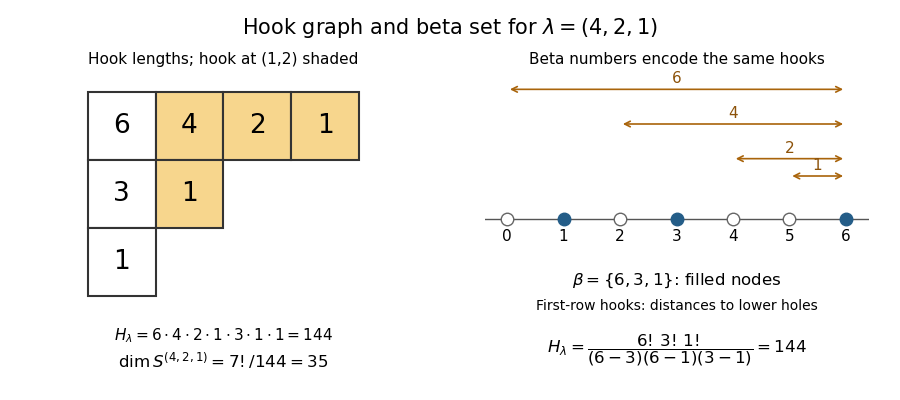


Pad to rows and use the beta set of a partition , so and , where . We prove the beta-set hook-product identity row by row. For , put ; then . The are distinct integers in , and none equals a beta number. Indeed, if then , whereas if then . Exactly beta numbers lie below , so the remaining integers in that interval are precisely these . ThereforeThis gives the equivalent Specht module dimension expression .
The standard Young tableaux of shape form the dimension count for the Specht module. The largest entry must occupy a removable corner. Deleting it bijects tableaux with the disjoint union of standard tableaux of the shapes obtained by deleting a corner, provingSet a term to zero whenever is not a partition: this includes equal adjacent rows and an attempted deletion from a zero row. The empty diagram has dimension .
For an algebraic proof that the proposed formula has the same recurrence, establish the Vandermonde shift identityIts left side is an alternating polynomial in the , because permuting the variables permutes the summands and changes the sign of every Vandermonde factor. It is therefore divisible by . The quotient is symmetric in and homogeneous of total degree one in , so has the form . At , . Differentiating in at zero and using the Euler theorem for homogeneous functions gives , so . This proves the identity as a polynomial identity, including repeated coordinates.
Take and . Since , it gives . For , this is exactlyThe summand is the proposed dimension for ; if two beta numbers collide its Vandermonde is zero, and if its coefficient is zero, so no negative factorial is needed. For the empty partition, and , giving initial value . Induction now proves the hook-length formula from the tableau recurrence.
For the final sum, tuples with repeated coordinates contribute zero. Sorting each distinct nonnegative tuple with sum gives one beta set of a partition of size , since subtracting the staircase removes from the sum. Conversely every partition of , padded to rows, supplies exactly ordered tuples, with the same squared summand. Hence the square-sum identity for shifted partition coordinates isThe middle equality uses the Artin–Wedderburn theorem for the group algebra and the complete classification of its simple modules by Specht modules. It explains why the last identity is a representation-dimension count rather than an accidental cancellation.
The characteristic equations for a transport equation on phase space areA sufficient global hypothesis is that is continuous in time, locally Lipschitz continuous in uniformly on compact time intervals, and, for every finite , satisfies for . These hypotheses give unique characteristic curves for all real times if the field is defined for all real times. It suffices for forward existence to impose them on nonnegative time. One may strengthen the spatial hypothesis to when differentiating the characteristic flow map below. Local Lipschitz continuity alone guarantees only local existence; the linear-growth bound prevents finite-time escape.
Put and . On a small closed time interval and a closed ball around the initial point, let bound and let be its spatial Lipschitz constant. The mapsends the corresponding closed ball of continuous paths into itself when the time length times is at most the ball radius. If the time length times is less than one, it is a contraction in the supremum norm. The Banach fixed-point theorem gives a local solution and uniqueness; differentiating its integral equation gives the ordinary differential equation. Overlapping local solutions agree by this uniqueness.
For continuation, the growth assumption gives, on any bounded time interval,for forward time, with the analogous reversed-time bound. The Gronwall inequality bounds the trajectory on that interval. A finite terminal time is impossible: within the resulting compact ball the field is bounded, so the path has a limit at the endpoint, and the local construction restarts there. This proves the global characteristic flow under linear growth. No differentiability of the flow with respect to its initial point is needed for this existence and uniqueness proof.
Articles were limited to the first 100 out of 1924 total.
Articles by others on the same topic
There are currently no matching articles.