Take regular adiabatic initial conditions and a common scale-invariant primordial amplitude, . Let . The three histories are distinguished by their time of cosmological horizon crossing:
- For , the mode remains outside the Hubble radius throughout radiation domination. Its potential remains nearly constant through equality, changing to of the primordial radiation value for a purely adiabatic transition. It stays constant after later horizon entry in matter domination.
- For , horizon entry occurs during radiation domination. Radiation pressure produces oscillations and a rapidly decreasing potential. The small cold dark matter component eventually supports a much smaller constant matter-era potential; the pure-radiation oscillations are not continued forever after equality.
- For , the transition and horizon entry overlap, giving an intermediate suppression before the potential approaches a constant.
The factor follows from conserving the large-scale adiabatic curvature: the constant potential is proportional to , whose matter-to-radiation ratio is . Define the cold-dark-matter transfer function by . Then on large scales, while far below the equality length, as explained by the density growth below.
The upper panel sketches for the three modes. The lower panel provides the corresponding density contrast histories used in the next part. A negative common primordial potential was chosen so the growing density is positive; this arbitrary phase has no effect on a cosmological density power spectrum.
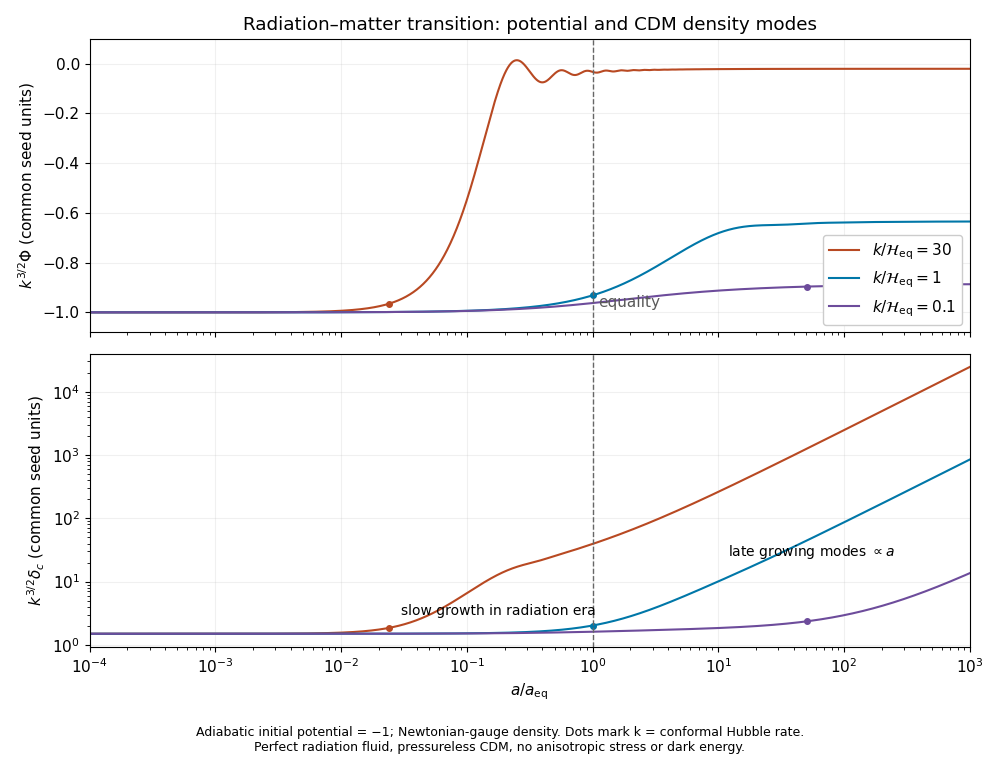
Evolution of scale-invariant gravitational-potential and cold-dark-matter density modes across radiation–matter equality
. The curves integrate the ideal coupled radiation-fluid and pressureless-matter equations, rather than patching a pure-radiation solution onto a matter solution. They neglect baryons, free-streaming anisotropic stress, dark energy and nonlinear evolution, consistently with the stated mixture. Dots mark ; equality is the dashed vertical line.
Articles by others on the same topic
There are currently no matching articles.