For a single barotropic perfect fluid in general relativity, the perturbations obey . This adiabatic closure is needed: constant background alone would not eliminate an independent entropy perturbation. The absence of scalar anisotropic stress allows the common potential used in Newtonian gauge in cosmology.
Substituting the density constraint into the pressure equation gives the gravitational potential evolution of a barotropic fluidSince , the conformal Hubble parameter is . The bracket cancels identically, leavingFor a Fourier transform mode, becomes .
During radiation domination, and . Set and write . The resulting equation is , so the two Spherical Bessel functions in the hint giveAt , the two solutions approach a constant and a mode proportional to . The regular adiabatic mode, normalized to its primordial potential, isAfter entry into the sound horizon, , the potential oscillates at cosmological sound speed with envelope . The Hubble radius and sound horizon differ by the sound-speed factor; outside the Hubble radius the regular potential is constant, while well inside it radiation supports acoustic oscillations.
During matter domination, gives at every wavenumber. HenceThe growing density mode has a constant potential both outside and inside the Hubble radius; the other potential mode decays. Pressureless matter has zero cosmological sound speed, so horizon entry does not produce the radiation acoustic decay. These formulas cover both independent solutions, while the subsequent sketches select the regular adiabatic growing mode.
Take regular adiabatic initial conditions and a common scale-invariant primordial amplitude, . Let . The three histories are distinguished by their time of cosmological horizon crossing:
- For , the mode remains outside the Hubble radius throughout radiation domination. Its potential remains nearly constant through equality, changing to of the primordial radiation value for a purely adiabatic transition. It stays constant after later horizon entry in matter domination.
- For , horizon entry occurs during radiation domination. Radiation pressure produces oscillations and a rapidly decreasing potential. The small cold dark matter component eventually supports a much smaller constant matter-era potential; the pure-radiation oscillations are not continued forever after equality.
- For , the transition and horizon entry overlap, giving an intermediate suppression before the potential approaches a constant.
The factor follows from conserving the large-scale adiabatic curvature: the constant potential is proportional to , whose matter-to-radiation ratio is . Define the cold-dark-matter transfer function by . Then on large scales, while far below the equality length, as explained by the density growth below.
The upper panel sketches for the three modes. The lower panel provides the corresponding density contrast histories used in the next part. A negative common primordial potential was chosen so the growing density is positive; this arbitrary phase has no effect on a cosmological density power spectrum.
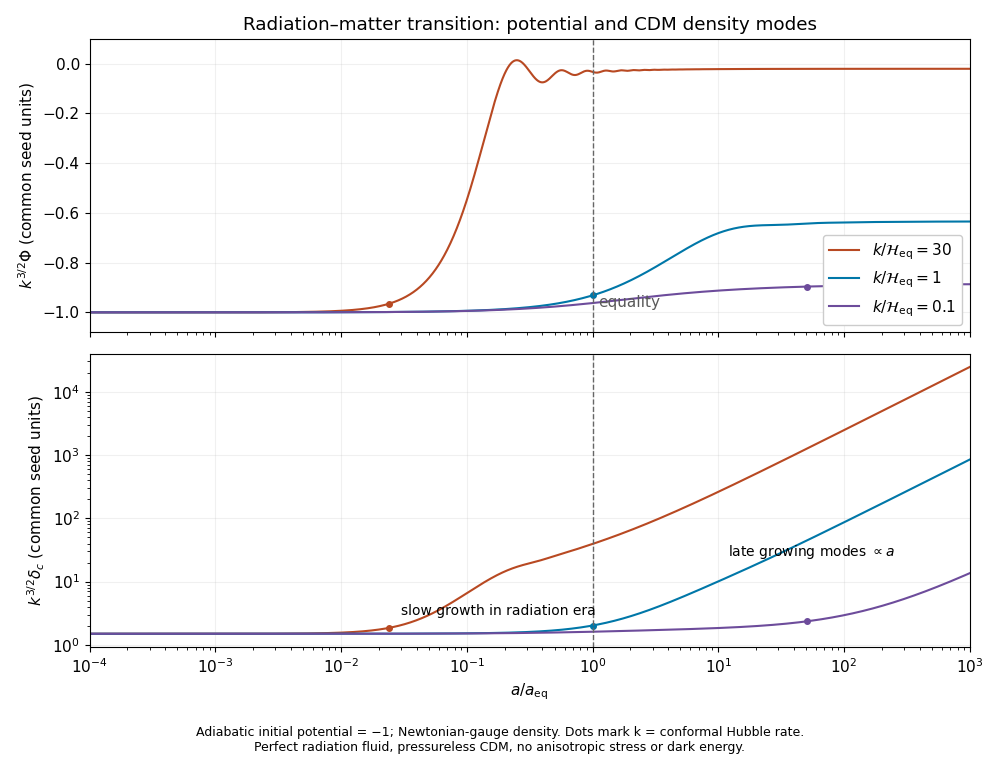
Evolution of scale-invariant gravitational-potential and cold-dark-matter density modes across radiation–matter equality
. Details. 
The curves integrate the ideal coupled radiation-fluid and pressureless-matter equations, rather than patching a pure-radiation solution onto a matter solution. They neglect baryons, free-streaming anisotropic stress, dark energy and nonlinear evolution, consistently with the stated mixture. Dots mark ; equality is the dashed vertical line.
In matter domination, the Einstein field equations with constant give the Newtonian-gauge matter density from a constant gravitational potentialWell inside the Hubble radius, the first term is negligible. Since and is constant,Equivalently, the matter-era growing and decaying density modes follow from : they are and .
The lower panel of the preceding figure gives the three requested density contrast sketches in Newtonian gauge in cosmology. Their early superhorizon density is nearly constant, rather than proportional to in this gauge. A large- mode enters first and grows only approximately logarithmically during radiation domination. Once the rapid radiation forcing has subsided, with , so . This is the Mészáros effect; forcing around entry determines the coefficients. After equality its growing part becomes proportional to .
A mode near begins substantial growth around equality. A small- mode keeps its superhorizon constant term until entering during matter domination, then follows the same growth law. Their entry scale factors satisfy during radiation domination and during matter domination. At a common late time, the scaled amplitudes are therefore of orderup to common dimensional constants and order-one matching terms. Thus the three late growth curves have the same logarithmic slope one as functions of , but different amplitudes. These amplitude statements require the modes to have entered the Hubble radius; the full Newtonian-gauge formula above remains available for modes that have not.
A scale-invariant primordial potential has . On subhorizon linear scales, the cosmological Poisson equation and the cold-dark-matter transfer function give , where during matter domination. ConsequentlyLarge scales enter only after equality and have . Small scales enter during radiation domination; their approximately logarithmic growth up to equality gives . ThereforeIf the slow logarithm is suppressed in a rough sketch, the slopes are and , with a turnover near . The logarithmic correction is real and should not be mistaken for a different primordial spectral index. In the matter-only late-time approximation with , the cosmological redshift means and ; it changes the amplitude, not these asymptotic shapes. Neither the initial normalization nor cosmological parameters needed for an absolute power are supplied.
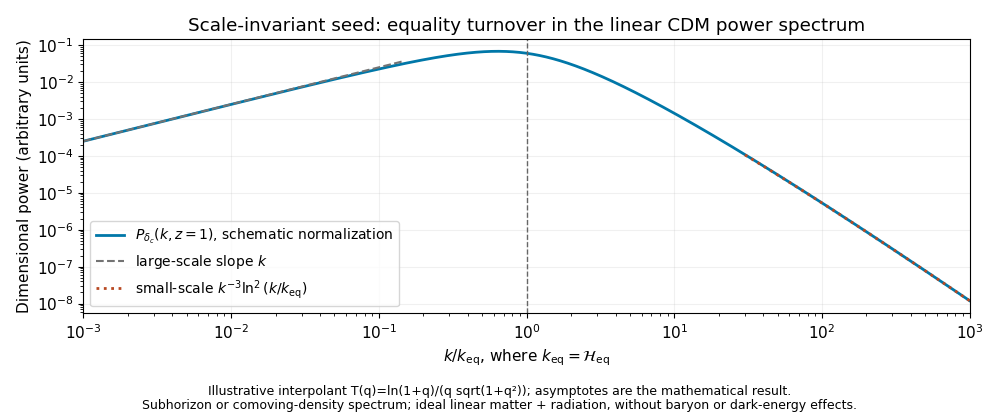
Linear cold-dark-matter power at redshift one with the equality turnover and its large- and small-wavenumber asymptotes
. Details. 
This is a schematic smooth interpolation with the derived asymptotes, not a precision transfer-function fit. The linear ideal-fluid model excludes baryonic acoustic structure and small-scale nonlinear evolution.
There is also a gauge and horizon qualification. For a mode still outside the Hubble radius at , the printed Newtonian-gauge density has , and its formal dimensional spectrum is instead proportional to . The conventional large-scale branch describes modes that are large relative to the equality scale but already subhorizon at the observation time. Alternatively, the comoving matter density, with , removes that constant gauge term and obeys in the growing matter solution. The usual matter-spectrum sketch can be continued to small in this comoving-density convention. The dimensional spectrum requested here is , rather than the dimensionless cosmological power spectrum , whose slopes would differ by three.
Articles by others on the same topic
There are currently no matching articles.