The initial table of content was limited to the first level because it is larger than 1000 articles. There are 2154 articles in total. Expand a branch to load its children.
A ring is Artinian when its ideals satisfy the descending chain condition: every chain eventually becomes constant. It is Noetherian when its ideals satisfy the ascending chain condition, equivalently when every ideal is finitely generated. We first prove finite length of a commutative Artinian ring; this gives the stronger structural reason for its Noetherian property.
If is a prime ideal of an Artinian ring, the quotient is an Artinian integral domain. For a nonzero element of that domain, the chain stabilizes. Thus for some , and cancellation gives . The quotient is a field, so every prime ideal is a maximal ideal.
There are only finitely many maximal ideals. Otherwise, choose distinct ones . The intersections form a strictly descending chain. To see strictness, for each choose ; their product belongs to the first ideals but not to the next one, since is prime. This contradicts the descending chain condition.
Put . This Jacobson radical is also the nilradical, since all primes are maximal. We need the stronger conclusion that is nilpotent, without assuming Noetherianity. Its powers stabilize, say . Suppose . By the descending chain condition, choose an ideal minimal subject to . Some has , so minimality gives . Moreover , and minimality gives . Hence for some . But is a unit: it cannot lie in any maximal ideal, because lies in all of them. Thus , a contradiction. Therefore .
The Chinese remainder theorem gives , a finite product of fields. Each quotient is an Artinian module over this product, and each field component must be a finite-dimensional vector space; an infinite-dimensional vector space admits a strictly descending chain of subspaces. Consequently every layer has finite composition length. The finite filtrationshows that itself has finite composition length. A strict inclusion of submodules strictly increases length, so an ascending chain cannot continue indefinitely. Every commutative Artinian ring is therefore Noetherian. This is the Artinian rings are Noetherian result.
For the formal power series ring, let with Noetherian, and let be any ideal of . For define a coefficient idealThese coefficient ideals of a formal power series ideal satisfy , by multiplication by . The ascending chain condition gives for all . For each , choose finitely many series whose coefficients at generate .
We claim that these finitely many series generate as an ordinary ideal. Given , cancel its coefficient at successively. After coefficients below have vanished, its coefficient at lies in . If , use an -linear combination of the . If , use a combination of , since . The remainder then belongs to .
Collect all the cancellations against each fixed generator. For its multiplier is a polynomial, while the multipliers of the are well-defined formal power series: at any fixed degree, only finitely many cancellation steps contribute. The remainder has every coefficient zero. ThusThis is a finite sum of ideal generators, rather than merely a topological closure assertion. Since was arbitrary,This coefficient-cancellation argument proves Noetherianity of a formal power series ring.
The corresponding Artinian assertion is false. For any nonzero ring , the idealsin are strictly decreasing, since has a nonzero coefficient in degree and no multiple of does. In particular, a field is Artinian, but is not. The zero ring is the harmless exception.
A prime ideal is minimal over if and no strictly smaller prime contains . An associated prime of a module is an annihilator of an individual nonzero element which happens to be prime. For the quotient module this readswhere . This is the annihilator of an individual element, rather than necessarily the annihilator of the whole quotient.
Minimal primes exist because is proper. First choose a maximal ideal containing . Within the primes contained in it and containing , an intersection of any decreasing chain is again prime. Indeed, if is in the intersection and is absent from one member, then belongs to that member and to every smaller member; it also belongs to every larger member. The intersection is still proper and contains . Zorn's lemma, applied with reverse inclusion, produces a minimal prime. This proves existence of minimal primes over a proper ideal, even without the Noetherian hypothesis.
Now fix a minimal prime and put . The localization at a prime ideal is nonzero and is a Noetherian local ring. By prime ideal correspondence for localization, its only prime is . Write this maximal ideal as . It is the nilradical; since it is finitely generated and each generator is nilpotent, some power of is zero. Explicitly, if its generators have nilpotence exponents , every product of degree vanishes.
Choose the smallest such that , and choose a nonzero element in ; when , choose . Its annihilator over is exactly . Represent it as with . Multiplication by the unit shows that has the same annihilator and remains nonzero.
Let generate in . For each , the equality supplies such that in . Put and . Its localization is nonzero, so , and every element of kills it. Conversely, an element outside becomes a unit and cannot kill the nonzero element . ThereforeThe key step in minimal primes are associated primes is clearing denominators for a finite generating set of ; that is where Noetherianity is used.
For an embedded associated prime, take and . Its radical is , so is its unique minimal prime. The nonzero class of satisfiesIndeed, is equivalent to by cancellation in the polynomial domain. Thus is associated but is not minimal, since . For comparison, , exhibiting the minimal associated prime as well.
An integral extension means that every element satisfies a monic polynomial with coefficients in :The Krull dimension is the supremum of the lengths of strict chains of primes:There need not be a finite bound on these lengths.
Here are the prime-ideal facts behind dimension preservation, with their relevant proofs. If a domain is integral over a subdomain and is a field, then is a field: for , a monic equation for , multiplied by a suitable power of , expresses as an element of . Conversely, an integral domain integral over a field is itself a field: a nonzero element has a polynomial equation with nonzero constant term after removing any factor of the indeterminate, and that equation expresses its inverse. Applied to quotients, these observations show that a prime in an integral extension is maximal if and only if its contraction is maximal.
For the Lying-over theorem, localize at . The inclusion remains injective and integral, and is nonzero. Any maximal ideal of contracts to the unique maximal ideal of , by the field criterion just proved. The prime ideal correspondence for localization then gives a prime of contracting to .
For the going-up theorem, suppose lies over and . The quotient inclusion is integral. Apply Lying-over theorem to the prime ; lifting back gives contracting to .
For the incomparability theorem for integral extensions, suppose contract to the same . After localizing at , both are maximal ideals, because they lie over the maximal ideal of . Their inclusion is therefore equality. The bijection between primes under localization gives .
Now contract a strict chain of primes in . Incomparability theorem for integral extensions ensures that every contraction remains strict, so . Conversely, Lying-over theorem lifts the first member of any finite chain in , and repeated going-up theorem lifts the remaining members; different contractions ensure a strict chain in . Taking suprema, including the possibility of infinity, givesThis proves that integral extensions preserve Krull dimension.
For the given quotient, put . The relation is monic in , so monic polynomial division gives a unique representative . Thus is injective and is free of rank two as a -module. In particular, is integral over . The one-variable polynomial ring has dimension one: its zero prime is strictly below , and every nonzero prime is maximal because is a principal ideal domain. HenceThis is an instance of dimension of a monic plane hypersurface. No irreducibility or algebraic-closure assumption on is needed; monicity supplies the integral extension in every characteristic.
Use the following finite-length version of the Hilbert-Serre theorem. Let be a graded algebra generated over an Artinian ring by finitely many homogeneous elements of positive degrees . For a finitely generated nonnegatively graded -module , define its Poincare series of a graded module byEvery component has finite length, and the theorem saysFor a module whose grading is merely bounded below, the same statement holds with a Laurent-polynomial numerator. When the generators all have degree one, the denominator is .
Here is an induction proof. An Artinian ring is Noetherian by question 1, so the Hilbert basis theorem makes Noetherian. If there are no positive-degree generators, and a finite homogeneous generating set for occupies only finitely many degrees. Each component is a finite module over the Artinian ring , hence has finite length of a module, and is a polynomial.
For , put , , and . Both are finitely generated graded modules annihilated by , hence modules over , which is generated by the first homogeneous elements. Their multiplication exact sequence isHere . Additivity of length degree by degree givesThis is the Hilbert series multiplication exact sequence. By induction, the right-hand side has denominator . Division by completes the proof of the Hilbert-Serre theorem. The finite-component and finite-generation claims also follow from the finite set of positive-degree algebra and module generators; no analytic convergence of a series is involved.
For the local invariant, use the usual Noetherian local ring hypothesis of Hilbert–Samuel growth dimension. Locality alone does not guarantee finite lengths or polynomial growth; the printed question leaves this finiteness assumption implicit. For instance, in the localization at a prime ideal of the polynomial ring at , the vector space has the infinitely many independent classes of the variables, so its length is not finite. Write and . Its associated graded ringis generated over in degree one, because is finitely generated. Thus its Hilbert series is rational with a denominator that is a power of . After cancelling factors, writeDefine , the pole order at , with when is a polynomial.
Equivalently, the Hilbert–Samuel functionhas generating series and eventually agrees with a polynomial of degree . Indeed, coefficients of are , and multiplication by leaves leading term . Consequently is the degree of the cumulative Hilbert-Samuel polynomial, rather than the degree of the individual graded-component function; the latter has degree when . This pole/growth invariant also equals Krull dimension by the local dimension theorem, although that theorem is not required to define it here.
For an example, take . Its associated graded ring is with the ordinary degree grading: degree has the monomials as a basis. ThereforeThe length formula also follows directly by counting monomials of total degree at most in .
The integral closure of in isIt is a subring: finitely many integral elements generate a finite -module algebra, and the determinant trick shows that each element of that algebra is integral. In particular, sums and products of integral elements remain integral.
A valuation ring is an integral domain such that, for every nonzero in its fraction field, either or . Equivalently, its ideals are totally ordered by inclusion. For principal ideals, comparability is precisely the condition on ; if two arbitrary ideals were incomparable, elements chosen from their differences would contradict principal-ideal comparability. Such a ring is local. Its nonunits form an ideal: if are nonunits and, for example, , then is still a nonunit. The unique maximal ideal consists of those nonunits.
First, valuation rings are integrally closed. If , then is a nonunit and lies in its maximal ideal . A monic relation for over , multiplied by , would givewhich is impossible modulo . Therefore every element integral over belongs to every valuation subring of containing .
For the reverse inclusion, we will construct a valuation overring that excludes any chosen nonintegral element. We need the valuation domination lemma: a local subring of a field is dominated by a valuation subring of , meaning and . Here is a proof, including the crucial maximality step.
Order the local subrings of dominating by domination. For a chain, take the union of the rings and of their maximal ideals. The union is a local ring: an element outside the union ideal is already a unit in a member of the chain, while an element in that ideal cannot become a unit in a later dominating member. The union still dominates . Thus Zorn's lemma supplies a maximal pair .
For any , at least one of and is proper. Suppose otherwise. There would be relationswith chosen minimal. Both are positive. Since and are units, normalize the relations to have zero constant term and left-hand side one. If , the second relation givesRepeatedly substituting this monic reduction in the first relation yields a relation for of degree less than , with every coefficient still in . This contradicts minimality of (or gives if the degree is zero). If , interchange and and use the first relation to reduce the second, contradicting minimality of .
Choose whichever extension has a proper extended ideal, then a maximal ideal containing it. Localizing that extension at the chosen maximal ideal produces a local ring dominating . If both and were outside , this would be a strict enlargement, contradicting maximality. Thus has the valuation property. In particular its fraction field is all of , since each nonzero element of or its inverse belongs to . This proves the valuation domination lemma.
Now let be nonintegral over , so , and set , . The ideal is proper: otherwise , and multiplication by gives a monic equation for over . Choose a maximal ideal of containing , and apply the valuation domination lemma to . Its dominating valuation ring contains and has . Hence is not invertible in , so .
We have excluded every nonintegral element from at least one valuation overring, while every integral element belongs to all of them. Therefore the integral closure as an intersection of valuation rings isNeither Noetherianity nor a discrete valuation is required for this separation argument.
Set , a multiplicative subset. The localization at a prime ideal is , whose elements are fractions . Equality of two fractions means that for some . Likewise the localization of a module is , withAddition uses a common denominator, and the module action isThe equivalence relations make these operations well-defined, so is an -module.
If , choose . Its annihilator is proper, so it lies in a maximal ideal . The element cannot vanish in : vanishing would mean for some , contrary to . The converse is immediate by localizing the zero module. ThusThis proof of localization detects zero elements actually applies to arbitrary modules, without finite-generation or Noetherian assumptions. We will use that extra generality for an Ext functor module below.
An injective module has the extension property: for each inclusion , every map extends to a map . Equivalently, is exact. A projective module has the lifting property: for each surjection , every map lifts to . Equivalently, is exact, or is a direct summand of a free module.
For the local criterion for injectivity over a Noetherian ring, recall the Baer criterion: is injective precisely when every map from an ideal into extends to . Through the short exact sequence , this is equivalent toWe also need localization of Ext over a Noetherian ring. Because is Noetherian, the module has a free resolution with every term finitely generated: all successive kernels are finitely generated, so this can be built recursively. For a finite free term , the natural mapis an isomorphism, as is clear from a finite basis. Exactness of localization lets us pass to cohomology of the Hom complex. ThereforeThis explains the finiteness hypothesis needed for the localization argument, rather than assuming that localization preserves injectivity automatically.
If is injective, the left-hand side vanishes for every and . Every ideal of is , where is its contraction to : if , then , and conversely localization of a member of the contraction stays in . Hence all ideal tests for vanish, and the Baer criterion over makes injective.
Conversely, suppose every is injective. For each ideal , the displayed Ext functor localization is zero at every prime. The zero-detection argument above gives , without needing this Ext module to be finitely generated. Applying the Baer criterion over provesIn fact, under the Noetherian ring hypothesis this equivalence holds for arbitrary ; the printed finite-generation assumption is more than is needed.
The global dimension iswhere projective dimension is the smallest length of a projective resolution, or infinity if there is no finite one. If , every module is projective. Given an inclusion , the quotient is then projective, so the exact sequence splits. A retraction exists. For any module and any map , the composition extends . Thus every module is also injective. Global dimension zero makes all modules both projective and injective, as recorded by global dimension zero and split exact sequences.
For a Lie algebra , write for the linear span of brackets with one argument in each indicated subspace. The three definitions areThese are respectively an Abelian Lie algebra, a solvable Lie algebra and a nilpotent Lie algebra. The second and third sequences are the derived series of a Lie algebra and the lower central series of a Lie algebra.
An Abelian Lie algebra has , and a nilpotent Lie algebra is a solvable Lie algebra: induction gives . Thus all the implications are generated byNone of the reverse implications holds. The Heisenberg Lie algebra with basis and , all other basic brackets zero, is nonabelian but has , . The two-dimensional affine Lie algebra of the line with has and , but for every . It is solvable and neither nilpotent nor abelian. These two examples answer all six ordered-pair comparisons.
The Lie theorem says that a finite-dimensional Lie algebra representation of a finite-dimensional solvable Lie algebra over an algebraically closed field of characteristic zero has a common eigenvector whenever its representation space is nonzero. Equivalently it admits an invariant complete flag, or simultaneous upper triangularization. Here the field may be taken to be ; these hypotheses are essential.
To prove the common-eigenvector assertion, induct on . The zero algebra is immediate. Since is nonzero and solvable, its derived algebra is proper. Choose a codimension-one Lie algebra ideal containing it, and write . The Lie algebra is solvable, so induction supplies and a linear functional with .
Consider the finite-dimensional cyclic subspace . Until the first linear dependence, these powers form a basis. The identityand show by induction, simultaneously for all , that is -invariant and that is upper triangular on it with every diagonal entry . It is also -invariant by construction. HenceThe trace of a commutator is zero, and characteristic zero gives .
The simultaneous eigenspace is nonzero and -invariant, sinceOver an algebraically closed field, has an eigenvector, which is therefore a common eigenvector for all of . This finishes induction. Apply the same assertion to the quotient representation by its invariant line, and then to successive quotients. A basis adapted to the resulting complete flag gives the stated simultaneous triangularization of a Lie algebra representation, completing the proof of the Lie theorem.
A nilpotent Lie algebra is a solvable Lie algebra, so the inclusion satisfies the Lie theorem and is upper triangular in a suitable basis, for finite-dimensional complex .
This is insufficient to prove the Engel theorem. Its matrix version starts with a Lie subalgebra of nilpotent endomorphisms and concludes that they are simultaneously strictly upper triangular; its abstract version concludes nilpotence from nilpotence of every Adjoint representation endomorphism. Merely upper triangular matrices can have nonzero diagonal entries: the one-dimensional algebra is an Abelian Lie algebra and a nilpotent Lie algebra, but acts by a nonnilpotent identity matrix. This is nilpotent Lie algebras need not act nilpotently. Moreover, in the abstract Engel theorem nilpotence of the algebra is a conclusion, so assuming it first to invoke the Lie theorem would be circular. Abstract nilpotence and nilpotence of each representing matrix are different conditions.
The Weyl complete reducibility theorem states that every finite-dimensional Lie algebra representation of a finite-dimensional complex semisimple Lie algebra is a direct sum of Irreducible Lie algebra representations. Equivalently, every invariant vector subspace has an invariant complement.
We use the permitted Casimir operator properties in the following precise form. There is a central quadratic operator commuting with the action on every module; it is zero on the trivial Lie algebra representation, and on every nontrivial finite-dimensional Irreducible Lie algebra representation it is a nonzero scalar . This follows from the Schur lemma and the Casimir eigenvalue , using the Killing form normalization. We also use the permitted one-dimensional-representation fact: a complex semisimple Lie algebra has only trivial one-dimensional representations. Equivalently, it is a perfect Lie algebra, , so a character annihilating brackets must vanish. Neither fact assumes complete reducibility of the module being proved reducible.
First prove that every finite-dimensional short exact sequencewith trivial quotient splits. If is nontrivial irreducible, the Casimir operator has image in and restricts to there. Consequently is a one-dimensional invariant complement to . If is trivial irreducible, has a basis in which every action is . The Lie algebra representation identity makes , so the one-dimensional-representation fact gives and again the sequence splits.
For general , induct on . Choose an irreducible submodule . The induced sequence with kernel and middle term splits by induction. The inverse image of its invariant complement is a submodule fitting into . The irreducible-kernel case gives an invariant line in mapping isomorphically to the quotient. It is also an invariant complement to in . The case starts this induction. This proves splitting of a trivial quotient for a semisimple Lie algebra, including kernels that are not assumed completely reducible.
Now let be any invariant subspace. On the Hom representation the action isLet consist of the maps whose restriction to is a scalar multiple of . This is a submodule, and restriction givesThe right-hand map is surjective because an ordinary linear projection exists; its quotient action is trivial because a commutator with is zero. The splitting just proved supplies an invariant with . Thus intertwines the actions, , andThe cases and are immediate. Choosing an irreducible submodule and repeating this complement construction proves the Weyl complete reducibility theorem. This last step is invariant complement from an equivariant projection.
Dropping finite dimensionality gives an example with the complex simple Lie algebra . Its Verma module of highest weight zero has a basis withwhere . These actions obey , , . The span of is a proper submodule and the quotient is trivial. It has no invariant complement: such a complement would be a trivial line, while is injective on the entire module. Thus a simple Lie algebra can have an infinite-dimensional representation that is not completely reducible, even over .
Use Dynkin labels for the highest weight of the complex special linear Lie algebra . The A2 root system has and in these coordinates. In the drawings, and have equal lengths and angle ; a label at a point records its weight multiplicity, not a further copy at a different position.
The defining fundamental representation has the three weightsFor , lower from its highest weight by the simple roots, retaining multiplicities. One convenient way to calculate them is the sl3 interlacing character formula: for shape the integer patterns satisfy , , , and contribute the weightEnumerating these patterns gives the weight diagramIts dimension is . The diagram below draws all twelve distinct positions, with the three inner multiplicities equal to two. The extra panel gives the symmetric square used in the calculation.
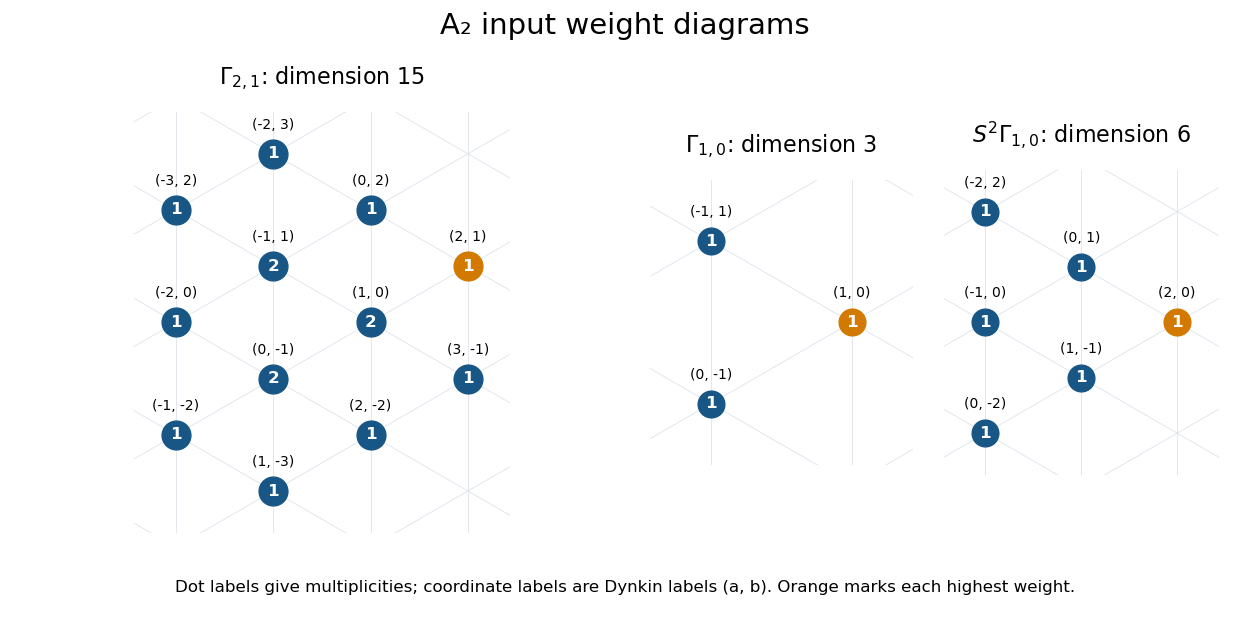
A2 weight diagrams for Gamma(2,1), the defining Gamma(1,0), and its symmetric square, with every weight multiplicity
. Details. 
The six symmetric monomials in the defining basis give , with weightseach occurring once. Thus the tensor product has dimensionIn a tensor product of Lie algebra representations, weights add and their multiplicities multiply. In terms of formal characters, . Consequently , summing over the six weights just listed. To show the indicated dominant multiplicities explicitly, the contributions in that order areThe tensor-product weight diagram below includes every position, and highlights these dominant weights. It also records the zero-weight multiplicity nine; that multiplicity is not a count of trivial summands.
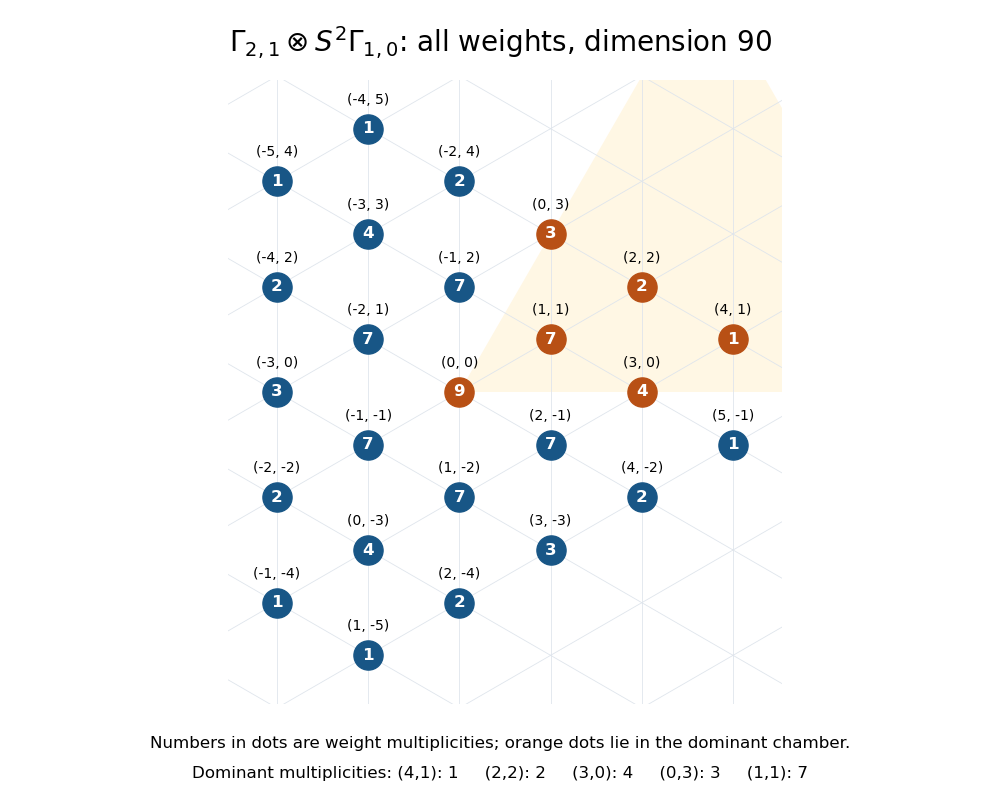
All weights of the ninety-dimensional sl3 tensor product Gamma(2,1) tensor Sym2 Gamma(1,0), with dominant weights highlighted and multiplicities labelled
. Details. 
Apply the Weyl complete reducibility theorem and subtract irreducible formal characters in decreasing dominance order. The multiplicities at these five dominant positions in the potential summands areThese entries can be obtained by the same interlacing enumeration or by weight strings. Starting with , subtracting leaves ; subtracting leaves ; then the two ten-dimensional modules leave a single copy of the dominant weight . This is highest-weight character subtraction. ThereforeEvery summand occurs once. The Weyl dimension formula gives , exhausting the dimension of and ruling out further irreducible summands. Computing the complete formal character also leaves no residual weight multiplicities.
The appropriate abstract object is a finite reduced crystallographic root system in a real inner product space . Its axioms are: is finite, spans , and does not contain zero; for , ; each root reflectionpermutes ; and every Cartan integer is an integer. The restriction to a reduced root system and crystallographic integrality distinguishes roots of complex semisimple Lie algebras from more general reflection configurations.
For any two roots of a root system, the Cauchy-Schwarz inequality givesIf the inner product is zero, both Cartan integers vanish. Otherwise their signs agree, and the absolute value of each is a positive integer. Dividing their product by an integer of absolute value at least one provesFor nonproportional roots the product is strictly less than four. In a reduced root system, proportional roots are just and have Cartan integers , so the printed bound is intentionally looser than the resulting bound of three.
A fundamental system of a root system is a basis of made of roots, such that each root is an integer combination of with either all coefficients nonnegative or all nonpositive. Its members are the simple roots. Suppose distinct had . Thenhas a positive coefficient of and a negative coefficient of , contradicting the defining sign condition. Thus . Distinct simple roots are linearly independent, so their Cartan-integer product is strictly less than four. Combining integrality and the sign condition givesHere nonpositive is the intended sense of the printed convention that includes zero among “negative” numbers; orthogonal simple roots really do give zero.
To form a Dynkin diagram, place a vertex at each simple root. Join two vertices by bonds, hence zero, one, two or three. A multiple bond has an arrow toward the short root. Indeed determines the squared length ratio, and the diagram with the Cartan matrix reconstructs the angles and relative lengths. A single bond joins equal-length roots.
The connected finite Dynkin diagrams are the following. The descriptions include bond multiplicities and arrow directions, so distinguish dual diagrams:
- An Dynkin diagram, for : a chain of vertices with only single bonds.
- Bn Dynkin diagram and affine extension, for : a chain whose last bond is double, with its arrow toward the terminal short root; all earlier bonds are single. Only its finite diagram is used here.
- Cn Dynkin diagram, for : the same chain with the double-bond arrow toward the penultimate short root and away from the terminal long root. and describe the same rank-two type after relabelling.
- Dn Dynkin diagram, for : a simply laced tree with one trivalent vertex and arms of lengths , counting edges.
- En Dynkin diagram, : simply laced trees with a trivalent vertex and arms of lengths respectively , , .
- F4 Dynkin diagram, : a chain of four vertices, with a double central bond and two single outer bonds. Two consecutive vertices are long and two are short; the arrow goes from the long pair toward the short pair.
- G2 Dynkin diagram, : two vertices joined by a triple bond, with arrow toward the short root.
There are no other connected finite Dynkin diagrams. Low-rank conventions also identify and ; is disconnected, so introduces no further connected type. Affine diagrams are outside this finite classification.
Finally suppose the underlying graph contained a cycle on distinct simple roots . Put . Any bonded pair hasand all other distinct pairs have nonpositive inner products. The cycle contributes at least bonded pairs, soBut the simple roots, and hence these normalized vectors, are linearly independent, making the displayed sum nonzero. Positive definiteness gives a contradiction. Thus the underlying graph of a finite Dynkin diagram has no cycle. This acyclicity of a finite Dynkin diagram argument also excludes cycles with extra chords or multiple bonds; multiple bonds themselves are not treated as two-edge cycles.
Let be a finite-dimensional Lie algebra representation. The form denoted isIt is the Trace form of a Lie algebra representation; the Killing form without a subscript is specifically the case , . The distinction matters: the form of the trivial representation cannot detect whether the algebra is semisimple.
Linearity of and trace proves bilinearity, and cyclicity of the trace gives symmetry. With , and , the representation identity givesThus it is an invariant bilinear form on a Lie algebra, and in particular the Adjoint representation preserves the Killing form.
The Cartan solvability criterion has two useful formulations. For a finite-dimensional complex Lie algebra ,Its matrix version says that a Lie subalgebra is solvable precisely when for all and . We prove the matrix version first, with ordinary trace in .
If is solvable, the Lie theorem makes all its matrices upper triangular. Their commutators are strictly upper triangular, so multiplying such a matrix by an upper triangular one still has zero diagonal and hence zero trace. This proves the easy direction.
Conversely assume the trace-orthogonality condition and fix . We show that all eigenvalues of vanish. Use its Additive Jordan decomposition with . On the generalized eigenspace of , define an auxiliary endomorphism to be . This need not be in ; we only need control of its commutator with .
On , acts by and by . Choose a polynomial with and at the finitely many distinct differences. Polynomial interpolation supplies it because equal differences have equal conjugates. Therefore .
The adjoint compatibility of additive Jordan decomposition identifies as the semisimple part of . Elementary Jordan–Chevalley decomposition gives for a polynomial with . Hence is a polynomial in with zero constant term. Since maps into and preserves that Lie algebra ideal, we obtainNo assumption that , or belongs to was made.
Write with . Cyclicity and the assumed orthogonality now giveOn the other hand the nilpotent parts have zero trace on each generalized eigenspace, soThus all are zero and is a nilpotent endomorphism. This is the Conjugate-spectrum proof of Cartan solvability.
The permitted Engel theorem, in the form needed here, states: a finite-dimensional Lie subalgebra of endomorphisms in which every element is nilpotent has a nonzero vector annihilated by all its elements, and iteration on quotients makes every element simultaneously strictly upper triangular. Apply it to . The strictly upper triangular algebra is nilpotent, so is a nilpotent Lie algebra and therefore solvable. Since is abelian, the derived series of a Lie algebra of terminates too. This proves the matrix criterion.
Apply it to . The condition on is exactly the matrix condition on . Thus is solvable. The kernel of is the center of a Lie algebra, which is abelian, so is solvable as well: once the derived series maps to zero it is central, and its next term vanishes. Conversely a solvable has solvable adjoint image, proving the abstract Cartan solvability criterion in both directions.
A finite-dimensional Lie algebra is a semisimple Lie algebra when it has no nonzero solvable Lie algebra ideal, equivalently its solvable radical is zero. Let . Invariance makes an ideal. For , induces zero on , and the block trace gives , where is the adjoint Killing form of itself. The Cartan solvability criterion therefore makes solvable. If is semisimple, .
Conversely suppose is a nondegenerate bilinear form. If a nonzero solvable ideal existed, its last nonzero derived term would be an abelian ideal of . For and , the operator has image in and is zero on , so its square and its trace are zero. Thus , contradicting nondegeneracy. This is Abelian ideals lie in the radical of the Killing form. We conclude the Cartan criterion for semisimplicity:
A real Lie group is a group equipped with a finite-dimensional real smooth manifold structure, conventionally Hausdorff and second countable, for which multiplication and inversion are smooth.
Its tangent space at the identity is defined by smooth curves through : two curves represent the same tangent vector when their derivatives in a local chart agree at zero. For , left translation determines the left-invariant vector fieldThe commutator of these derivations on smooth functions is another left-invariant vector field, so define the Lie bracketThis construction supplies the Lie algebra structure. In a Matrix Lie group, and differentiating the two fields gives .
For the special linear group, differentiate the determinant along a curve through . Expansion of the determinant, or its differential , givesThe determinant differential is surjective at , so the level set has tangent space equal to its differential's kernel. Equivalently, every tangent matrix has zero trace, and every zero-trace matrix supplies a curve of determinant . Hencewith the matrix commutator bracket. The same calculation over gives the complex special linear Lie algebra ; as a real group, the complex group has that space viewed as a real Lie algebra.
The matrix exponential is the everywhere-convergent serieswhose inverse matrix is . The matrix logarithm is locally defined near byThese maps are inverse on suitable neighbourhoods of zero and , giving a logarithmic chart of a matrix Lie group. A logarithm is not a globally single-valued inverse of the exponential.
Every invertible complex matrix nevertheless has at least one matrix logarithm. Put it in Jordan normal form. For a block , and , choose any complex scalar logarithm of and setThe finite logarithm and exponential identities in the nilpotent variable give . Combine the blocks and conjugate back. Thus the exponential map is surjective on , by existence of a logarithm for every invertible complex matrix.
A connected counterexample is . It is connected: polar decomposition of an invertible real matrix writes each element as , with and positive definite symmetric of determinant one; is connected and is connected to through .
But belongs to this group and is not for any real . Such an would commute with . Since has two distinct real eigenvalues, direct commutation makes a real diagonal matrix. Its exponential has positive diagonal entries, a contradiction. ThereforeThis is an exponential-surjectivity obstruction from distinct negative eigenvalues; connectedness does not eliminate the obstruction.
Write a finite quiver as , with vertex and arrow sets and source/target maps. A representation of a quiver assigns a vector space to each vertex and a linear map to each arrow. A quiver representation morphism is a family satisfying .
The path algebra has every directed path, including each length-zero path , as a basis. Multiplication is composition when endpoints match, and zero otherwise; in , the path is traversed first. The orthogonal idempotents satisfy .
The path-algebra module equivalence is explicit. From a representation, form , let project onto , and let each path act by the composite of its arrow maps. Conversely, an -module gives and . An -module homomorphism restricts to the required vertex maps, and a compatible family extends by direct sum. These constructions are mutually inverse up to their evident natural identifications.
is finite-dimensional exactly when is finite and has no oriented cycle. For a finite acyclic quiver, paths have length at most . An oriented cycle has arbitrarily many distinct powers, giving infinitely many basis paths. If arbitrary infinite quivers are allowed, finiteness of both vertices and arrows is also necessary; the unital module correspondence above uses finite .
Choose only the orientation . The interval representations of an equioriented three-vertex quiver have at vertices , zero elsewhere, and identity arrows within that interval. The complete list isHere is an elementary proof, without the Gabriel theorem. For , set . Choose complementing in , complementing in , and complementing in . Then , and is injective on . Lift bases of to a complement of in , and extend the bases of to . These bases split into precisely the six kinds of interval block. Every block has endomorphism ring , hence is indecomposable, and their different supports make them pairwise nonisomorphic. The same basis argument handles arbitrary vertex dimensions; each indecomposable block itself is finite-dimensional.
For a finite acyclic quiver, the arrow ideal of a path algebra is nilpotent, and . If is a simple module, its submodule is either zero or . The latter would imply for every , contradicting nilpotence. Thus , and a simple module over the product of fields is supported at one coordinate. Therefore the simples are exactly , with at , zero elsewhere, and zero arrows; the vertex is unique.
A finite-dimensional semisimple module is consequently , where . Its dimension vector of a quiver representation determines its isomorphism class.
For an arbitrary finite quiver, cycles allowed, the vertex projective module of a path algebra is . Its space at vertex has basis all paths from to , and an arrow acts by adjoining that arrow at the end of the path. Its endomorphism ring iswhere is spanned by the closed paths based at . The opposite multiplication appears because endomorphisms act by right multiplication.
The evaluation isomorphism for a vertex projective isFor , its inverse sends a path starting at to . This proves both injectivity and surjectivity, and is natural in . Vertex evaluation is exact, so is a projective module; alternatively it is a direct summand of the free module .
The closed-path corner of a path algebra is a domain: in a product of two nonzero linear combinations, choose their longest path lengths. Concatenation in that top degree has a unique cut at those lengths, so a product of two nonzero top coefficients cannot cancel. Hence its only idempotents are zero and one. The same is true of the opposite ring, proving is an indecomposable module, even when cycles make it infinite-dimensional.
The extension group consists of equivalence classes of short exact sequences , with the zero class represented by a split sequence and addition given by the Baer sum. The extension complex of quiver representations givesThe printed map has , so its kernel is and its cokernel is . Reversing the overall differential sign changes neither identification.
For dimension vectors , the Ringel form isThe first expression makes its dependence only on the dimension vectors explicit.
For the one-loop representation with loop scalar , on . Both cochain spaces have dimension one, so , for every . Concretely, a self-extension has loop matrix , with the extension parameter.
The four-subspace quiver has four one-dimensional sources and a two-dimensional sink. Its Tits form of a quiver at this dimension vector is .
An endomorphism comprises source scalars and a sink matrix . The first two columns force . The third column then forces , making scalar. Since the fourth column is always nonzero, its scalar is also the same, for every .
Thus , so the representation is a brick module. The Ringel form givesThis conclusion also covers , where the fourth line repeats one of the earlier lines; the first three lines already force scalar endomorphisms.
A unipotent algebraic group admits a faithful linear representation in which every group element is a unipotent matrix. For , invertibility is the nonvanishing condition . Therefore is a nonempty Zariski-open subset of the vector space .
Take a Krull-Schmidt decomposition , with pairwise nonisomorphic indecomposable modules. The Fitting lemma makes each a local endomorphism ring. Its residue division algebra is : over an algebraically closed field, every element of a finite-dimensional division algebra has an eigenvalue and hence must be scalar. The semisimple quotient of a module endomorphism algebra consequently gives, for the Jacobson radical ,is surjective with kernel . The nilpotence of makes finite and each unipotent. The kernel is closed and normal. Acting on the multiplicity spaces embeds the product of general linear groups back into and splits this quotient. This proves the Levi decomposition of a quiver automorphism groupSince is the unipotent radical, a nonzero is indecomposable exactly when : the product has a single factor of size one.
For the base change action on quiver representations, the orbit map is . Substituting , with , shows its differential isIts kernel is . The stabilizer is smooth because it is open in that vector space. Hence the differential has rank , and its image is the Zariski tangent space . The normal space to a quiver orbit is thereforeThe ambient quiver representation space is an irreducible affine space, and orbits are locally closed. An orbit is open exactly when its dimension equals that ambient dimension, equivalently when . This proves that rigid quiver representations have open orbits. Such an orbit is dense and unique, since two nonempty open subsets of an irreducible space intersect.
For a finitely generated associative algebra , the representation variety of an associative algebra consists of generator matrices satisfying all defining polynomial relations. With fixed orthogonal idempotents , require a representation on to send to the standard vertex projector. This is the meaning of ; without specified idempotents, use the usual single dimension and . Polynomial relations cut out a closed affine variety in the space of generator matrices.
The group acts by conjugation, preserving the prescribed projectors. Its stabilizer is , a nonempty open subset of . The orbit dimension formula consequently givesA degeneration of a module to means that , equivalently that one representative of lies in this closure.
For , choose a vector-space splitting, so every generator has block matrix . Conjugation by , , givesThis polynomial family extends to , retains all algebra relations, and at zero represents . Thus splitting an extension gives a module degeneration. Iterating along a composition series gives . Degenerations are transitive because an orbit closure is closed and invariant under base change.
For the one-arrow quiver with dimension vector ,The action is . Its rank orbits of a matrix under left-right multiplication are indexed by , with a representative containing an identity block and zeros elsewhere. Their dimensions are ; their closures contain exactly matrices of rank at most .
Write the two arrow matrices as . The base change action on quiver representations sends them to . Starting from yields precisely the pairs with both matrices invertible: given such a pair, choose , , . HenceThis is a nonempty Zariski-open subset of the irreducible affine space , so its closure is the entire representation space. Its boundary in that closure is .
The rank classification of a two-step linear map says an orbit is determined by . Indeed, the six interval multiplicities from the elementary decomposition areThey are nonnegative exactly when and . Apart from the open orbit , there are nine boundary orbits. Put and ; representatives areThe two rank-one/rank-one cases differ by whether ; the individual arrow ranks alone do not distinguish them.
A nonzero finite-dimensional representation is a brick module when its endomorphism ring is a division algebra. Over the algebraically closed field , this means : for any endomorphism , an eigenvalue makes noninvertible, hence zero in a division algebra.
For a counterexample to the converse of “brick implies indecomposable”, take the one-loop representation with nilpotent Jordan block . Its endomorphism ring is , a local endomorphism ring of dimension two. It has no nontrivial idempotents, so the module is indecomposable, but it is not a brick.
For the one-arrow quiver, splitting the kernel, image and target complement decomposes any representation into copies of , and . Each has endomorphism ring . Therefore every indecomposable of the one-arrow quiver is a brick.
For the Kronecker quiver representation with arrows and , an endomorphism satisfies and . Solving the second equation givesThus this representation is indecomposable but is not a brick: its endomorphism ring is a local endomorphism ring, while the nonzero endomorphism is nilpotent.
For a general indecomposable non-brick, the proof of Ringel lemma on bricks finds a proper indecomposable submodule with nonzero self-extensions. Repetition in strictly decreasing dimension reaches a brick module with . The linked proof supplies the minimal-rank, retraction and hereditary-extension steps.
Now assume the Tits form of a quiver is positive definite. If an indecomposable were not a brick, this would give the contradictionHence is a brick. For its nonzero dimension vector , positivity and integrality then implyThus every indecomposable in this case is a rigid brick. This deduction uses the Ringel lemma on bricks and the Ringel form, without requiring the full Gabriel theorem.
Construct the free product from the empty word and all finite alternating words , whose syllables in a free product are nonidentity elements of tagged copies of , with adjacent syllables from different factors. Multiply by concatenating, multiplying adjacent elements in the same factor, and deleting identities until the word is reduced. The normal form theorem for a free product gives a unique result; reducing three concatenated words gives the same result under either parenthesization, so multiplication is associative. The empty word is the identity, and the inverse reverses the word and inverts each syllable. Each factor embeds as words of length one.
The universal property of a free product says that for every group and group homomorphisms there is a unique group homomorphism extending both. Explicitly, send a reduced word to the product of its syllable images; reduction preserves this product. This gives existence, while generation by the two factors gives uniqueness.
A standard form of Klein's combination theorem, or the ping-pong lemma, is the following. Let nontrivial subgroups of the homeomorphisms of a topological space have disjoint nonempty subsets withAssume also that at least one factor has at least three elements. Then the generated subgroup is . The cardinality hypothesis cannot simply be omitted: the same involution swapping two disjoint sets would otherwise provide a counterexample with both factors equal to .
Here is the ping-pong lemma proof. A reduced word of odd length begins and ends in the same factor, so repeated application of the displayed inclusions sends the other factor's domain into that factor's domain. Disjointness shows that the word is not the identity. For an even reduced word, relabel the factors so that , and invert the word if necessary to make it begin with and end in . Choose . The conjugate reduces to an odd-length word beginning with and ending with , both in , so it is nontrivial. Thus no nonempty reduced word lies in the kernel of the natural group homomorphism , proving the theorem.
For an explicit example, let be the one-dimensional Real projective space, and take the Möbius transformationsFor every nonzero integer , sends into , while sends into . Indeed when , and . Both transformations have infinite order. Hence the ping-pong lemma gives , a free product of two nontrivial finitely presented groups.
A finitely presented group admits a group presentation with both and finite; it is the quotient of the free group on by the normal closure of . Ifwith disjoint generator sets, thenMaps from this group presentation to any group are exactly pairs of maps from and , so the universal property of a free product proves the formula.
For a group homomorphism , choose a word representing for each . The presentation of a semidirect product isThe presentation maps onto the specified semidirect product. Conversely, its conjugation relations allow any word to be written as a word from followed by one from . The natural maps from the two factors to the presented group satisfy the full action relation, because conjugation agrees with first on generators and hence on all elements. They define the reverse group homomorphism . The two maps are inverse on every generator, proving the group isomorphism. There are finitely many cross-relations, so the result is again a finitely presented group.
Apply this to the specified permutation action. The presentation isEliminate and . The last cross-relation becomes , already implied by . ThusBoth factors are nontrivial finitely presented groups, as required.
A soluble group, also called a solvable group, has a terminating derived series:For a subgroup , induction gives , so subgroups of soluble groups are soluble. For a surjective group homomorphism , , so quotients of soluble groups are soluble. Finally, in a group extension , suppose and . Then and . Soluble groups are closed under subgroups, quotients and group extensions.
A virtually soluble group contains a soluble group as a finite-index subgroup. The finite-index facts proved in parts (i)–(iii) imply closure under subgroups and quotients: intersect a finite-index soluble subgroup with the chosen subgroup, or take its image under the quotient map.
For group extensions, no finite-generation hypothesis may be inserted. We first establish the finite-index characteristic soluble subgroup lemma. If is a virtually soluble group, the kernel of its action on the cosets of a finite-index soluble subgroup is a soluble normal subgroup of finite index. Among soluble normal subgroups containing , choose with maximal , possible because is finite. If is any soluble normal subgroup of , then is soluble: it is an extension of by . Maximality forces . Thus is the unique largest soluble normal subgroup of , making it a characteristic subgroup, and it has finite index.
Now suppose has both and virtually soluble. Replace by the preimage of a finite-index soluble subgroup of . The subgroup just constructed is characteristic in and therefore normal in . In , the subgroup is a finite normal subgroup, and is a soluble group. The centralizer has finite index in , since conjugation gives a map with finite image. Its intersection with is the center of a group , an abelian group, while its quotient by embeds in the soluble group . Thus is a soluble group. Its preimage in is an extension by , so it too is soluble and has finite index in . Virtually soluble groups are closed under group extensions.
For the final example take the restricted direct sum of groupswhere is the nonabelian simple group of even permutations on five letters. Every finite collection of elements lies in a product of finitely many finite factors, so is a locally finite group and hence a torsion group. It cannot contain a nonabelian free group, which is a torsion-free group.
To show that is not a virtually soluble group, let be any finite-index subgroup and let be the kernel of the finite coset action. Each coordinate maps either injectively or trivially into the finite quotient , by Simplicity of the alternating group A5. The nontrivial images of distinct factors commute, and each has trivial centre, so any of them generate a direct product of groups of order . Only finitely many such images can occur in a finite quotient. Therefore , and hence , contains a whole coordinate copy of , which is not soluble: its nontrivial commutator subgroup is normal and therefore equals . No finite-index subgroup of is soluble.
The map between left-coset setsis well defined and injective: equality of the images is equivalent to , and this element already lies in . These are coset sets, not asserted quotient groups, since need not be normal. Thus the index of a subgroup satisfies
Apply part (i) with and use multiplicativity of the index of a subgroup along a subgroup chain:Thus the intersection of two finite-index subgroups again has finite index.
The map of coset setsis well defined and surjective, because the group homomorphism is surjective. ThereforeNo normality assumption on is required.
Let . The group action by left multiplication on gives a group homomorphism . Its kernel is the normal core of a subgroup,The containment follows by looking at the stabilizer of the coset , and finite index follows from the finite image in .
The Higman group isIt is visibly a finitely presented group. To prove infinitude, first formIt is the amalgamated free product of and , identifying their infinite cyclic subgroups generated by . Each factor is an HNN extension of an infinite cyclic group, so its base and stable letter both have infinite order. No nonzero power of belongs to in the first factor, by the map to sending to one and to zero. In the second factor, no nonzero power of belongs to : the stable-letter map forces a hypothetical equality to have , and the base has infinite order. The normal form theorem for an amalgamated free product therefore shows that is a rank-two free group.
Similarly,contains as a rank-two free group. Identifying these two free subgroups yieldsThe normal form theorem for an amalgamated free product embeds in . In particular, contains a free group of rank two and is infinite.
The finite quotients of cyclic squaring presentations argument now rules out every nontrivial finite quotient of . In a finite image, a relation forces the order of to be odd, since conjugate elements have the same order. If any generator has nontrivial image, let be the least prime number dividing the order of any of the four generator images, and choose whose order is divisible by . Its predecessor conjugates it to its square. If is the order of , iterating conjugation gives . Hence the multiplicative order of modulo divides . It is greater than one and divides , so it has a prime factor smaller than , which also divides . This contradicts the minimal choice of . Thus all four generator images are trivial. has no nontrivial finite quotient, and the normal-core argument above implies that has no proper finite-index subgroup.
For the final argument, Conjugation preserves the order of an element. Thus if one nonidentity element has finite order , every nonidentity element has that same order, and . Moreover is prime: if a prime factor properly divides , then is nonidentity but has the smaller order .
When , the element is nonidentity, so choose with . The conjugator is not the identity, since , and therefore . Induction gives , and at this yieldsBut Fermat's little theorem, with the odd prime , gives , contradicting that divisibility.
For , is not in the nonidentity conjugacy class, so the required conjugator cannot be chosen. Instead, a group in which every element has square one is an abelian group: also equals . In an abelian group every conjugacy class is a singleton, so one nonidentity class permits only one nonidentity element, giving a group of order two. This contradicts infinitude. Consequently the infinite group in question is a .
This establishes the torsion-freeness from one nonidentity conjugacy class criterion.
A residually finite group has the property that every survives under a group homomorphism to some finite group. Equivalently, the intersection of its finite-index normal subgroups is trivial. A Hopfian group is a group for which every surjective endomorphism is an automorphism.
Suppose is generated by elements. A group homomorphism is determined by the images of these generators, so there are at most such maps. Every subgroup of index gives a transitive coset group action on an -element set, and the subgroup is the stabilizer of a point in that action. There are at most point stabilizers per action. The finite-index subgroup count for a finitely generated group therefore gives
Now let be a surjective endomorphism. For any fixed , inverse image under preserves the index of a normal subgroup. It is also an injective function on the finite set of normal subgroups of index : if , surjectivity gives . It is therefore a permutation of that finite set. Given any finite-index normal subgroup , there is another such subgroup with , so . If is a residually finite group, intersecting all these gives . Hence is an automorphism. Every finitely generated group that is a residually finite group is a Hopfian group.
A useful residual finiteness of semidirect products theorem is: if is a finitely generated group, thenMore generally, the forward construction only requires that have a separating family of finite-index normal subgroups invariant under the action, and that be a residually finite group. Necessity follows by restricting finite separating maps to the embedded subgroups and .
For sufficiency, first consider with : projection to and then a suitable finite quotient separates it. If and , choose a finite-index normal subgroup with . Because is finitely generated, it has only finitely many subgroups of index at most . Their intersection is a finite-index characteristic subgroup of , is contained in , and is invariant under every automorphism in the action. The quotient is finite. Let be the induced action. The mapis a group homomorphism to a finite group and separates . This proves the theorem and the more general invariant-subgroup criterion. The finite-generation condition is used to produce the characteristic subgroup , not assumed for .
The first Baumslag-Solitar group iswhere the second infinite cyclic group acts on the first by inversion. The presentation of a semidirect product proves this identification; both copies of are residually finite groups, since reduction modulo a suitable positive integer separates any nonzero integer. The normal factor is finitely generated, so the residual finiteness of semidirect products theorem applies.
In any finite image, let be the order of the image of . The relation conjugating to givesThus . Since is invertible modulo , the relation implies that the image of is a power of the image of . Therefore every finite image kills the group commutatorusing .
View as an HNN extension of , with associated subgroups and . A pinch in an HNN extension would be or . The word has none: its intervening exponents are , incompatible with the required divisibilities . By Britton's lemma, . Hence finite quotients fail to separate this nonidentity element, proving the conclusion.
Both displayed matrices have determinant one and integer entries, so the generated group lies in . For any nonidentity matrix , some entry of is a nonzero integer . Choose a prime number not dividing . The reduction modulo a prime in an integral matrix group gives a group homomorphismto a finite group in which is nonidentity. No determination of the abstract subgroup generated by the two matrices is needed.
For a group presentation with finite, let be its free group. For a nontrivial relator defineThe p-deficiency in the unshifted convention used here isIf the weighted sum diverges the value is ; identity relators may be omitted or assigned weight zero. Roots are taken in the free group, not in the presented quotient. Some authors subtract one from this definition; here the requested threshold is .
Two elementary bounds explain why p-deficiency detects infinitude. The p-rank of a group isHere denotes the subgroup generated by all th powers. Each relator that is not a th power imposes at most one linear relation in this vector space, and a th-power relator imposes none. If there are relators of the first type, then
The second bound is the index-p rewriting bound for p-deficiency. Suppose has index , and its preimage in is . The Nielsen–Schreier formula gives rank . For a relator , there are two cases in the Reidemeister–Schreier theorem. If , its coset-conjugates are all th powers in , with total weight at most . If , then , since . Its cosets generate , so representatives show that the rewritten conjugates of are redundant up to conjugation in . One relator suffices, and has weight at most . In both cases the total weight is at most times the old weight. Thus the induced group presentation of satisfiesThe argument applies termwise to infinitely many relators whenever the weighted sum converges.
If , the p-rank of a group bound gives a surjection to , hence a normal subgroup of index . The rewriting bound gives that subgroup another presentation of p-deficiency at least one. Iterating produces subgroups of index for every . p-deficiency at least one implies infinitude.
Now enumerate the nonidentity elements of and choose the presentationIts p-deficiency obeysThe infinitude criterion shows that is infinite. It is generated by two elements, and every element is represented by some or is the identity; the imposed relation makes its order a power of . Thus . This is a torsion group construction by p-power relators; the presentation intentionally has infinitely many relators.
No prime and no presentation of have p-deficiency at least one. Abelianizing the cyclic squaring relations makes each generator zero: for example becomes , so , and the other four relations kill . Thus the abelianization of is trivial and for every prime number . The presentation-independent p-rank of a group bound from the general solution givesfor every group presentation of . This rules out alternative presentations, not just the one displayed.
Yes, for . The displayed group presentation is that of the infinite dihedral group. Put and . Then andConversely, from , set and ; then . These inverse substitutions giveEach relator has free-group -root exponent one, soThe change of presentation matters: the original presentation's mixed conjugation relator has weight one and would give a smaller p-deficiency.
No prime and no presentation of have p-deficiency at least one. Set . The relations giveEvery element has form or with . Conversely, the usual rotations and reflections of a regular -gon satisfy the presentation and give distinct elements. Hence is the finite dihedral group of order . The criterion p-deficiency at least one implies infinitude excludes every alternative presentation and every prime. As a check, the given presentation has
Yes: the displayed presentation already has p-deficiency exactly one for . The words are not proper powers in the free group. For the length-two words this follows directly from their distinct consecutive letters in a cyclically reduced word. Thus each relator's -root exponent is precisely the exponent of in its displayed power. The relator weights, in the given order, areTheir sum is , givingIn particular the infinitude criterion proves that this group is infinite, although the question only asks for the existence of the presentation and prime.
The Taylor series definition says that and, for every , there is such thatThe equivalent factorial derivative criterion for real analyticity says that, for every , there are a neighborhood of and constants such thatThe uniformity over matters: bounds only at do not exclude a flat function.
Assume the factorial derivative criterion for real analyticity. The Taylor theorem with Lagrange remainder giveswhen the segment from to is contained in . For sufficiently small the Taylor remainder tends to zero, proving the Taylor series definition.
Conversely, write the convergent power series at as . Choose strictly inside its radius of convergence; then for some . Termwise differentiation on givesHere the sum is , obtained by differentiating the geometric series. This is the required locally uniform bound. The two definitions of a real analytic function are equivalent.
Consider the flat functionAway from zero every derivative has the form for a polynomial : differentiating preserves this form. For every ,because an exponential function decays faster than any power. Inductively, extend each displayed derivative by zero at zero. It is continuous there, and its difference quotient at zero also tends to zero by the same estimate with one extra power of . Thus each extension is the derivative of the preceding extension. This proves and for all .
Its Taylor series at zero is identically zero, whereas for every . It is smooth everywhere but not real analytic at zero.
The complex Liouville theorem states that a bounded entire function is constant. Indeed, if , the Cauchy estimate on any disc of radius centered at gives . Letting gives everywhere.
The analogous conclusion for bounded real analytic functions on is false. For example, is bounded, nonconstant, and real analytic on the whole real line. Boundedness only on that line does not bound its holomorphic extension on the complex plane.
The printed assertion about all locally square-integrable functions is false. The proposed average is not even finite for every such function: for ,It also fails positive definiteness. The nonzero function hasConsequently this formula cannot define an inner product, much less a Hilbert space, on .
A precise version of the intended nonseparability argument uses the mean-square completion of trigonometric polynomials. Start with the real vector space of finite linear combinations of , , and , with arbitrary . Product-to-sum identities show that all the proposed cross averages exist. Distinct frequencies are orthogonal, each sine and cosine has squared norm one, and the constant function has squared norm two. Thus, after collecting equal frequencies,This is positive definite on . Its Hilbert space completion contains the uncountable orthonormal set . The distance between two distinct members is . Their open balls of radius are pairwise disjoint, and a dense subset must meet each one. A countable dense subset is therefore impossible: this corrected completed space is nonseparable. Completion is an essential additional construction; it does not validate the printed claim about all of .
The closest point theorem in a Hilbert space says that, for every nonempty closed convex set and , there is exactly one minimizing .
Put and choose with . The midpoint belongs to because it is a convex set. The parallelogram law givesThus is a Cauchy sequence. Completeness of the Hilbert space and closedness of give a limit , with . Applying the same identity to two minimizers gives their squared distance at most zero, proving uniqueness.
The resulting projection is characterized byIndeed, differentiate at ; the minimum there gives the inequality. Conversely, expanding proves minimality from this inequality. For a closed linear subspace, both signs of each direction are allowed, so is orthogonal to that subspace: this recovers the orthogonal projection.
The Riesz representation theorem states that every bounded linear functional on a real or complex Hilbert space is represented by a unique :For the complex case take the inner product to be linear in its first argument.
If , choose . Otherwise its kernel is a closed linear subspace. Choose with and let , using the orthogonal projection. Then , , and . For every ,Therefore take in the real case, and in the complex case. The conjugate in the latter formula compensates for conjugate linearity in the second argument.
The Cauchy-Schwarz inequality gives , and evaluation at when gives equality of the norms. If two vectors represent , their difference is orthogonal to every vector, including itself, hence zero. This proves all assertions of the Riesz representation theorem.
The real Lax-Milgram theorem applies to a Hilbert space and a bounded bilinear form satisfyingFor every bounded linear functional there is a unique withSymmetry of the bilinear form is not required.
By the Riesz representation theorem, write and . The operator is linear and bounded, with . The coercive bilinear form bound and the Cauchy-Schwarz inequality implyHence is injective. Its range is closed: if converges, this last inequality applied to differences makes a Cauchy sequence, and its limit maps to the proposed range limit. If is in the orthogonal complement of the range, then for all ; taking and using coercivity gives . The range is thus dense as well as closed, so it is all of . Solve uniquely; the displayed lower bound gives the asserted estimate.
For complex Hilbert spaces the same proof works for a bounded sesquilinear form, linear in the first argument, with . In the convention , must then be a bounded conjugate-linear functional represented as .
The total differential order of is two, so its principal symbol is . The conormal to is , on which vanishes. The initial line is a characteristic hypersurface for this total-order symbol; the first-order time derivative does not enter it.
Suppose a real analytic solution existed near . Repeated use of the heat equation gives . The initial power series is near zero, henceThe time Taylor series at would therefore have coefficients . The ratio of successive absolute coefficients is , giving radius of convergence zero. This contradicts the assumed real analytic regularity. No such analytic local solution exists, although the initial function itself is real analytic.
For a defining function with , the characteristic hypersurface test is that the principal symbol vanish at .
For the wave equation with speed ,Thus its characteristic hypersurfaces satisfy . In one space dimension the two families are ; cones are characteristic away from their vertices.
For the free Schrodinger equation, in normalized units,Its total-order characteristic hypersurfaces satisfy . Their normal is purely temporal, so locally they are constant-time hypersurfaces. Multiplying the equation by a nonzero constant or choosing the opposite sign convention does not change this test.
For the Laplace equation,There are no real characteristic hypersurfaces for the Laplace equation, since their normal cannot be zero. These statements concern the ordinary total-order principal symbol, not a weighted space-time grading.
Articles were limited to the first 100 out of 2154 total.
Articles by others on the same topic
There are currently no matching articles.