Positive denotes inward flow. In steady state, mass conservation gives . In the remote-feeding approximation, take the incoming flux at large radius inside the feeding region to approach . The cumulative loss exterior to is , so the steady photoevaporating-disk mass flux isIt is constant inside , continuous at , and increases outwards towards . Its right derivative is positive and decreases as . The curve has a change of slope at because the wind turns on there. Physically less mass survives to cross successively smaller radii, while the inner disk has no wind sink. The star accretes at .
For constant kinematic viscosity , set . The supplied viscous evolution of an accretion disk relation becomes . The viscous torque in an accretion disk is proportional to , so the zero-stress condition at the idealized origin sets . ThusFor the integral is . For , separating the two intervals givesConsequently the surface density of a steady photoevaporating disk isBoth the density and its first derivative match at . Let and take the special case . Then throughout the inner disk, while outsideThe profile leaves zero with zero slope at , rising as locally, and approaches from below at large radius. The requested sketches are:
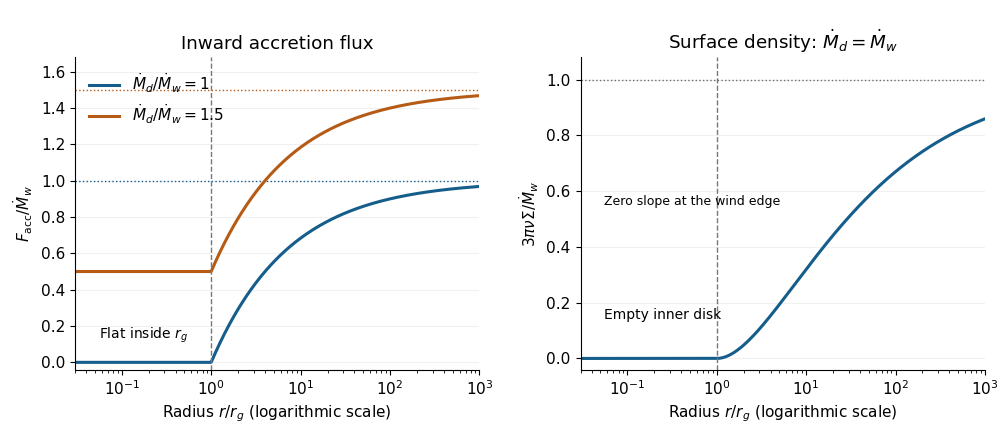
Steady photoevaporating-disk inward mass flux and the surface density when feeding balances wind loss
. Details. 
The analytic profiles describe the region interior to a distant feeding boundary. A finite outer radius and the disk outside the feeding point need additional boundary conditions. For example, if the wind is truncated at and , the exact interior formulas above replace by ; the total wind inside is . The displayed profiles are their remote-boundary limit. Extending the prescribed wind to infinity is useful for estimating mass loss but is not a complete global angular-momentum boundary condition for a finite feeding radius.
As the viscous supply decreases towards the wind rate, the inner accretion flux approaches zero. Wind removal near can cut off replenishment of the inner disk, which then drains on its own viscous timescale, leaving a gap or inner hole. This is photoevaporative gap opening. If supply falls below wind loss, the formal steady profile would require negative inner density and is unphysical; time-dependent depletion must replace it. The exposed outer edge may then be removed rapidly. Equality of the two rates indicates the onset of rapid clearing, rather than a negative steady surface density.
Articles by others on the same topic
There are currently no matching articles.