The circular Keplerian orbit has speed . Equating it with the heated gas sound speed givesThis is the photoevaporative gravitational radius, where thermal and orbital binding energies have the same order of magnitude. A circular orbit has specific mechanical energy . Heating adds thermal energy and, in a fluid outflow, available specific enthalpy of order . For example, if is the adiabatic sound speed, an ordinary ideal gas has enthalpy ; for this is . At , this more than compensates the circular-orbit binding energy. Equivalently the hot hydrostatic scale height satisfies , so a thin bound surface layer cannot be maintained. With continued irradiation, the gas can expand into a thermal wind: photoevaporation removes disk material.
The condition is a thermal binding scale, rather than an assertion that the sound speed equals the ballistic escape speed, which is . Detailed wind launching can change the numerical critical radius by factors of order unity. Using exactly the supplied numerical estimates, , and therefore
The wind removes of mass per unit time from an annulus; is already the surface-density loss term in the supplied mass conservation equation, so there is no additional two-face factor. Integrating the photoevaporation profile givesThe convergence at infinity is important: the loss is concentrated near the photoevaporative gravitational radius. Using yields , or about . The initial disk mass is , so the wind-only depletion time isThis estimate treats the heated area and wind normalization as fixed and neglects additional removal through stellar accretion. Once the disk shrinks, its wind rate and geometry need not remain constant.
Positive denotes inward flow. In steady state, mass conservation gives . In the remote-feeding approximation, take the incoming flux at large radius inside the feeding region to approach . The cumulative loss exterior to is , so the steady photoevaporating-disk mass flux isIt is constant inside , continuous at , and increases outwards towards . Its right derivative is positive and decreases as . The curve has a change of slope at because the wind turns on there. Physically less mass survives to cross successively smaller radii, while the inner disk has no wind sink. The star accretes at .
For constant kinematic viscosity , set . The supplied viscous evolution of an accretion disk relation becomes . The viscous torque in an accretion disk is proportional to , so the zero-stress condition at the idealized origin sets . ThusFor the integral is . For , separating the two intervals givesConsequently the surface density of a steady photoevaporating disk isBoth the density and its first derivative match at . Let and take the special case . Then throughout the inner disk, while outsideThe profile leaves zero with zero slope at , rising as locally, and approaches from below at large radius. The requested sketches are:
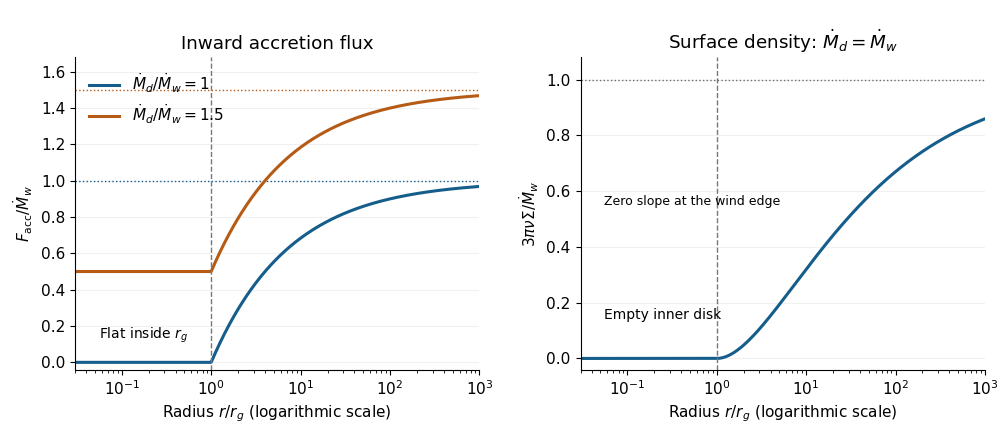
Steady photoevaporating-disk inward mass flux and the surface density when feeding balances wind loss
. Details. 
The analytic profiles describe the region interior to a distant feeding boundary. A finite outer radius and the disk outside the feeding point need additional boundary conditions. For example, if the wind is truncated at and , the exact interior formulas above replace by ; the total wind inside is . The displayed profiles are their remote-boundary limit. Extending the prescribed wind to infinity is useful for estimating mass loss but is not a complete global angular-momentum boundary condition for a finite feeding radius.
As the viscous supply decreases towards the wind rate, the inner accretion flux approaches zero. Wind removal near can cut off replenishment of the inner disk, which then drains on its own viscous timescale, leaving a gap or inner hole. This is photoevaporative gap opening. If supply falls below wind loss, the formal steady profile would require negative inner density and is unphysical; time-dependent depletion must replace it. The exposed outer edge may then be removed rapidly. Equality of the two rates indicates the onset of rapid clearing, rather than a negative steady surface density.
Write the perturbation velocity as , the density amplitude as , and . Axisymmetry removes advection by the background azimuthal flow, but the radial perturbation advects the Keplerian shear: . Combining this with the Coriolis force gives the linearized shearing sheet equationsThe razor-thin disk Poisson kernel supplies the self-gravity term. The coefficient, rather than , is essential: it includes the perturbed advection of the background velocity.
Put and . The determinant of the three amplitude equations isExpanding it gives the dust gravitational dispersion relation with gas dragUsing a determinant avoids division by and retains the neutral/secular branch. The radial epicyclic frequency of this Keplerian shearing sheet is , so the three terms in represent rotational support, self-gravity and dust pressure.
Without gas drag, the dispersion relation factorizes as . There is a neutral branch and two density-wave branches. If , the waves have ; if , one root is and the dust layer is gravitationally unstable.
For , complete the square in the wavenumber magnitude:The minimum occurs at . Thus the Toomre stability criterion isAt the minimizing mode is marginal. For there is no growing axisymmetric wave in this razor-thin, pressure-supported, drag-free model. The unstable band for isIn a finite layer, this band must contain an admissible mode; the continuum statement assumes an adequately large domain.
For fixed and weak gas drag, expand a wave root as with . At order , the dispersion relation yieldsSince , this reduces to . The weak-drag dust density waves therefore haveThe first-order real part is negative: the two density waves are weakly damped, with their frequencies unchanged to first order. Gas drag removes their perturbation energy relative to the fixed gas flow. The expansion is an asymptotic result at fixed positive ; it is not uniform close to , where the nominal damping can become comparable to the oscillation frequency and a different scaling is needed.
The branch originating at has . Keeping first-order terms in the cubic dispersion relation gives . Hence the weak-drag secular gravitational growth rate isCarrying forward the positive- regime of the preceding part, this mode grows when . This specifies the scope of the source's abbreviated condition. If , the small root written here is instead damped, while the separate dynamical branch already grows; the dust is still unstable, but growth is not identified with this particular small-root continuation. The expansion also fails at .
At sufficiently small nonzero , is positive and just below , sinceTherefore an infinite dust layer with nonzero self-gravity and nonzero drag has a long-wavelength secular gravitational instability of an astrophysical disk, even when . Its small- growth rate tends to , and vanishes at ; the uniform-density mode itself is neutral. Drag transfers perturbation angular momentum to the gas, weakening rotational support while self-gravity exceeds pressure on long wavelengths.
The instability is not limited to weak drag as an existence statement. For any , the cubic has and on the positive real axis. Thus it has a positive real root whenever . This exact positive-root criterion for dust self-gravity with drag distinguishes the growth criterion from the approximation used to compute its slow rate.
The secular gravitational instability needs . A finite radial extent removes arbitrarily small wavenumbers; the smallest available one is , where is a boundary-dependent constant of order unity. With and the dust Toomre parameter,Thus the finite-size secular gravitational criterion is at the rough accuracy requested. For example, a periodic radial interval has and gives in this idealized model. The numerical prefactor is not universal, but the scaling is. Finite size therefore restores a practical threshold for the otherwise long-wavelength instability. Growth must additionally occur within the disk lifetime, and a global wavelength comparable to disk radius lies beyond the strictly local shearing sheet approximation.
Turbulence usually makes the onset of dust gravitational instability of an astrophysical disk harder in three complementary ways. It increases the dust random velocity dispersion, raising and the Toomre parameter; it stirs dust vertically, reducing the self-gravity enhancement of a razor-thin disk; and it mixes density enhancements through turbulent diffusion. The last effect is particularly important for a slowly growing secular gravitational instability, which can be erased before it amplifies appreciably.
A simple diffusion model adds to the dust continuity equation, giving a damping scale of order . Growth then has to compete with mixing as well as pressure and rotational support. In the long-wavelength weak-drag regime where , the indicative competition iswith further pressure and finite-thickness corrections. This is a model-dependent long-wave estimate, not a substitution into the original cubic without changing its continuity equation. In an infinite domain, diffusion proportional to need not remove growth proportional to at every arbitrarily long wavelength; in a finite disk, the remaining wavelengths and their growth times may be inadequate. The conclusion is therefore a higher practical collapse threshold and slower growth, rather than guaranteed stability for all turbulent flows.
Turbulence can also concentrate dust through coherent structures or pressure maxima, increasing local surface density and encouraging collapse. Its net quantitative effect requires a model for stirring, diffusion, thickness and concentration. The deterministic fixed gas flow used in the preceding parts does not specify those statistics. This competition is turbulent mixing of a secularly unstable dust layer.
Write the horizontal velocity amplitudes as and magnetic amplitudes as . The perturbation is horizontally uniform, divergence-free, and has no vertical velocity, so the unperturbed density and pressure are consistent at linear order. In the Keplerian shearing sheet, the horizontal components of the linearized ideal magnetohydrodynamic equations areUse the undivided equations at a zero of . If , the magnetic-force coefficient becomes ; the stratification cancels. The ideal magnetohydrodynamic induction equation similarly reduces toThe azimuthal induction term is field stretching by the background differential rotation. The four amplitudes obey the homogeneous systemIts determinant must vanish for a nonzero normal mode. Put . For nonzero , elimination first gives and , whose solvability condition is . The original determinant extends the same polynomial to marginal . ThusThis is the ideal magnetorotational dispersion relation with the midplane Alfvén speed . The vertical structure enters through the admissible eigenvalues , rather than through a different horizontal dispersion polynomial. No division by a vanishing growth rate is required in the determinant derivation.
Set , so and . The vertical equation becomesFor , division by the common factor gives the Legendre differential equation with eigenvalue . Requiring boundedness at both surfaces selectsThe second independent solution is unbounded at an endpoint. These are the bounded vertical modes of a sech-squared magnetized disk. The division by is outside the square root, as in the original PDF; the converted TeX places it incorrectly. The magnetic perturbation involves , which tends to zero at either surface.
The constant function has . The specified magnetic ansatz contains and must not be applied to it. A uniform horizontal velocity with no magnetic perturbation is an epicyclic motion, not a growing magnetic mode; the zero-wavenumber formal degeneracy does not provide growing MRI at arbitrary field strength. Nontrivial magnetically coupled vertical modes have .
For , the magnetorotational instability grows when . Indeed, the quadratic in then has a negative constant term, and one positive root. For , the two roots are nonpositive, since their sum is negative, their product nonnegative, and their discriminant is . The smallest nonzero vertical eigenvalue is , so all vertical modes are stable ifThe strict inequality requested gives stability, and equality is marginal for . A sufficiently strong field increases magnetic tension. The unstable MRI needs a sufficiently long vertical wavelength to exchange angular momentum without excessive restoring tension; bounded vertical structure imposes a smallest nonzero effective wavenumber. Beyond the finite-thickness magnetorotational instability criterion, no allowed magnetic mode is long enough to remain unstable.
Let . The growing root of the ideal magnetorotational dispersion relation isIts derivative is , so the continuum maximum occurs at , with . For the bounded vertical modes of a sech-squared magnetized disk,Modes are unstable; have . The function increases up to and decreases thereafter, so the only candidates for the discrete maximum are , with , and , with . Their values are and . HenceThe associated velocity profile is . Discrete vertical quantization makes its growth slightly smaller than the continuum maximum. This is the fastest discrete mode of a stratified magnetorotational instability.
Articles by others on the same topic
There are currently no matching articles.