Let be the manager's utility function as a function of nonnegative terminal fund wealth. WriteThenBoth pieces are increasing and strictly concave functions. However, the derivative jumps upward from to at . The payoff utility is increasing but not concave. A concave function must have nonincreasing one-sided slopes.
For concavification of incentive utility, the common tangent for exponential incentive utility replaces the upward kink by its common tangent. There are contact points and a common slope satisfyingSince and , the chord condition gives . Solving the derivative matching yields the contact pointsThe assumption that is large enough means, explicitly, thatso . The inequalities follow from and for .
The least concave majorant on isIt is increasing and concave: the derivative is decreasing outside the interval and equals inside. The tangent line lies above each original branch. Any concave majorant must lie above the chord joining the two contacts, so this one is the least.
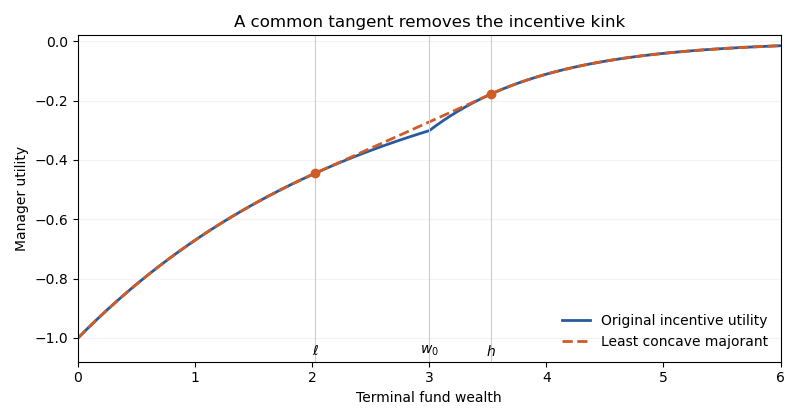

The state-price budget constraint now reduces the problem to pointwise maximization of , where and is chosen so that . Because is finite, the nonnegative wealth constraint must be included. The optimal terminal wealth isAt , any point of maximizes the concavified objective. If , the state-price density has a continuous log-normal distribution, so this event has probability zero. The optimizer then avoids almost surely and satisfies . The supporting-line proof from part (i), with supergradients at the contacts, proves optimality for the concavified problem; the pointwise equality proves the same optimizer and value solve the original manager's problem. Nonnegative replication is available in the complete market.
If , the state-price density is deterministic. If the required deterministic mean terminal wealth lies in the linear segment, randomize between and at the common slope instead of choosing an interior wealth. This maintains the budget and attains the same concavified value. The Brownian market can replicate that bounded lottery even when its market price of risk is zero.
In the special case , and the fund has a fair-game wealth process. Since , the manager uses fair-game gambling induced by an incentive fee:For example choose a threshold event in with the displayed probability and replicate its payoff. Then remains between and , so the strategy respects nonnegative wealth. It earns no risk premium but raises expected incentive utility function above the value at the unrandomized , because the common tangent lies strictly above the kink.
Articles by others on the same topic
There are currently no matching articles.