The initial table of content was limited to the first level because it is larger than 1000 articles. There are 2186 articles in total. Expand a branch to load its children.
A Noetherian ring is a ring whose ideals satisfy the ascending chain condition; equivalently every ideal is finitely generated. For the surjective ring endomorphism, put . The ascending chain of ideals stabilizes, say . If , surjectivity of gives with . Then , so and . The endomorphism is therefore injective, hence a ring automorphism.
The nilradical is the idealFor example, if , the binomial expansion gives ; multiplication by any ring element also preserves nilpotence. Every prime ideal contains each nilpotent element, since implies . Conversely, if is not nilpotent, the multiplicative subset avoids . By Zorn's lemma, choose an ideal maximal among those disjoint from this subset. It is a prime ideal: if but neither factor is in , then and both meet the subset, and multiplying their two witnesses puts a power of in , a contradiction. This prime ideal excludes . HenceFor the zero ring the empty intersection is the whole ring, as required.
Here is a finite prime-intersection representation of a radical argument that does not assume the result. In a Noetherian ring, suppose some ideal has ideal radical not expressible as a finite intersection of prime ideals, and choose such a maximal by the ascending chain condition. It is proper and cannot be prime. Choose with . The two larger ideals and have finite prime-intersection radicals, andIndeed, if and , then . This contradicts the choice of . Applying the result to proves that is the intersection of finitely many prime ideals. Empty intersections handle the unit ideal.
For reducedness of a formal power series ring, the inclusion of constants gives one implication: a nonzero nilpotent element of remains nonzero and nilpotent in . For the other, let be a reduced ring and take a nonzero formal power series with . The coefficient of in is , because is reduced. Thus is not nilpotent. ThereforeNo Noetherian ring hypothesis is needed for this argument.
For a nilradical that is not nilpotent, takeEvery element of this ideal uses finitely many variables and is nilpotent: an element using variables lies in an ideal whose st power is zero. The quotient by this ideal is the field , so it is exactly the nilradical. Nevertheless for every , because the square-free monomials form a vector space basis. Thus for all .
For each , and each , choose , using incomparability. PutThen belongs to the other two prime ideals and does not belong to , by primality. In particular each lies in the union. But for every : modulo , the sum equals . The union is not closed under addition and is not an ideal. This is a concrete instance of prime avoidance.
The union of three incomparable nonprime ideals example can retain pairwise incomparability. In the ringtakeThese distinct two-element ideals are pairwise incomparable, yetwhich is an ideal. None is prime: its quotient ring still contains a nonzero element of square zero. The three one-dimensional vector subspaces cover the two-dimensional vector space over .
Use the convention that a multiplicative subset contains and is closed under multiplication. Usually is excluded; allowing it gives the harmless zero-ring localization. A prime ideal disjoint from is mapped toin the localization of a ring. This ideal is proper, andis an integral domain, since the denominators are nonzero in the integral domain . Thus is a prime ideal.
Conversely, for a prime ideal in , its contractionis a prime ideal disjoint from : each is a unit and cannot belong to a proper ideal. Membership in is equivalent to numerator membership in , since . Hence .
To check the other composite, implies for some , by the equality criterion for fractions in a localization of a ring. Since , primality gives . Therefore extension and contraction are mutually inverse:If , both sets are empty. This is the prime ideal correspondence for localization.
Suppose is a saturated multiplicative subset, and take . The principal ideal is disjoint from : otherwise would force . The prime ideal avoiding a multiplicative subset argument from Question 1 extends to a prime ideal disjoint from . Thus every point of the complement belongs to such a prime ideal, andIf , this is the empty union.
Conversely suppose is a union of prime ideals. If and , some prime ideal in that union contains , and hence , a contradiction. The same holds for . Thus The saturated complement as a union of prime ideals characterization holds.
For units with no finite prime-union complement, takeProducts of units are units, and a product is a unit only if both factors are units, so is a saturated multiplicative subset. Every nonunit integer lies in some with a positive prime, giving . If finitely many prime ideals sufficed, discard any and write the others as . A prime outside this finite list belongs to none of them but is a nonunit, a contradiction. There is always such an : a prime divisor of is outside the list.
An integral extension means every satisfies a monic polynomialTo prove the Lying-over theorem, localize at . The injection remains injective, and is integral over : a monic relation for divided by suitable powers of gives one for . This is a nonzero ring, so choose a maximal ideal of it.
The contraction of to is maximal. To see this directly, a field integral over a subring forces that subring to be a field. For nonzero in the subring, is integral; multiply its monic equation of degree by to express as a polynomial in with coefficients in the subring. Apply this to the integral extensionSince is a local ring with unique maximal ideal , we obtain .
The key is a Laurent normalization by a monomial change of variables. We prove the slightly stronger assertion that every nonzero quotient of a Laurent polynomial ring in variables is finite as a module over an embedded Laurent polynomial ring in some number of variables.
Induct on . If the defining ideal is zero, the ring itself works. Otherwise choose a nonzero Laurent polynomialin that ideal, with nonzero coefficients. For a sufficiently large positive integer , the weightsare distinct for all . Indeed, each difference gives a nonzero polynomial in , which has only finitely many integer roots. Make the invertible monomial substitutionIts inverse is , so it is an automorphism of the Laurent polynomial ring. When there is no substitution and distinct exponents already give distinct weights.
As a Laurent polynomial in , the transformed relation has unique lowest and highest exponents. Their coefficients are nonzero scalar multiples of monomials in , hence units inMultiplying by a power of and the inverse leading coefficient givesHere : a single-term Laurent polynomial would be a unit and the quotient would be zero. Reversing the equation and dividing by gives a monic equation for . Thus both and are integral over the image of in . In fact being a unit also expresses as a polynomial in , so is generated as a -module by .
The ring is itself a nonzero quotient of an -variable Laurent polynomial ring. By induction, it is finite over an embedded Laurent polynomial ring in variables. Finiteness of modules is transitive, so the same is true of ; a finite ring extension is an integral extension, by the determinant trick applied to multiplication by an element.
Applying this to yields an embedded subringThe base case means the subring ; finiteness over it would make a finite-dimensional vector space. The hypothesis excludes this, so , as required. No infinitude assumption on is used.
The height of a prime ideal is the supremum of the lengths of strict chains of prime ideals ending at :The last equality follows from the prime ideal correspondence for localization. Here is a length-growth proof of the Krull height theorem that makes the bound explicit.
We first establish a prime-chain lower bound for local length. For a Noetherian local ring admitting a prime chain of length , put . Thenfor some . For , use . For , quotient by the first prime ideal of the chain; this only decreases and reduces us to a local integral domain withTake and put . It has a prime chain of length , so induction bounds below by a positive multiple of .
The Artin-Rees lemma applied to gives, for a fixed integer ,Because is a non-zero-divisor, the first term in the exact sequencehas length at least . HenceIterate this inequality about times, while its arguments remain at least . This gives the desired positive multiple of . The particular Artin-Rees lemma inclusion used here follows directly from finite generation: the Rees algebra is Noetherian, by the Hilbert basis theorem, and its graded submodule has finitely many homogeneous generators. A bound on their degrees gives .
Now localize at the given minimal prime ideal . Write , , and . The only prime ideal of containing is , so . Since is finitely generated, some . Thus has finite module length, say . The ideal is generated by at most elements.
For , products of these generators give a surjection from copies of onto . Summing the lengths gives the generator bound for primary-ideal lengthSince , we have , and thereforeThe prime-chain lower bound for local length now excludes any chain of length greater than . ConsequentlyFor , minimality over the zero ideal says that is a minimal prime ideal, so its height is zero. This also handles that boundary case.
A local ring is a nonzero ring with one maximal ideal . Write for its residue field. Its Krull dimension is the supremum of lengths of strict chains of prime ideals; in a local ring chains may be extended to end at .
For the local Hilbert-function convention, define the Hilbert–Samuel growth dimensionEquivalently it is the order of the pole at of the Hilbert series of the associated graded ringThis finite standard graded -algebra is generated by . The Hilbert-Serre theorem makes the cumulative Hilbert function eventually polynomial, which establishes the definition. For an Artinian local ring, the polynomial is constant and nonzero, so .
For every prime chain of length , the prime-chain lower bound for local length proved in Question 4 gives . A polynomial of degree cannot satisfy this when . Thus the requested inequality isFor clarity, the embedding dimension is the different invariantThe equality follows from the Nakayama lemma. Applying Question 4 to gives , while the polynomial-algebra surjection below also gives . In particular, growth dimension and embedding dimension should be kept distinct.
A regular local ring is a Noetherian local ring with . Let this common value be and choose a minimal generating set of . The initial forms give a surjective graded ring homomorphismFor , the Nakayama lemma gives , so is a field. Assume . If the kernel contained a nonzero homogeneous polynomial of degree , the cumulative Hilbert function of the target would be bounded by that of . Multiplication by is injective in the polynomial integral domain, so this bound isBut provides a prime chain of length , and Question 4 gives . This is a contradiction. Hence the associated graded ring of a regular local ring isan integral domain.
Finally the Krull intersection theorem gives . One can see the needed separatedness directly: for the finitely generated ideal , the Artin-Rees lemma gives , and the Nakayama lemma gives . Therefore each nonzero has finite -adic order , with nonzero initial form in . For nonzero , their initial forms have nonzero product in the graded integral domain. It follows that , and indeed its order is the sum of their orders. Thus is an integral domain.
For , write for multiplication by in . The algebraic differential operator ring is defined by the filtrationThe order of an algebraic differential operator is the least for which ; the zero operator may be assigned order . In degree zero, commuting with all multiplication maps means , so . The commutator identity proves by induction that , so the union is a ring under addition and composition.
The derivations of an algebra formEvery such derivation has and , so has differential order at most one. Conversely, if , set and . Then and is a multiplication map. Evaluating at shows it is ; evaluating at gives the Leibniz rule. Hence the first-order algebraic differential operator decomposition isIt is a direct sum as -vector spaces: a multiplication map that is a derivation vanishes at , and is zero.
The complex Weyl algebra has generators and relationsTake . If a nonzero unital module had finite dimension of a vector space over , its representing matrices would satisfy . Taking the matrix trace gives , impossible in characteristic zero. The Weyl algebra has no nonzero finite-dimensional modules. For the algebra is and this assertion has the obvious exception.
For a nonzero finitely generated Weyl algebra module, use the Bernstein filtrationThe ordered monomials form a vector space basis, soTo justify the ordered basis, the relations move all to the right and give spanning. Independence follows in the action on : apply a putative zero operator coefficientwise to the formal exponential , obtaining . Thus every coefficient vanishes.
Choose a finite-dimensional nonzero generating subspace and set . The associated graded module is finitely generated over the polynomial associated graded ring, so the Hilbert-Serre theorem implies is eventually a polynomial. DefineThis Bernstein growth dimension of a Weyl algebra module equals the Gelfand–Kirillov dimension of a module, not its ordinary vector-space dimension. If a different finite generating subspace is used, each lies in some fixed filtration step of the other. The corresponding are sandwiched between shifted filtrations, so the degree is unchanged.
We prove Bernstein inequality for Weyl algebra modules using an injectivity estimate. The faithful finite-step action of a Weyl algebra claim is that the mapis injective for every . Induct on . For , a scalar annihilating is zero. Suppose annihilates . For any generator or , the commutator belongs to and annihilates : both and vanish. The induction hypothesis gives for every generator. In the ordered basis,In characteristic zero these identities force to be a scalar. Since it annihilates , it is zero. This proves injectivity.
ConsequentlyThe left side grows as a positive constant times ; the right side has growth degree . Comparing powers provesThe polynomial module , with the usual multiplication and differentiation actions, has , showing the bound is sharp.
A nilpotent endomorphism satisfies for some positive integer . A nilpotent Lie algebra has a terminating lower central series of a Lie algebra: with and , one has for some . These are different conditions: the first concerns a particular linear map, whereas the second concerns repeated Lie brackets.
The representation form of Engel theorem says that if a finite-dimensional Lie subalgebra consists entirely of nilpotent endomorphisms, with , then contains a nonzero vector annihilated by every element of . Consequently there is a basis in which every element of is strictly upper triangular. No assumption on the characteristic of a field or algebraic closure is required.
We prove the common-vector assertion by induction on , simultaneously for every nonzero finite-dimensional representation space. The zero algebra is immediate. First, nilpotence of commutation by a nilpotent endomorphism follows fromIf , the right-hand side vanishes for , in every characteristic of a field. For any proper Lie subalgebra , its Adjoint representation on therefore consists of nilpotent endomorphisms. Its image has dimension at most , so the inductive assertion gives a nonzero class annihilated by . Equivalently and . Thus the Engel normalizer lemma gives .
Choose a maximal proper Lie subalgebra . Its normalizer of a Lie subalgebra must be all of , so is an ideal of a Lie algebra. Moreover has dimension one: otherwise a one-dimensional Lie subalgebra of this quotient would have a proper inverse image strictly between and . By induction the space is nonzero. It is invariant under , since . Write . The restriction of the nilpotent endomorphism to has a nonzero kernel, and any vector in that kernel is annihilated by all of . This completes the induction. Apply the assertion repeatedly to to obtain a complete invariant flag with . A basis adapted to that flag makes every matrix strictly upper triangular.
A nilpotent abstract Lie algebra need not act by nilpotent matrices. For , the scalar algebra is an abelian Lie algebra, hence a nilpotent Lie algebra, but . No change of basis makes strictly upper triangular. The failed implication is precisely the distinction described in nilpotent Lie algebras need not act nilpotently.
If is a nilpotent Lie algebra, then , so every is a nilpotent endomorphism. Conversely, apply Engel theorem to acting on . Its invariant flag is lowered by every Adjoint representation matrix, so every product of such matrices vanishes. Since is spanned by expressions , the lower central series of a Lie algebra terminates. ThereforeFinally suppose is an algebraically closed field. If some is not a nilpotent endomorphism, it has a nonzero eigenvalue and an eigenvector , giving . The vectors are linearly independent and span a nonabelian two-dimensional Lie subalgebra. Conversely, a Lie subalgebra of a nilpotent Lie algebra is nilpotent because its lower central series of a Lie algebra lies termwise in the ambient series. A nonabelian two-dimensional Lie algebra has a basis with : choose spanning the nonzero derived algebra and rescale a complementary vector. Its Adjoint representation has the nonzero eigenvalue , so it is not nilpotent. This proves the two-dimensional subalgebra criterion for Lie algebra nilpotence:
Use the sl2 Lie algebra relations , and . A highest-weight vector satisfies and , and . For , . Assuming the formula at , one getsThus the sl2 highest-weight lowering formula isIn particular a finite-dimensional Irreducible Lie algebra representation has highest weight and weight vectors , as in the classification of finite-dimensional sl2 representations.
Let be a finite-dimensional Irreducible Lie algebra representation of a complex semisimple Lie algebra, with highest weight . Write , taking it to be zero when is not a weight, and let be the half-sum of positive roots. The Killing form induces an inner product on the real span of weights. Freudenthal multiplicity formula statesThe sums are finite. For a weight , the coefficient on the left is positive: move into the dominant Weyl chamber, use that a weight is below in dominance order, and note that does not increase on moving back out of that chamber. The resulting recursion starts from .
Here is a proof using the allowed Casimir operator. Choose root vectors for positive and negative roots, normalized by , and let satisfy . Invariance of a bilinear form on a Lie algebra gives . If are dual bases of the Cartan subalgebra under , the Casimir operator isOn the weight space of , the first sum acts by . Replacing with givesDefine . The cyclic trace identity between adjacent weight spaces and the commutator relation yieldIterate upwards until the weight spaces vanish to obtain . Finally take the trace of the displayed restriction of . Its Casimir eigenvalue is , so subtracting proves the formula. This trace argument handles weight multiplicities greater than one without choosing a separate sl2 Lie algebra string through each vector.
Work over . Decompose as the direct sum of the generalized eigenspaces of . Define to be on and set . Then is a diagonalisable endomorphism, is a nilpotent endomorphism, and they commute. For uniqueness, any commuting decomposition has and commuting with , hence preserving each . Decompose further into eigenspaces of . On a nonzero such space with eigenvalue , the operator has only the eigenvalue , so . Since is diagonalizable, throughout . Thus and . This is the Additive Jordan decomposition.
The Chinese remainder theorem for the pairwise coprime polynomials also gives a polynomial with , where is the largest Jordan block size. Consequently and . This polynomial description shows that both parts preserve every -invariant subspace.
On the operator is the scalar , so it is diagonalizable. The nilpotence of commutation by a nilpotent endomorphism makes nilpotent. They commute, since . Uniqueness of the Additive Jordan decomposition therefore gives the adjoint compatibility of additive Jordan decomposition:Now let be a complex semisimple Lie algebra and . Since the semisimple part of is a polynomial in , it preserves . Thus . By the Weyl complete reducibility theorem, the Adjoint representation of on has a decomposition into invariant subspaces. Write with and . For , the vector lies in , and invariance of puts it in as well. Hence .
Decompose into Irreducible Lie algebra representations. Each is preserved by and by , hence by . The Schur lemma makes . A semisimple Lie algebra is a perfect Lie algebra, so every representing element of has zero trace on every . Also , because is nilpotent there. It follows that . In characteristic zero, , so . Therefore and . This proves that semisimple matrix Lie algebras are closed under additive Jordan decomposition, including representations with repeated isomorphic irreducible summands.
Take the Lie subalgebra of all upper-triangular matrices. It is a solvable Lie algebra with a nonzero abelian ideal of a Lie algebra, hence is not a semisimple Lie algebra. For every , the polynomial description in the Additive Jordan decomposition keeps upper triangular; then is upper triangular too. Thus the upper-triangular matrix algebra is closed under Additive Jordan decomposition despite being nonsemisimple. A diagonal matrix algebra gives an even simpler abelian Lie algebra example.
Let and . This one-dimensional abelian Lie algebra is not a semisimple Lie algebra. For , its Additive Jordan decomposition is and . Neither belongs to : comparing diagonal entries and then the upper-right entry rules out both scalar multiples. Therefore nonsemisimple matrix Lie subalgebras need not be closed under Additive Jordan decomposition.
Define the exterior square over the arbitrary field by . Write the image of as . Then and ; the basis is with , in characteristic two as well. The exterior-power Lie algebra representation isThe tensor product of Lie algebra representations descends to this quotient: is a linear combination of square tensors, namely . On the wedge basis its coefficients follow directly from the original representing matrices. Expanding both actions shows .
The inclusions of and into their direct sum define the mapA combined basis shows that this sends a basis to the pure-, pure- and mixed wedge basis vectors, with no overlap and no omission. The defining action on each wedge proves equivariance. Hence the exterior square of a direct sum givesNo division by is involved, so the proof remains valid in characteristic two.
For the complex special linear Lie algebra , write for the irreducible highest-weight representation with Dynkin labels , and . First the sl3 decomposition of the symmetric-square dual tensor product isIndeed contraction is a surjective Lie algebra representation homomorphism onto . Its 15-dimensional kernel contains the highest-weight vector of weight . The Weyl dimension formula gives , and the Weyl complete reducibility theorem identifies the kernel and splits the map. With , the direct-sum identity reduces the requested calculation to , and .
For completeness, these decompositions can be checked entirely by formal characters. Let , , and . Then . The Weyl character formula takes the determinant formSubstitute into and collect the determinant characters. This gives the exterior square of the sl3 representation of highest weight (2,1) and the sl3 highest-weight tensor rule:The first line has dimensions ; the tensor product has dimension . Equivalently, enumerate weights with the sl3 interlacing character formula and subtract characters from the highest weight downwards. FinallyIts dimension is . The exterior square here is taken of the entire 18-dimensional tensor product; taking it only of would be a different representation.
For a complex semisimple Lie algebra , a Cartan subalgebra is a maximal abelian subalgebra consisting of elements whose Adjoint representation matrices are diagonalizable. Equivalently it is a nilpotent self-normalizing Lie subalgebra. The root-space decomposition iswhere the roots are the nonzero weights of that Adjoint representation.
We use these properties of the Killing form : it is nondegenerate on and on , it is invariant, distinct root spaces are orthogonal unless their roots sum to zero, and pairs nondegenerately with . Define by , and choose , with . Since weights add, , and invariance givesThe nonisotropic root lemma shows . Here is its short proof: if this number were zero, the span of would be a solvable Lie algebra with central. Apply the Lie theorem to its action on . The commutator would be strictly upper triangular and hence nilpotent. But makes it diagonalizable. It would therefore be zero, putting in the zero center of a Lie algebra of , contrary to its definition. SetThenso their span is the sl2 subalgebra associated with a root.
The abstract reduced crystallographic root system axioms are as follows. In a finite-dimensional real inner product space , the set is finite, consists of nonzero vectors and spans ; for every , one has ; the root reflection preserves ; and is an integer for every pair of roots. We verify the positive-definite real form as well as these axioms, rather than assuming the complex Killing form is already positive.
First is finite and has no zero element by its definition. The roots span over : any annihilated by all roots commutes with the whole root-space decomposition and is central, hence zero. Therefore the , and also the , span over . For every root , the classification of finite-dimensional sl2 representations applied to the Adjoint representation of the root subalgebra gives . Put . Every root takes real values on this space, andThe strict inequality follows because the roots span . This also shows that the complexification of injects into : an equality with real would contradict positivity of and . Since its complex span is all of , it is a real form. Moreover , so is a real scalar multiple of . The dual inner product thus makes a Euclidean space, as in the Euclidean subspace of a Cartan subalgebra.
To prove reducedness without assuming it, consider the root-subalgebra modulewith absent root spaces understood to be zero. Its weights are even, so every nontrivial Irreducible Lie algebra representation in it has even positive highest weight and one-dimensional weight-zero space. The action of on its weight-zero space has image exactly , of dimension one. Therefore there is precisely one nontrivial irreducible summand, the already embedded adjoint module of highest weight . Thus and . If is any root on the same real line, the integral numbers and have product . Hence is one of ; the half and double cases are excluded by applying the preceding argument to the appropriate root. This proves the root-space reducedness lemma and .
For a root not parallel to , the sum of root spaces is stable under the root . Its integer weights are symmetric under sign in each irreducible summand. Therefore the weight also occurs, at the root . The Killing form normalization givesso this root is exactly . For the reflection just swaps the two roots. This proves reflection invariance and the Cartan integer condition. All axioms of the reduced crystallographic root system have now been verified.
A real Lie group is a finite-dimensional real smooth manifold with a group structure whose multiplication and inversion are smooth. Its tangent space at the identity element is the vector space of velocities of smooth curves through . For the general linear group it identifies with . The matrix exponential and local matrix logarithm areThe exponential is globally defined, and each matrix is invertible with inverse . The logarithm here is a local map near ; it is not a globally defined inverse on every real invertible matrix. The differential of at zero is the identity, and the two power series are inverse locally.
For a general , the assumed Exponential map of a Lie group with has a smooth local inverse by the inverse function theorem, giving a local exponential chart. Define the Lie bracket from local group commutators byFor small the group commutator lies in that chart. More explicitly, the map is smooth and has . Its mixed second differential at is a bilinear map of , proving bilinearity. Swapping the two group elements inverts the commutator, and near . Thus and . In the matrix group, expansion to the mixed term gives the familiar commutator .
For , let and define the Adjoint representation of a Lie group by . It is smooth and satisfies . Its derived representation is . Naturality of the Exponential map of a Lie group under conjugation givesAt , the derivative of the logarithm of the commutator is : the derivative of multiplication at adds tangent vectors, and . Differentiate in to concludeTo prove the Jacobi identity without assuming it in the bracket construction, first establish that the differential of a Lie group homomorphism preserves Lie brackets. For a homomorphism , the allowed exponential identity gives locally. Apply this identity to the group commutator and take the mixed derivative to obtain . In particular givesApplying both sides to yields . Rearranging with antisymmetry provesNeither injectivity of nor the existence of a global logarithm was used.
Finally let be a normal Lie subgroup of , with its corresponding Lie algebra . For each , conjugation restricts to , so its differential preserves : . Differentiate along to get for every and . Thus the Lie algebra of a normal Lie subgroup is an ideal of a Lie algebra. The assertion concerns a subgroup carrying the corresponding Lie-subgroup structure, for example any closed subgroup; no arbitrary abstract subgroup is being assigned a tangent space.
A representation of a quiver assigns a -vector space to each vertex and a linear map to each arrow . Here and are its source and target. A quiver representation morphism is a family of linear maps such that every arrow square commutes:Composition and identities are defined vertex by vertex. A quiver representation morphism is an isomorphism precisely when every is invertible.
Use the following Jacobson radical facts for a unital algebra: a nilpotent ideal is contained in the Jacobson radical; under a surjective algebra homomorphism the image of the Jacobson radical is contained in the radical of the quotient; and a finite product of fields has zero Jacobson radical. For completeness, if and , then for every , and is invertible with inverse . The usual unit criterion for the Jacobson radical therefore gives . The quotient assumption gives . HenceThis is the nilpotent ideal with semisimple quotient radical criterion.
For the finite quiver under consideration, let be the arrow ideal of a path algebra, spanned by paths of positive length. If has vertices and no oriented cycle, a path cannot repeat a vertex, so . Meanwhile , with the constant paths giving the coordinate idempotents. The criterion just proved yields .
The condition on cycles is necessary. A quiver with one loop has path algebra , whose arrow ideal is . But : the maximal ideals , , have intersection zero, since the algebraically closed field is infinite and a nonzero polynomial has only finitely many roots. Thus the arrow ideal need not be the Jacobson radical when oriented cycles are present.
Rows in the following matrix index the source, columns the target, in the order . Solving the arrow-square equation for a quiver representation morphism givesIn particular, the nonzero morphisms between distinct representations are and , each a one-dimensional family of scalar multiples of the vertexwise inclusion or projection. A map is forced to vanish at the source by the identity arrow of ; similarly a map is forced to vanish at the target. Maps between and are zero. Each endomorphism ring is .
The extension complex of quiver representations for the one-arrow quiver isIts cokernel is . Substitution of the three representations givesHere the first argument is the quotient endpoint of a short exact sequence. Thus the only possible nonsplit endpoint pair is subobject , quotient . The sequenceis nonsplit, since is indecomposable. More explicitly, all extensions with these endpoints have a middle arrow : gives the split short exact sequence, while each gives a middle representation isomorphic to . With endpoint identifications fixed the extension classes form ; up to endpoint automorphisms all nonzero classes give this same nonsplit sequence. There are no other nonsplit sequences with the listed endpoints, including equal endpoints.
The path algebra is the -vector space with basis all directed paths, including the length-zero path at each vertex. Extend path composition bilinearly, declaring the product zero when the paths cannot be composed. We use the left-module convention: means first traverse , then ; for an arrow , .
The constant paths are mutually orthogonal idempotents. For any path ,Consequently, for the finite vertex set used here,It acts as an identity on every basis path, hence on the entire path algebra. Finiteness of the vertex set is what makes this a genuine element of the algebra; an infinite-vertex path algebra instead has finite vertex sums as local units.
There is one constant path and loop generators; every other path is a word in those loops. Distinct words are distinct basis paths, so there are no relations among the generators. Thereforethe free associative algebra on generators, with each loop sent to its corresponding generator. For this is ; for it is noncommutative. The quiver with one loop is the case of the quiver with r loops.
Number the source vertices and the sink , and write for the arrows. The only basis paths are . Using standard matrix units, defineThe relations , orthogonality of the vertex idempotents, and agree exactly with multiplication of these matrix units. The map is therefore an algebra homomorphism, and its images form a basis of the algebraThis is an explicit isomorphism of the path algebra of the subspace quiver with a -dimensional triangular matrix algebra.
First split off the kernel of each source-to-sink arrow. Each kernel contributes copies of the simple representation supported at that source. The remaining arrows are injective, so identify the three source spaces with subspaces of the sink space . We now give an elementary three-subspace decomposition.
Split off the common intersection : any projection onto it preserves all three subspaces. Next split off each pairwise intersection. For example, once the triple intersection has gone, is disjoint from ; a projection onto that kills preserves . This extracts blocks whose membership is exactly . Repeating for the other pairs leaves pairwise disjoint subspaces.
For each , choose a complement to in . A projection onto killing preserves the triple, so these complements split off as blocks of membership exactly . In the remaining triple, every lies in the sum of the other two and all pairwise intersections are zero. Thus the sum is , and both projections of onto are isomorphisms. Hence is the graph of an isomorphism . Choose a basis of and the basis of ; this graph decomposes into two-dimensional blocks with three distinct lines. A complement to in contributes sink-only simple blocks.
The complete list of indecomposable blocks is therefore:
Each of the first eleven blocks has endomorphism ring . For the exceptional indecomposable of the three-subspace quiver, an endomorphism of preserving the first two lines is diagonal; preserving the third makes its two diagonal entries equal. Its endomorphism ring is also , so all twelve are indecomposable. Their dimension vectors of quiver representations distinguish them. The decomposition argument proves completeness, and hence there are exactly isomorphism classes. No general classification theorem is needed.
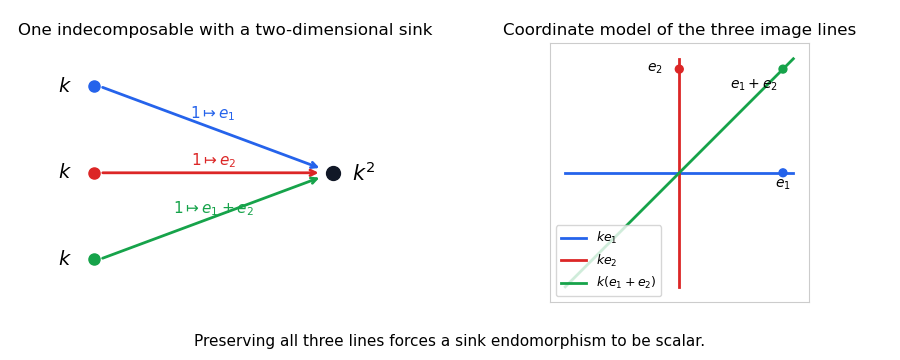
Exceptional three-subspace representation with a two-dimensional sink and three distinct image lines
. Details. 
Set , , and let be the action of the arrow on . Write , a left projective module. The standard projective resolution of a quiver representation isThe algebra acts on the first tensor factor. The augmentation is . On the summand for , the differential sends to in the -summand minus in the -summand. Here , so . These formulas specify every term and map, and .
Exactness is the standard path resolution fact: the relations identify a path acting on a vector with successively applying its arrows; uniqueness of the first traversed arrow supplies injectivity of the relation map. Each is a direct summand of because is an idempotent, and tensoring with a -vector space gives a direct sum of copies of . Both terms preceding are consequently projective modules. Thus the displayed sequence is a projective resolution of length at most one.
The same path resolution works for arbitrary left modules, with possibly infinite-dimensional and arbitrary direct sums of projective modules. Hence every left -module has projective dimension at most one. Equivalently, is a left hereditary ring: if with projective, dimension shifting gives for every , so is projective. This argument also covers quivers with oriented cycles.
For dimension vectors , define the Ringel formApply to the projective resolution. Evaluation at identifies with . Consequently there is an exact sequencewhereThis is the extension complex of quiver representations. Taking its alternating dimension sum yields
Let and . Consider the map from the arrow term of the extension complex of quiver representations to that restricts its -component to and then takes the quotient in . This map is surjective: a map can be lifted to and extended from to .
Every coboundary is killed by this map, since for ,It therefore induces a surjectionBoth vector spaces in the final Hom functor are nonzero, so its dimension is positive. Hence . This is the kernel-cokernel obstruction to splitting a quiver extension and remains valid for loops and repeated arrows elsewhere in the quiver.
If an arrow map failed to have maximal matrix rank, it would have both a nonzero kernel of a linear map and a nonzero cokernel. Apply the preceding obstruction with . It would give , contrary to the assumption. Therefore every arrow map is injective or surjective, equivalently its rank is the minimum of the two vertex dimensions. This is a necessary property of a rigid quiver representation.
We first record why rigid quiver representations have open orbits. Let , and . The stabilizer is , the nonempty open set of units in , so it has dimension . The dimension formula for an algebraic group homomorphism, or the same constant-fiber argument for the orbit map, givesBy the Ringel form identity and , this equals . An algebraic-group orbit is locally closed; since is an irreducible affine space, this full-dimensional orbit is open and dense.
Write for the composed path. Each matrix entry of is a polynomial function on . Since , change of basis makes it zero on all of , hence on all of by density. Suppose instead that . The condition ensures that every vertex space visited by is nonzero. Choose a vector and a functional with at every vertex visited by . Assign to every arrow occurring in the map , and assign arbitrary maps, say zero, to the other arrows. At this representation, the path carries its initial chosen vector to its final chosen vector, so is nonzero, a contradiction.
The construction uses a single assigned map per arrow, so it still works if an arrow or vertex occurs repeatedly in the path. ThereforeThis proves the path identities in a rigid quiver representation claim for an arbitrary quiver. Maximal rank of the individual arrows alone would not justify the conclusion about their composition.
The dimension of a topological space by irreducible chains is the supremum of the integers for which there is a chain of nonempty irreducible closed subsets of the space. Closedness here is relative to the given locally closed space. For varieties this is their Krull dimension.
An algebraic group is a group whose underlying space is an algebraic variety and whose multiplication and inversion are morphisms. An algebraic group action on a variety is a morphism satisfying the identity and associativity axioms of a group action.
For the homomorphism , the kernel is , so the kernel is closed. To prove closedness of the image, use the Chevalley constructibility theorem: the image of a morphism of varieties is constructible. Thus is a constructible subset of a variety and an abstract subgroup. Its closure is also a subgroup: translation by elements of preserves , and continuity then extends multiplication and inversion to .
A dense constructible subset contains a dense open subset of its closure. For , both and are dense open subsets of , so their intersection is nonempty. If with , then . Hence , proving that the image is closed. This is the principle that a constructible subgroup is closed.
Every nonempty fiber of is a translate of and has that same dimension. The fiber dimension theorem therefore givesThis dimension formula for an algebraic group homomorphism is a dimension statement, so it does not require separability of .
For a dimension vector of a quiver representation , setThe base change action on quiver representations isThe entries are regular functions on the product of the general linear groups and the quiver representation space, because inverse entries are cofactors divided by the invertible determinant. Thus this is an algebraic group action.
For nonzero , let be the common scalar subgroup and define . Common scalars act trivially, so the formula descends to an algebraic group action of this projective base change group of a quiver. This is a quotient by one common scalar, not a product of the individual projective groups. If every , the representation space is a point and both actions are taken to be trivial.
An algebraic group is connected when its underlying Zariski topology is a connected space. An unipotent algebraic group is a linear algebraic group whose elements, in a faithful matrix realization, satisfy that is nilpotent. A reductive algebraic group, in the connected convention, is a connected linear algebraic group whose unipotent radical is trivial: it has no nontrivial connected normal unipotent algebraic subgroup.
Let . It is a finite-dimensional associative algebra, and . The latter is the nonempty open subset where the determinant on is nonzero. Since the affine space is irreducible, this open subset is irreducible and hence connected. It is a linear algebraic group: within it is cut out by the linear equations of preserving the vertex summands and commuting with the arrow maps. Thus the automorphism group is connected.
By the Krull–Schmidt theorem, write , with pairwise nonisomorphic indecomposables . The Fitting lemma makes each a local algebra. Its residue division algebra is : every element of a finite-dimensional division algebra over the algebraically closed field has an eigenvalue for left multiplication, and subtracting that scalar gives a noninvertible element, hence zero.
The standard radical description of the endomorphism algebra of a Krull-Schmidt decomposition therefore givesConcretely, maps between nonisomorphic summands lie in the radical, while on each isotypic block one reduces all entries modulo the local radical. The off-diagonal rule follows because a composition cannot be a unit for : it would split off the indecomposable , forcing an isomorphism. The finite-dimensional radical description then identifies the kernel of this block reduction with . Put . The Jacobson radical of the finite-dimensional algebra is nilpotent, so every is a unit and is unipotent on . Also is closed, being the translate of the linear subspace , and normal, being the kernel ofThis map has an explicit algebraic section: after fixing the direct-sum decomposition, a matrix acts on the copies by . These block actions give a subgroup with trivial intersection with . Every unit is uniquely a product of an element of and one of . HenceThis Levi decomposition of a quiver automorphism group holds in every characteristic; the section is constructed directly from the multiplicity spaces.
A representation of the one-arrow quiver is an matrix . If , changes of basis put it in the form with an identity block and all other entries zero. Since multiplication by invertible matrices preserves matrix rank,This describes the orbit for every , including the zero orbit. Its dimension isIndeed, choosing its -dimensional image contributes parameters in a Grassmannian, and choosing a surjective map from onto that image contributes . This is a rank orbit of a matrix under left-right multiplication.
If , the component maps are invertible and satisfy . Thus they define a quiver representation isomorphism . Conversely, any such isomorphism consists of invertible maps , and its commuting squares rearrange to . ThereforeThe base change action on quiver representations consequently identifies its orbits exactly with isomorphism classes at fixed dimension vector of a quiver representation.
Split the sequence as vector spaces at each vertex. In these coordinates, the middle arrow maps have block formFor , change basis by at every vertex. It changes the off-diagonal block to . These arrow matrices depend polynomially on and at give . Thus the split extension as a degeneration showsWe must check that the two orbits are different. If , apply to the original short exact sequence. Exactness makes the kernel of equal to . The assumed isomorphism of the middle representation gives , so this map is surjective. In particular the identity of lifts to , splitting the sequence, a contradiction. Hence the orbits are indeed distinct.
The group is irreducible, so is irreducible. An algebraic-group orbit is locally closed, hence open in its closure; its boundary is a proper closed subset of smaller dimension. The distinct orbit lies in that boundary. Therefore
An acyclic finite quiver has integer vertex weights such that for every arrow ; for example, let be the maximum length of a path ending at . For , act by . ThenEvery exponent is positive. The arrow matrices therefore extend polynomially to with all arrows zero, which is the origin of the quiver representation space. The values for lie in , soThis proves that acyclic quiver representations degenerate to zero, also when some vertex spaces are zero.
A nonzero finite-dimensional quiver representation is a brick module when . If with both summands nonzero, projection onto is an idempotent endomorphism different from zero and the identity. That is impossible in . Hence every brick is indecomposable.
For the requested converse counterexample, take the dual-number algebra and its left regular module . The algebra is local with maximal ideal , and it is not simple because this is a nonzero proper ideal. The module is indecomposable: its endomorphism ring is , which has no nontrivial idempotents. But this ring has dimension two over , so the regular module is not a brick. Thus indecomposable need not mean brick without the positive-definiteness hypothesis used below.
Use the allowed Ringel lemma on bricks in the following precise form: a finite-dimensional indecomposable quiver representation that is not a brick module contains a nonzero brick with .
Suppose such a nonbrick indecomposable existed, and let . The Tits form of a quiver is , so the Ringel form identity would givePositive definiteness gives for nonzero , a contradiction. Therefore every indecomposable is a brick.
If is indecomposable, part (i) makes it a brick module. For its nonzero dimension vector of a quiver representation ,The Tits form of a quiver takes integer values on integer vectors, so and has no self-extensions.
Conversely, suppose has nonnegative integer entries and . Choose a representation of that dimension vector whose orbit has maximal dimension. Such an orbit exists because dimensions are integers bounded by . If with nonzero , a nonzero extension in either direction would, by part 5(c), produce a middle representation of the same dimension vector with larger orbit. Hence .
Writing and , the Ringel form identity then givesThe last inequality uses positive integral values of at both nonzero vectors. This contradiction makes indecomposable. Thus the indecomposable dimension vectors are exactly the positive roots .
An indecomposable of dimension vector is a brick module and has by the previous parts. Its automorphism group of a quiver representation has dimension one. ThereforeIt follows that its orbit is open and dense in the irreducible quiver representation space. Two different indecomposables of the same dimension vector would give two disjoint nonempty open orbits. Nonempty open subsets of an irreducible space must intersect, so this is impossible. Hence an indecomposable is uniquely determined by its dimension vector, up to isomorphism. This is the positive definite Tits form indecomposable classification.
If is empty, there are no nonzero indecomposables and the conclusion is immediate. Otherwise positive definiteness of the Tits form of a quiver gives a constant with for every real vector : take the minimum of on the compact unit sphere. Every positive root of a quiver therefore satisfies . Only finitely many nonnegative integer vectors lie in this bounded set. Parts (ii) and (iii) give exactly one indecomposable isomorphism class for each such root, and no others. Consequently has finite representation type.
Number the vertices consecutively along the underlying chain. Orientation does not affect the quadratic Tits form of a quiver:If has nonnegative integer coordinates and , the sum of integer squares on the right is . There are therefore exactly two nonzero consecutive differences, each of absolute value one. Their sum is zero, so one is and the other . Nonnegativity forces the to occur first. Thus the positive roots of type A are exactly the vectors with a single nonempty interval of ones and zeros elsewhere.
There is one such vector for every pair of endpoints , givingFor , the full list isThe difference-of-coordinates proof includes and is independent of the chosen arrow orientation.
Choose a projective presentation , with a projective module. Continuing it to a projective resolution showsIndeed a degree-one cocycle in the Hom functor applied to the projective resolution descends to , while the degree-one coboundaries are exactly restrictions of maps from . This establishes the description of the Ext functor without first assuming the extension classification.
For a module extension with inclusion and quotient map , projectivity lifts to . Since , there is a unique map with . A different lift changes by for some . An equivalence of module extensions, which is the identity on both end modules, also preserves this class. We have therefore defined a map from extension classes to .
Conversely, for , form the pushout of a module extensionThe map sends to , and sends to . The first is injective because is injective. If , write ; then , proving exactness in the middle. The last map is surjective. Thus is a module extension. If , the map is an equivalence of module extensions from to . Finally identifies the pushout of a module extension built from an existing extension with its middle module. These two constructions are inverse, proving the classification:The zero class corresponds to a split short exact sequence. Fixed end modules matter: equivalence does not permit arbitrary automorphisms of or .
In the second calculation the acting group is the infinite cyclic group. Its modules are modules over the group ring , not merely over the underlying ring . The trivial representation has acting as the identity. Its projective resolution isMultiplication by is injective, and the augmentation quotient is . Applying the Hom functor into the trivial module makes the differential zero, so . Taking two copies gives .
An explicit representative of this extension of trivial modules for an infinite cyclic group is the abelian group , with injection , quotient , , and actionThis is an invertible action: the inverse subtracts the same multiples of . Every underlying abelian-group extension splits because is free, so any group-module extension has this form after choosing lifts of the quotient basis. Replacing those lifts by multiples of does not alter . An equivalence fixing the ends has exactly such changes of lifts, so two representatives are equivalent precisely when their ordered pairs agree. Only splits as a group-module extension; overlooking the group action would incorrectly give a single class.
For central , define the Koszul complex on central ring elements using formal exterior symbols:with zero terms outside and differentialThe terms are free bimodules with the formal symbols commuting with coefficients. Centrality makes a bimodule map, and the terms in cancel in pairs because the commute. This defines the Koszul complex over a possibly noncommutative ring without using an undefined exterior algebra of arbitrary one-sided modules. In particular is a well-defined chain complex of left modules.
A regular sequence on a module means that multiplication by is injective on for each , usually with the additional convention that the final quotient is nonzero. The homology vanishing below uses only the injectivity conditions. For one element, the chain complex is , with zero first homology and zeroth homology .
For the induction let . Adjoining the last generator identifies the new Koszul complex with the mapping cone of multiplication by on . In the convention its differential is ; the identification is . The long exact sequence in homology of this mapping cone givesThe induction hypothesis is for and . Regularity makes injective. Hence the new positive homology is zero and its zeroth homology is . The augmentation to this quotient induces these homology isomorphisms, giving the quasi-isomorphismwhere the right side is placed in degree zero. The results used are the long exact sequence in homology of a degreewise short exact sequence of complexes and its mapping cone form, together with the stated induction; no unmentioned acyclicity criterion is needed.
For , is a regular sequence: is a non-zero-divisor in , and multiplication by is injective in , even when is composite. The Koszul resolution of isWith and acting as zero, applying the Hom functor gives the cochain complexThus, more generally, the Ext groups between polynomial-ring residue modules areand vanish in all degrees above two. For the equal-modulus case,These are -modules through and reduction modulo . If the multiplicative self-Ext functor is desired, the Koszul self-Ext algebra is the exterior algebra on two degree-one generators over . The two contractions on the Koszul resolution lift these classes, square to zero and anticommute, so this description also holds for composite and characteristic two. For coprime , multiplication by is invertible on , so both its kernel and cokernel vanish:
For a cohomological spectral sequence, and the next page is its cohomology. In the bounded setting, convergence of a spectral sequence to means that each has a finite decreasing, exhaustive and separated filtration withHere is the eventual stable value. This determines the associated graded module of , rather than automatically a canonical direct-sum decomposition of . For unbounded filtrations additional completeness/convergence conditions are necessary; boundedness removes those issues here.
The bounded filtered-complex convergence theorem states the following. If is a decreasing filtration by cochain subcomplexes, preserved by the differential, finite in each cochain degree (uniform bounds , are sufficient), then there is a spectral sequenceThe abutment filtration is . Its finite length ensures stabilization and the displayed limiting-page identification. The filtered cochain complex need not itself be bounded in cochain degree. In the degreewise finite version, the bounds in degrees suffice to stabilize the terms of total degree .
For a double cochain complex bounded in both indices, form the total cochain complex with anticommuting differentials and total differential . If the original differentials commute, inserting the usual sign in one of them gives this convention. Filtering by the first index gives and then . Filtering by the second index gives the spectral sequence taking horizontal cohomology first and vertical cohomology next. Both filtrations are finite, so both converge to . This is the two spectral sequences of a bounded double complex construction.
The printed left/left tensor expression needs a handedness repair. Over an arbitrary ring, a tensor product of modules over pairs a right module with a left module. To retain the order of the printed formula, take to be a bounded cochain complex of projective right -modules and a left -module. Alternatively, keep left, take right, and write and . For a commutative ring no repair is needed. We prove the first, correctly typed formulation.
Finite projective dimension gives a finite projective resolution by left modules. Form for . On take and . These anticommute, and the double cochain complex is bounded in both directions. Projective modules are flat modules, so taking vertical cohomology first givesThe first identification uses flatness of ; the second is the Tor functor computed by resolving its left-module argument . Balancedness of the Tor functor allows either correctly sided projective resolution to compute it, by the double-resolution argument.
Taking horizontal cohomology first instead uses flatness of . The resolution then leaves only in column . Its remaining differential is , so the augmentation is a quasi-isomorphism. Apply the convergence theorem to this underlying abelian-group double complex. The two spectral sequences therefore prove the Künneth spectral sequence:These are abelian groups in general; an extra module structure requires appropriate bimodule hypotheses. The index is nonpositive, so is the nonnegative homological index of the Tor functor.
Finally write the cycle modules as and the boundary modules as . If every boundary module is projective, the short exact sequence splits. Thus is projective. The short exact sequence is now a length-one projective resolution, so for . The page occupies only columns . Every for goes columns to the right, hence has zero source or zero target. ThereforeThis two-column degeneration of a Künneth spectral sequence gives the edge short exact sequencesDegeneration itself does not supply a canonical splitting. Projective boundaries also do not force to be projective: a complex with differential multiplication by over has projective boundary but a cohomology group.
Articles were limited to the first 100 out of 2186 total.
Articles by others on the same topic
There are currently no matching articles.