The cubic scalar field theory has a one-particle-irreducible Feynman diagram with two cubic vertices, one external leg at each vertex, and two internal lines joining them:
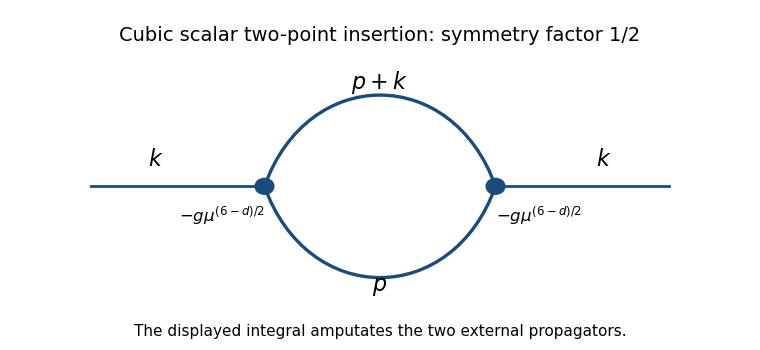

The Euclidean Feynman rule for each cubic interaction vertex is : the minus sign comes from expanding , and in the action cancels the permutations of its three fields. The mass dimension of the cubic coupling is , so permits to remain dimensionless. Two vertices supply .
Each internal scalar propagator contributes with its own momentum. Conservation leaves one independent loop momentum; choose the two propagator momenta to be and . The remaining Fourier integration measure is . Finally, the factor is the Feynman-diagram symmetry factor for exchanging the two identical internal lines. Direct Wick contraction counting gives the same factor: two choices for which vertex receives a labeled external leg, choices of the incident fields and pairings of the remaining fields, divided by , yield .
The displayed loop integral is the amputated two-point insertion. For the correction to the full propagator, multiply it by the external scalar propagators, giving with .
Apply a Feynman parameter and shift the loop momentum to . The common denominator becomes , whereFor positive , the Gamma-integral representation and a Gaussian integral giveThis formula initially converges for and defines the Euclidean massive loop integral at other dimensions by analytic continuation. Consequently,With , the Gamma function factor is . Only its pole matters: the other factors can be evaluated at when extracting that pole. Since ,This is the one-loop two-point divergence in six-dimensional cubic scalar theory. Its polynomial momentum dependence is precisely what permits subtraction by local counterterms.
Use a mass counterterm and a wavefunction renormalization counterterm, defining their additive coefficients byThe sign follows from how the Euclidean path integral expands. A quadratic counterterm inserts into the propagator, whereas the loop defined in the question inserts . To this order,Thus cancellation requires , rather than its negative. In the minimal subtraction scheme, with no finite parts added,These are the minimal-subtraction two-point counterterms in cubic scalar theory. They absorb respectively the and constant terms in the two-point pole.
The additive mass coefficient is distinct from the shift of a bare mass when the bare field also includes wavefunction renormalization. If and , then to one-loop orderThis last relation specifies the convention; the boxed coefficients are those multiplying the local counterterms displayed above.
Articles by others on the same topic
There are currently no matching articles.