For an optically thin, low-density plasma, the astrophysical cooling function packages collisional radiation losses and temperature-dependent ion fractions into the coefficient multiplying . Because the volume loss rate has units , the coefficient has units . The energy-density unit printed in the numerical hint cannot be the unit of this coefficient. Interpret the quoted logarithmic values in the dimensionally consistent cooling-coefficient unit.
Assume collisional ionization equilibrium, a primordial hydrogen-helium mixture and no external photoheating. In the specified range, the primordial atomic cooling curve has the following features. Just above , thermal Electrons begin to excite neutral hydrogen efficiently; subsequent line emission, especially Lyman-alpha emission, causes a steep rise. The excitation rate contains a threshold factor of order . Hydrogen line cooling is strong near a few times ; the supplied value at provides a useful low-temperature label.
As hydrogen becomes ionized, neutral-hydrogen line cooling declines. Helium excitation and ionization produce a further shoulder or peak around . Collisional excitation, collisional ionization and radiative recombination all contribute: excitation photons remove Electron kinetic energy, ionization consumes it, and recombination produces free-bound radiation. Once hydrogen and helium are almost fully stripped, their bound-state cooling disappears and the curve falls into a relatively inefficient interval. At high temperature, thermal bremsstrahlung dominates, with an approximate tail and a weak Gaunt-factor correction.
The sketch uses the two supplied numerical labels and a qualitative hydrogen-helium interpolation; it is not a tabulated atomic-rate calculation.
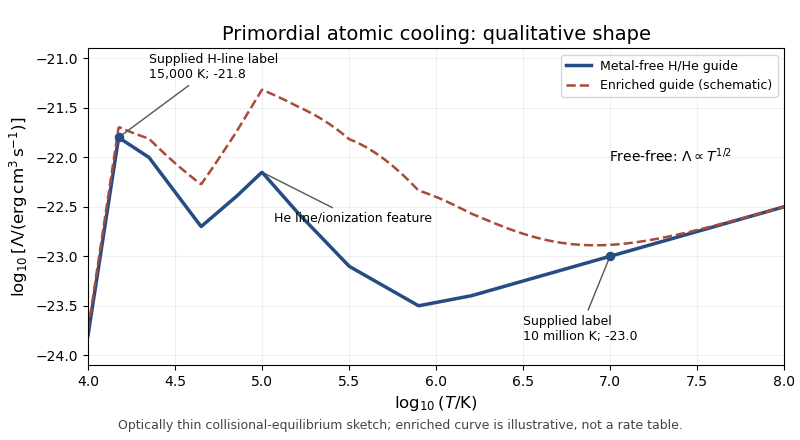
Qualitative primordial atomic cooling curve with hydrogen and helium line features, a bremsstrahlung tail, and an illustrative metal-enriched comparison
. Metal-line cooling raises the cooling coefficient markedly over much of –, because heavier elements supply many ions and excitation transitions after hydrogen and helium have lost their bound Electrons. It also broadens and reshapes the line-cooling peaks. Fine-structure lines can permit cooling below the hydrogen atomic threshold; molecular hydrogen can likewise cool metal-free gas below that threshold, but lies outside the requested temperature range. At sufficiently high temperatures thermal free-free emission again dominates the continuum. The enhanced curve in the figure is a schematic comparison, not a numerical claim about a specified metallicity. Thus metals generally shorten the cooling time and extend the temperature range of efficient cooling; ionization state, abundance and radiation field determine the actual curve.
Articles by others on the same topic
There are currently no matching articles.