Let be the dimensional cosmological density power spectrum and its dimensionless power spectrum. In linear theory,where is the linear growth factor and is the cosmological transfer function. An approximately scale-invariant primordial curvature spectrum corresponds, with the conventional matter-spectrum normalization, to with . This does not say that the dimensional density spectrum is white noise or that the early curvature and density perturbations are the same variable.
The crucial scale dependence develops around horizon entry and matter-radiation equality. Modes entering during radiation domination undergo only logarithmic cold-matter growth, whereas modes entering later avoid that suppression. For cold dark matter, the large-scale transfer tends to a constant and the small-scale transfer behaves schematically as . ThusFor , the dimensional spectrum turns from an approximately rise to an approximately decline. Multiplying by shows that the dimensionless small-scale power still increases slowly. The resulting variance of density fluctuations smoothed on mass generally increases as decreases, over the scales relevant to galaxy assembly.
After equality, and over scales where linear growth is scale-independent, the transfer shape is approximately preserved while the amplitude grows. During matter domination, ; late accelerated expansion slows that growth. A region collapses when its linearly evolved density contrast reaches the linear spherical-collapse threshold. Smaller mass scales, having larger variance, typically reach this threshold earlier. Small haloes form first, then accrete matter and merge into larger haloes; galaxies form from cooling baryons in those wells and themselves merge. This small-to-large assembly is hierarchical galaxy formation. It is a statistical trend: rare high peaks can produce unusually massive early objects, and gas cooling and feedback prevent a one-to-one identification of halo collapse with star formation.
For cold dark matter, random particle velocities are small enough that collisionless free streaming erases little power on galactic scales. Warm dark matter retains a larger early velocity dispersion and a larger free-streaming length, suppressing power below a finite scale. There are consequently fewer low-mass haloes, delayed formation of the smallest galaxies, and a lower limit to the hierarchy that can develop. Above the cutoff, warm-matter structure can still assemble hierarchically. The distinction concerns the particles' velocity history and transfer function, not the thermal temperature of gas in a galaxy today. The broad late-time shape was largely established by early horizon-entry physics, with subsequent nonlinear collapse and merging altering the spectrum at high wavenumber.
For an optically thin, low-density plasma, the astrophysical cooling function packages collisional radiation losses and temperature-dependent ion fractions into the coefficient multiplying . Because the volume loss rate has units , the coefficient has units . The energy-density unit printed in the numerical hint cannot be the unit of this coefficient. Interpret the quoted logarithmic values in the dimensionally consistent cooling-coefficient unit.
Assume collisional ionization equilibrium, a primordial hydrogen-helium mixture and no external photoheating. In the specified range, the primordial atomic cooling curve has the following features. Just above , thermal electrons begin to excite neutral hydrogen efficiently; subsequent line emission, especially Lyman-alpha emission, causes a steep rise. The excitation rate contains a threshold factor of order . Hydrogen line cooling is strong near a few times ; the supplied value at provides a useful low-temperature label.
As hydrogen becomes ionized, neutral-hydrogen line cooling declines. Helium excitation and ionization produce a further shoulder or peak around . Collisional excitation, collisional ionization and radiative recombination all contribute: excitation photons remove electron kinetic energy, ionization consumes it, and recombination produces free-bound radiation. Once hydrogen and helium are almost fully stripped, their bound-state cooling disappears and the curve falls into a relatively inefficient interval. At high temperature, thermal bremsstrahlung dominates, with an approximate tail and a weak Gaunt-factor correction.
The sketch uses the two supplied numerical labels and a qualitative hydrogen-helium interpolation; it is not a tabulated atomic-rate calculation.
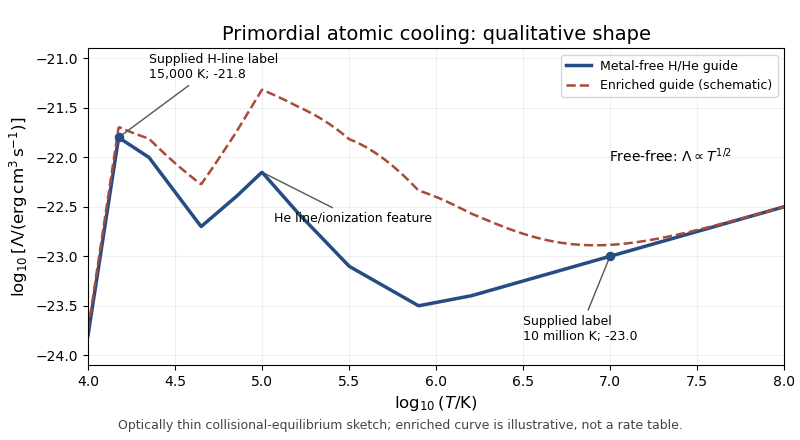
Qualitative primordial atomic cooling curve with hydrogen and helium line features, a bremsstrahlung tail, and an illustrative metal-enriched comparison
. Details. 
Metal-line cooling raises the cooling coefficient markedly over much of –, because heavier elements supply many ions and excitation transitions after hydrogen and helium have lost their bound electrons. It also broadens and reshapes the line-cooling peaks. Fine-structure lines can permit cooling below the hydrogen atomic threshold; molecular hydrogen can likewise cool metal-free gas below that threshold, but lies outside the requested temperature range. At sufficiently high temperatures thermal free-free emission again dominates the continuum. The enhanced curve in the figure is a schematic comparison, not a numerical claim about a specified metallicity. Thus metals generally shorten the cooling time and extend the temperature range of efficient cooling; ionization state, abundance and radiation field determine the actual curve.
The optically thin gas cooling time is thermal energy density divided by the radiative loss rate. Write for the number of thermal particles per hydrogen nucleus, for the hydrogen mass fraction, and for the gas fraction of the gravitating mass. ThenThe last expression is the free-fall time of a uniform sphere. Equating the two times gives the cooling-to-free-fall equality curveAt fixed temperature, : above the curve, ; below it, cooling is slower. The temperature dependence is approximately . Strong line cooling therefore creates low-density troughs, whereas the fully ionized bremsstrahlung tail gives .
For the diagram choose a self-gravitating uniform gas cloud, , with , proton mass , and the fully ionized particle ratio . Using this fixed ratio is a convenient sketch normalization; the varying low-temperature ion fraction changes the coefficient by a factor of order unity. The supplied cooling values then give at and at . A dark-matter-dominated potential has , shortening the free-fall time and moving the equality curve upward by .
To relate the plane to mass, use the virial theorem for a uniform self-gravitating sphere. Its gravitational potential energy is , so , where . With , the virial mass contours in a cooling diagram satisfyThe coefficient is for this uniform-sphere convention; other halo profiles change it. The horizontal mean-density label is . Real collapsing clouds are overdense, and their characteristic densities rise at earlier epochs.
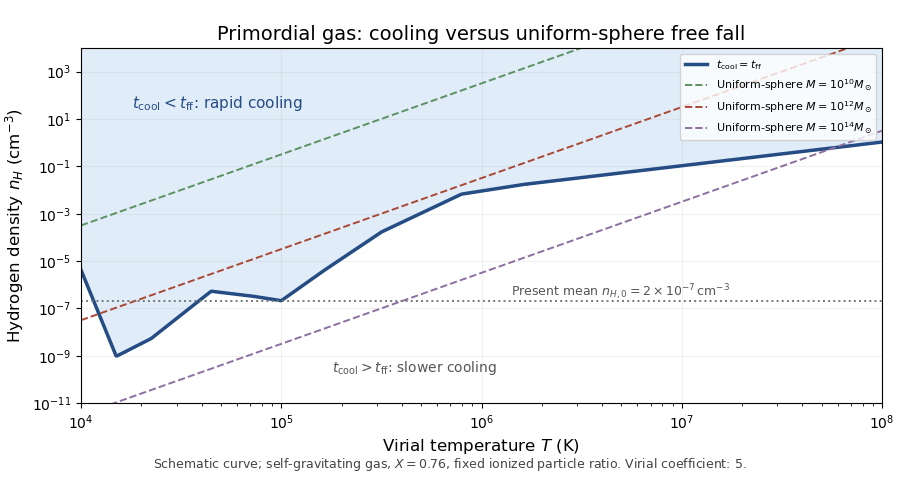
Cooling and free-fall equality in hydrogen density and virial temperature for a uniform primordial gas cloud, with constant-mass contours and the present mean hydrogen density
. Details. 
The cooling criterion for galaxy formation requires a cloud to lose shock-generated virial heat rapidly enough to contract and fragment. At higher virial masses and temperatures, hydrogen-helium line cooling ceases to be efficient, so a growing bound aggregate can remain a hot, pressure-supported atmosphere rather than condense as one giant luminous galaxy. Combined with virial mass contours and the densities at which clouds assemble, the diagram gives a characteristic upper galaxy-scale cooling mass, conventionally of order in the simple baryonic-cloud argument. Larger aggregates are predominantly groups or clusters containing smaller galaxies and hot gas.
This upper galaxy mass from gas cooling is a physical scale, not an exact universal mass cutoff derivable from the two cooling labels alone. Composition, formation density, geometry, metals and a dark-matter potential shift it. Cooling that is slower than free fall but faster than the available cosmic time can still yield gradual central condensation. Mergers of existing stellar galaxies can also assemble a larger stellar system without rapidly cooling the entire gas mass of its host halo.
Articles by others on the same topic
There are currently no matching articles.