Choose downslope along the rigid plane and normal to it into the fluid, with the wall at and the flat free surface at . The gravitational body force per unit volume has components . The wind's tangential traction on the top surface is in the direction; the atmospheric normal traction is in the direction. At the wall there is no-slip boundary condition, and the wall supplies the opposing normal force and a tangential traction whose sign depends on the wind strength.
The velocity is parallel to the plane, . Its velocity profile is a concave quadratic, with and negative slope at the free surface when . The diagram uses moderate wind, for which the flow is still everywhere downslope. Stronger wind can reverse the upper portion, or the entire moving layer; the later cases quantify this.
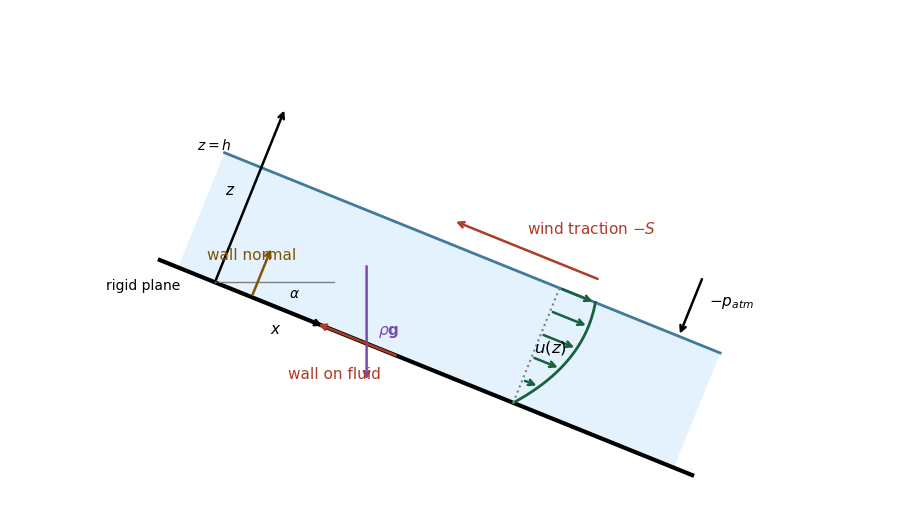
For an inclined viscous film with opposing surface shear, the steady parallel velocity automatically satisfies the continuity equation and the advective acceleration vanishes. The two components of the Navier-Stokes equations reduce toThe uniform thickness and constant atmospheric pressure make . The boundary conditions areThese are respectively no-slip boundary condition, imposed tangential traction on the surface with outward normal , and the normal stress condition on the flat free surface. The normal viscous stress is zero because the normal velocity vanishes. Integrating givesIn particular is the downslope tangential traction exerted by the fluid on the wall. The wall's tangential traction on the fluid has the opposite sign, because the outward normal of the fluid at its bottom is . This fixes the potentially confusing wall sign convention.
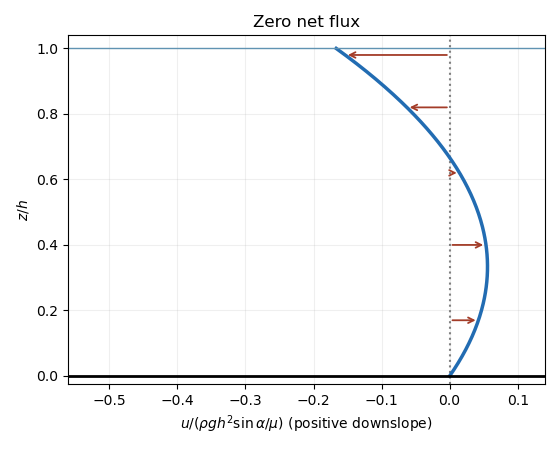
The volume flux per unit transverse width isThusAssume a genuinely inclined plane, . With and , the zero-flux velocity profile is . It is positive for , zero at , and negative above that level. Its maximum is at , and its surface value is . Thus equal integrated downslope and upslope transports cancel, rather than the fluid being motionless.
The wall shear stress vanishes when . ThereforeFor a genuinely inclined plane the entire moving layer now flows upslope. The profile touches zero at the wall with zero derivative and becomes increasingly negative towards the surface. In the plot with velocity horizontal and height vertical, the zero derivative at the wall is represented by a vertical tangent. The resulting volume flux is , so zero wall shear stress does not mean zero flux.
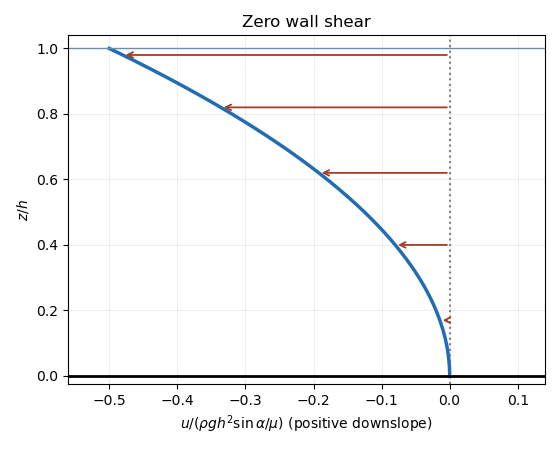
Zero wall shear and an entirely upslope velocity profile
. Articles by others on the same topic
There are currently no matching articles.