Write and , so the PDF's vector potential vorticity is . The local TeX loses some of this boldface. Taking the vertical curl of the momentum equation gives , while mass conservation gives . ThusThis is the linear perturbation of shallow-water potential vorticity, scaled by ; it should not be confused with the full nonlinear conserved ratio .
Since , taking the divergence of momentum gives . Differentiate mass conservation and use to obtainFor , substitution of the stated plane wave gives the linear rotating shallow-water dispersion relation, with :The two even branches approach at large and have values at . The original dispersion diagram below also compares the speed magnitudes.
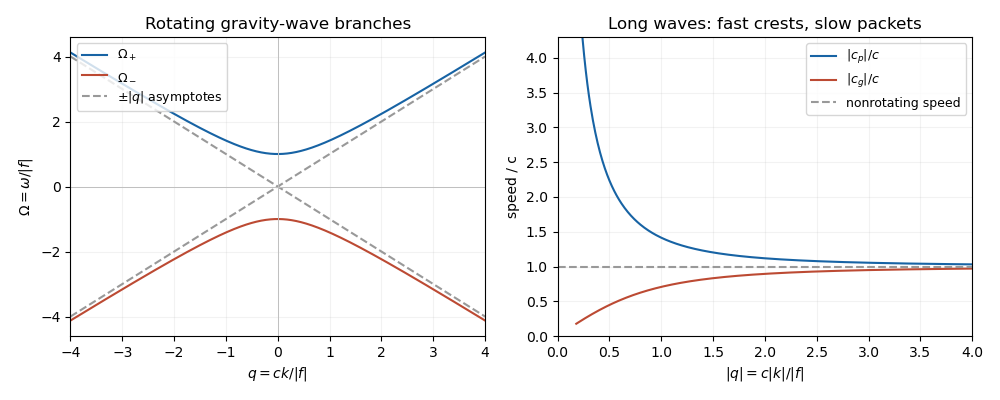
For , the phase velocity and group velocity magnitudes areThe printed convention means the signed phase velocity is and the signed group velocity is . The speed magnitudes above are independent of that sign convention.
For , longer wavelengths have greater phase velocity but smaller group velocity: individual crests and wave packets therefore answer “faster or slower” differently. At long wavelength, , the frequency is nearly the inertial frequency , , and . Rotation has its largest relative effect here, and the waves are strongly dispersive. At short wavelength, , both speeds tend to and rotation gives only a small, weakly dispersive correction. If , the gravity waves are nondispersive, with speed ; at the phase velocity formula is undefined.
Articles by others on the same topic
There are currently no matching articles.