Take the physical diffusion and consumption constants . Use the travelling wave coordinate , with . Then and . The original PDF has the bacterial drift flux : the TeX transcription's is erroneous. Substituting the logarithmic chemotactic sensitivity givesPrimes here denote differentiation with respect to . The second equation already shows that nutrient increases towards the front whenever the bacterial density is positive. For the positive band, at every finite , so division by is legitimate, despite its zero limit far behind.
Integrating the first equation once giveswith constant . For a localized band with no bacterial flux at infinity, and its flux terms vanish ahead, so . Equivalently the laboratory flux equals . The Keller--Segel model then has the useful first-order reductionThe far-field conditions choose this zero-flux integration constant; it should not be imposed for an arbitrary nonlocalized travelling solution. We solve its positive localized branch in the next part.
Put ; here is the dimensionless chemotactic ratio, unrelated to the fluid viscosity in the other questions. Integrating the first-order relation yieldsSubstitute into and separate variables. With ,The first integration constant is fixed by the positive nutrient concentration ahead. The second positive constant can be written , and a translation of the wave origin sets . Indeed with . With that origin choice the nutrient-consuming chemotactic travelling band isThe second formula also follows by differentiating the first and using , so its prefactor is fixed, not a freely chosen independent amplitude.
As , and . As ,Thus all four required limits hold. The singular sensitivity causes no finite- problem, and tends to the finite value behind. Since , is strictly monotone increasing.
For the bacterial peak, differentiate its logarithm:This strictly decreases from to , so it vanishes exactly once. The peak values areAccordingly the nutrient curve is a smooth rising front, and the bacterial curve is a positive pulse, with generally different exponential decay lengths ahead and behind. The nutrient concentration is the undepleted nutrient density in the fresh liquid ahead of the migrating band. Behind the band the nutrient has been consumed. The plot shows the front and pulse for several admissible chemotactic ratios; at the bacterial pulse is symmetric about .
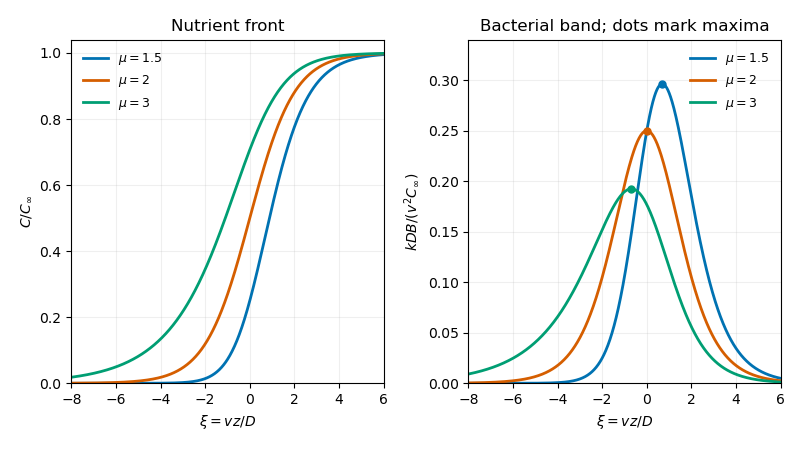

The condition is sufficient for this smooth exponential-tail family. The derivation does not claim to classify all limiting or weak solutions at other parameter values.
Let denote tube cross-sectional area in this question, not a filament or sphere radius. The bacterial density is uniform across that section in this one-dimensional Keller--Segel model, so the total bacterial number isIntegrating the nutrient balance across the complete band givesHence the speed of a nutrient-consuming chemotactic band isThis is a nutrient budget: the whole population consumes at rate , while advancement of the band at speed brings fresh nutrient at rate . The conservation of mass equation for bacteria ensures stays constant when there is no flux at infinity and no cell birth or death.
At fixed total bacterial number, the speed grows linearly with and the per-cell consumption rate , and decreases with tube area and nutrient concentration ahead. More nutrient takes longer to deplete, giving the inverse dependence on . Although and determine the width, skewness, peak density and admissibility of the smooth band, they do not appear in this speed when are fixed. This independence relies on neglecting nutrient diffusion and using the specified concentration-independent consumption law; it is not a general prediction for all chemotaxis models. Dimensionally is nutrient amount per time and nutrient amount per length, so their ratio is a velocity.
Articles by others on the same topic
There are currently no matching articles.