The initial table of content was limited to the first level because it is larger than 1000 articles. There are 2152 articles in total. Expand a branch to load its children.
A simple Lie algebra is a nonabelian Lie algebra whose only Lie algebra ideals are zero and the whole algebra. Assume ; is not simple. We prove the assertion by the matrix-unit extraction lemma for special linear ideals, avoiding any classification theorem.
Let be a nonzero ideal in the special linear Lie algebra and . If an off-diagonal entry is nonzero, two commutators with the matrix unit giveso . If is diagonal and nonscalar, choose unequal diagonal entries; again supplies a matrix unit. A nonzero scalar matrix cannot have zero trace over , so these cases cover every nonzero .
Once , its bracket with gives , and puts the reverse unit in . Bracketing with the other off-diagonal matrix units generates every off-diagonal unit: for a third index , and ; using the reverse unit fills the remaining row and column, then fills the others. Opposite pairs generate every trace-zero diagonal matrix. These vectors span , so
In field characteristic , the identity matrix has trace , and hence belongs to . Its span is a nonzero proper central ideal, so is not a simple Lie algebra. In fact its center of a Lie algebra is precisely : commuting with every off-diagonal matrix unit forces a matrix to be scalar.
For , the matrix-unit extraction lemma for special linear ideals still works because two is invertible. Any ideal containing a nonscalar matrix contains every off-diagonal matrix unit and every trace-zero diagonal matrix, hence equals . Therefore an ideal of the quotient Lie algebra pulls back either to the center or to the whole algebra. The quotient is nonabelian, since remains nonzero modulo the center. ConsequentlyNo separation of diagonal root spaces is needed, so this proof also handles without assuming their weights are distinct.
For , every trace-zero two-by-two matrix has the form . The only nonzero bracket between these basis vectors is , which is central. Thus
For the finite-dimensional Lie algebra representation specified in the PDF, a Lie-invariant bilinear form satisfiesThe dual Lie algebra representation has action , so the map defined by is an intertwining operator. If is irreducible and , its kernel is zero. Since have equal finite dimension, is an isomorphism, and is a nondegenerate bilinear form.
For , the composition is a representation endomorphism. Over an algebraically closed field, the Schur lemma makes it scalar, provingTransposing gives another Lie-invariant bilinear form. For , write ; transposing twice gives . In field characteristic different from two, this means or . Thus the form is a symmetric bilinear form or an alternating bilinear form, respectively. The zero form has both properties. In the second case forces , using the same characteristic assumption.
Use the classification of finite-dimensional sl2 representations. In the irreducible representation , choose , , sowith vectors beyond the endpoints interpreted as zero. The invariant form on an irreducible sl2 module isIts anti-diagonal entries are nonzero, so it is nondegenerate. Lie-invariant bilinear form invariance under follows from the sum of the two weights. For , the two potentially nonzero terms are and . For , their coefficients coincide when , and their signs are opposite. These checks prove invariance under the generators of the sl2 Lie algebra.
Interchanging multiplies the form by , givingEquivalently it is a symmetric bilinear form in odd integer dimension and an alternating bilinear form in even number dimension. The Weyl complete reducibility theorem expresses any finite-dimensional representation as a direct sum of these irreducibles. Give each summand the displayed form and make different summands orthogonal. The resulting form is invariant and nondegenerate. On a reducible representation with both parities, this orthogonal sum need not itself be symmetric or alternating; the dichotomy in the preceding part required irreducibility.
The PDF's is the anti-diagonal identity matrix. Write and . Its diagonal Cartan subalgebra consists ofThe defining matrix identity says . The root spaces have the following root vectors, together with their opposites:The negative short root has vector . Hence the root-space decomposition is , each root space is one-dimensional, and the Bn root system isThere are roots and zero-weight dimensions, giving as a check. Upper triangular matrices giveFor , the highest root is . The fundamental weights and Weyl vector areThese weights pair to with the simple coroots; summing the positive roots gives the displayed .
The Dynkin diagram is the chain , with single edges except a double edge between and , whose arrow points to the short root . In the Extended Dynkin diagram, attaches by a single edge to when . For , both long nodes have a double edge to the short node . The Bn Dynkin diagram and affine extension below distinguishes these small-rank cases.
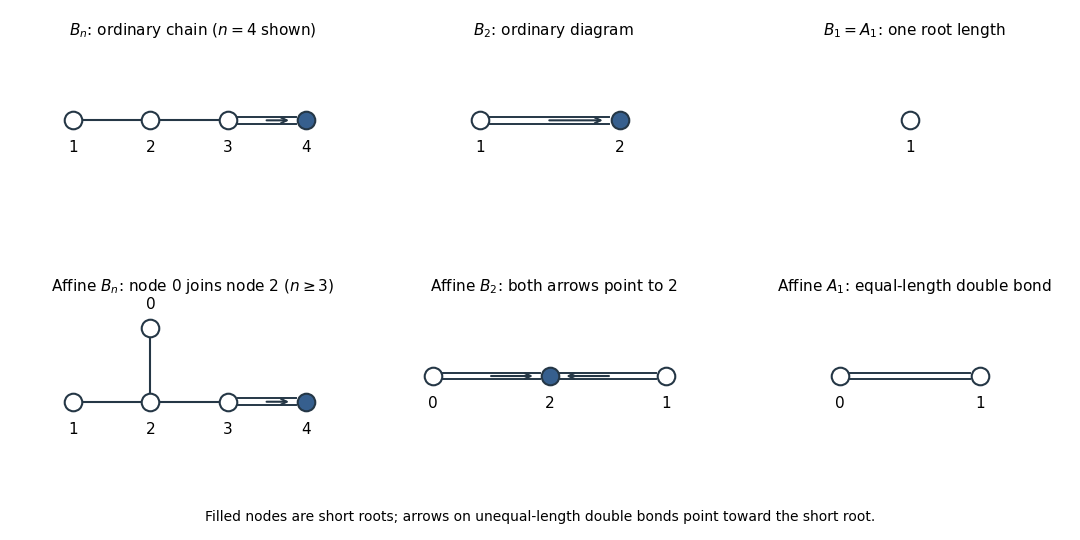
Ordinary and affine Dynkin diagrams of type B
. Details. 
For , the system is : , , . Its ordinary diagram is one node; its affine diagram has two equal-length nodes with the usual affine double bond.
Let be a four-dimensional symplectic vector space. The symplectic contraction of an exterior square splits into its five-dimensional primitive exterior square and the invariant line spanned by the inverse symplectic bivector . Choose . Exterior multiplication defines a symmetric bilinear form on by ; it is symmetric because both degrees are two. In a symplectic basis, , and , so the restriction to is nondegenerate.
The symplectic Lie algebra preserves this form, giving a homomorphism . It is injective: an element acting trivially on also acts trivially on , hence on all of . In a four-vector basis, the identities first force every off-diagonal coefficient of to vanish, then force for every pair. Over these equalities imply .
Both Lie algebras have dimension ten: and . The injective map is therefore an isomorphism, proving the exceptional isomorphism between sp4 and so5:
Identify the diagonal Cartan subalgebra with coordinates . The root reflection is in the standard Euclidean identification. For the Bn root system, this givesAll unlisted coordinates stay fixed, and . These transformations are coordinate permutations and independent sign changes. They generate exactly the signed symmetric group, soHere permutes the factors in the semidirect product.
The PDF uses for ; the TeX incorrectly turns this into a power of two. The crystal of the defining odd-orthogonal representation is the chain with weights . Label its vertices . Its directed edge colors areIn particular the short-root string has two edges of color .
For a full drawing of the tensor product of crystals in any rank, take every ordered pair of chain vertices . Let count incoming edges of color along its string, and let count outgoing ones. We use the conventionomitting an edge when the indicated operator vanishes. This crystal tensor-product rule specifies every vertex and every edge; the raising rule uses for its first-factor branch. The picture shows the chain and all 25 tensor vertices for , with connected components distinguished by node color.
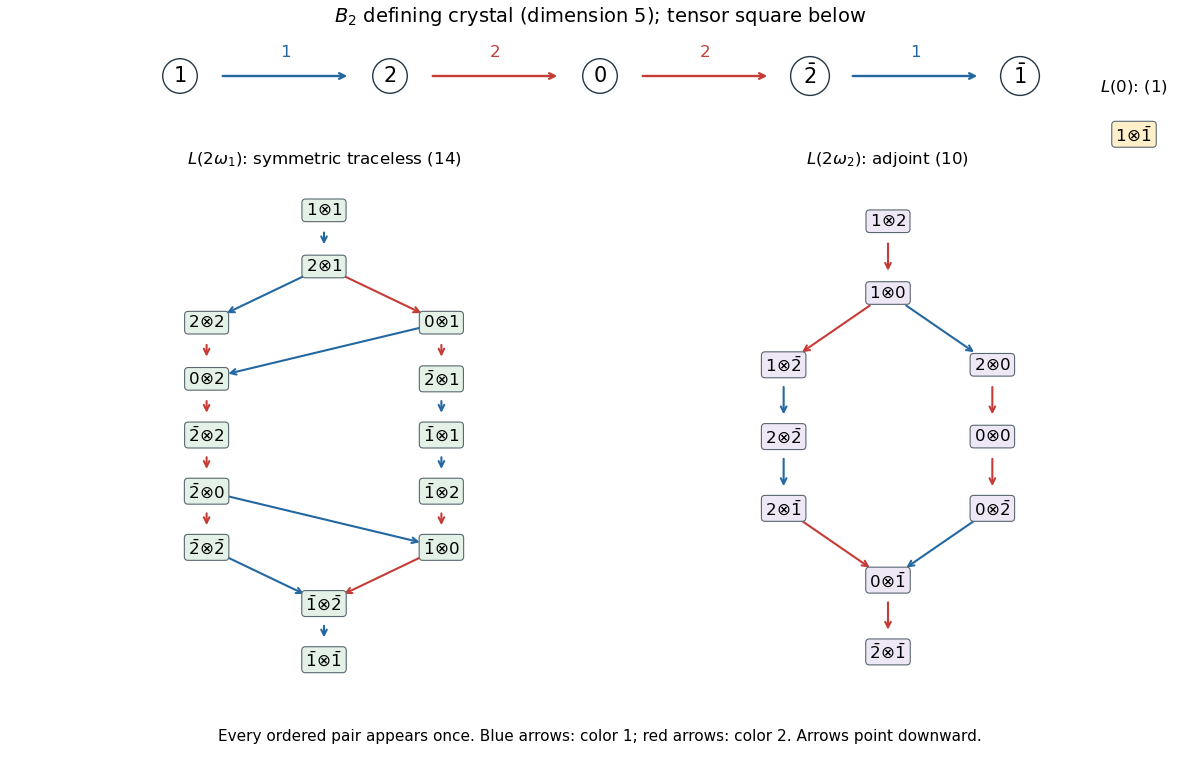
The type-B2 defining crystal and its tensor square
. Details. 
For , the three highest-weight vectors of the tensor crystal are , and . They have weights , and zero. There are no others: a highest tensor vertex must have highest first factor, and the string inequalities then restrict its second factor to these three vertices. ThereforeThe summands are the traceless symmetric square, the exterior square (the Adjoint representation), and the invariant scalar line. Their dimensions are , and one, summing to . For the first two highest weights are ; for they are . For , the three tensor highest vertices are , giving of dimensions .
Choose a positive root system for a complex semisimple Lie algebra, with Weyl group and Weyl vector . For a dominant integral weight , let denote its finite-dimensional irreducible representation, and use formal symbols with . Its formal character of a weight module is . The Weyl character formula saysHere , the sign of the product of simple root reflections. The Weyl denominator formula isThe quotient is initially interpreted in the fraction field of the group algebra of the weight lattice; the theorem makes it a finite character.
Take an integer , so is a dominant integral weight. Apply the dilation to the Weyl denominator formula:This is exactly the numerator of the Weyl character formula for . Divide by its denominator and use a finite geometric series in each root direction:This character of a Weyl-vector multiple also gives by evaluating every formal exponential at one. This evaluation is safe in the final polynomial expression, without dividing by a zero denominator.
Number the G2 root system with short and long, normalized by , and . Its positive roots are , and the negatives complete the twelve-root system. The short roots form one hexagon, and the long roots form a rotated hexagon whose radius is times larger. The picture also supplies the crystal requested in the next part.
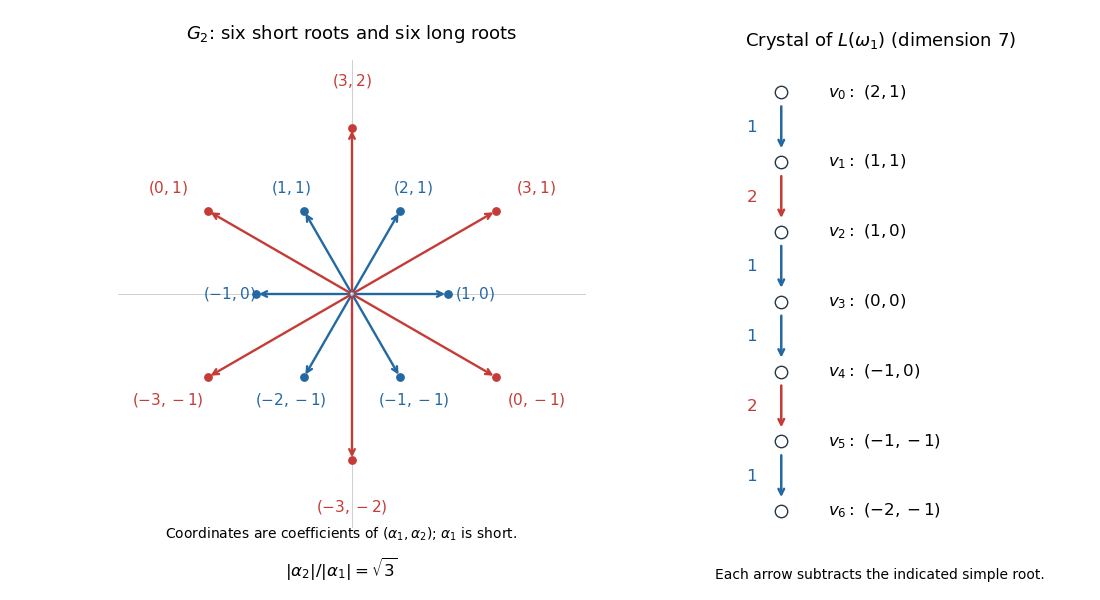
The type-G2 root system and defining crystal
. Details. 
The fundamental weights are , , and . The six positive coroots, in coordinates relative to , are . Applying the Weyl dimension formula to therefore gives the G2 dimension polynomialThe denominator is the product of the corresponding pairings with . As checks, the weights give dimensions respectively.
The G2 dimension polynomial gives dimension seven at the short-root fundamental weight, soThe crystal of the seven-dimensional G2 representation is a chain whose weights, in order, areIts successive arrow colors are , as drawn above. Each arrow subtracts its indicated simple root; in particular the central three vertices form a length-two string of color one. The six nonzero weights are exactly the six short roots, each with multiplicity one, and the zero weight also has multiplicity one.
Choose the chain basis from the preceding part, normalized by , , . The associated sl2 Lie algebra strings give , and ; other raising actions used below vanish because their proposed weights do not occur.
In the exterior square, is a highest-weight vector of weight : produces , and kills both factors. Alsois a nonzero highest-weight vector of weight . Its two terms cancel, and its image is zero. The Weyl complete reducibility theorem supplies irreducible summands with those weights; their dimensions exhaust . ThusFor the symmetric square, is a highest-weight vector of weight , giving a 27-dimensional summand. The longest Weyl-group element of acts as minus the identity, so the highest weight of a dual representation is : is self-dual. A nonzero intertwiner gives a nondegenerate Lie-invariant bilinear form. It is symmetric, since an alternating bilinear form cannot be nondegenerate in odd dimension. Its inverse is a nonzero invariant vector in , supplying the scalar summand. Since ,These are the exterior and symmetric squares of the seven-dimensional G2 representation; all highest-weight and dimension claims are specified rather than relying on an unstated cross-product identity.
Work over the complex numbers. The chain has multiplicity-free restriction: each irreducible representation restricts to a direct sum of pairwise inequivalent irreducible representations. This structural fact can be proved before identifying the branching diagram. Indeed, the permitted Olshanskii centralizer lemma makes commutative, since it is generated by the center at the previous level and the commuting element . In each irreducible block this is the endomorphism algebra of the restricted module; a repeated summand would give a noncommutative matrix algebra factor. Thus no identification of the branching graph with Young diagrams is being assumed here.
Successively restricting an irreducible representation gives one-dimensional spaces indexed by paths of irreducible representations from the trivial -module to . Choosing one nonzero vector in each gives a Gelfand–Tsetlin basis. Define the Gelfand–Tsetlin algebra as the subalgebra of acting diagonally in all these bases. The Artin–Wedderburn theorem identifiesUnder this identification the Gelfand–Tsetlin algebra is the direct sum of the full diagonal matrix algebras in the indicated bases, so it is commutative.
To see that it is actually available inside the group algebra, let be the central primitive idempotent selecting the irreducible representation of . For a path the productis the projection onto in its final irreducible representation and is zero in every other final block. These products commute: a center at a higher level commutes with every element at a lower level. The are precisely the diagonal matrix units, and therefore span the proposed algebra.
If an element of the group algebra commutes with every , its matrix preserves every and is diagonal in every block. It already belongs to the Gelfand–Tsetlin algebra. Thuswhich proves that it is a maximal commutative subalgebra.
The projections in the Gelfand–Tsetlin algebra satisfyConsequently the map sending a diagonal element to its scalar on each Gelfand–Tsetlin basis vector is a ring isomorphismEach factor is a simple module over this algebra, and the algebra is their direct sum as a module over itself. This proves that is a semisimple algebra. The argument uses its explicit diagonal structure; being a subalgebra of a semisimple algebra by itself would not suffice.
The Young–Jucys–Murphy elements arewith products of permutations composed from right to left. Fix . In , all pairs of disjoint transpositions commute. The only terms left, for each , areIndeed and . Summing directly provesThus all the Young–Jucys–Murphy elements commute.
The primitive idempotent products used above show that the Gelfand–Tsetlin algebra is generated by the centers at all levels: those products give every diagonal matrix unit, whereas each center acts diagonally. Hence
For the second generation assertion use the permitted Olshanskii centralizer lemma, in the precise formIn particular . Induction puts every in . Conversely, if is the sum of all transpositions in , then and . ThereforeHere generation is unital; the zero generator causes no problem.
The deletion projection for a symmetric group removes from the cycle containing it. A cycle becomes , with a singleton understood as a fixed point; all other cycles remain unchanged. This describes a genuine permutation of and immediately proves the two identity assertions.
The printed uniqueness assertion has an exceptional case at . To locate it, use the two double cosetsAn -bimodule-equivariant set map is determined by and . Equivariance requires andbecause and commutes with this subgroup. These conditions are also sufficient: define and . Changing the double-coset expression only inserts an element of , which commutes with .
For , the center of and this centralizer are both trivial. For the latter, a commuting permutation must fix the unique point outside and lie in the center of ; that center is trivial when . Therefore , giving deletion. For , however, . The choiceis well defined and satisfies all the printed equivariance conditions, but sends to rather than to the identity. Uniqueness holds for ; it is false at as printed. Even requiring the map to restrict to the identity on does not remove this counterexample.
There is a separate problem with the printed linear-span assertion, when denotes the usual centralizer of a subalgebra. Let be the sum of all transpositions in . Direct expansion in the group algebra givesThus commutes with and satisfies . For it contains nonzero coefficients on three-cycles involving , whereas every element of is supported only on the identity and transpositions. Therefore is an explicit counterexample to the asserted equality.
One correct description of the entire preimage is obtained by putting . Equivariance gives , and is the identity on that center. It follows thatA useful corrected two-dimensional statement restricts the support to the identity and the transpositions : invariance under conjugation by then forces their coefficients to be equal, yielding exactly . This additional support restriction is absent from the PDF.
Use the Young–Jucys–Murphy elements in the group algebra . Their joint spectrum isEquivalently one can use the regular representation, which contains every irreducible representation. The commuting elements are self-adjoint in a unitary representation, so there is a simultaneous eigenbasis.
A standard Young tableau has entries increasing along each row and down each column. If entry occupies cell , its Content of a Young-diagram cell is . Define the set of content vectors of standard Young tableaux byThe shape here is a partition of an integer; it is not itself the vector of eigenvalues. For both sets consist of .
The first Young–Jucys–Murphy element is the empty sum . Applying it to the nonzero simultaneous eigenvector defining a point of the joint spectrum gives . HenceFor the remaining spectral arguments use the following local facts, without assuming the restriction branching rule for a symmetric group: consecutive eigenvalues are distinct; a difference makes act on the corresponding line as ; every other adjacent interchange gives another point of the joint spectrum in the same irreducible representation. These are the local spectral rules for Young–Jucys–Murphy elements. They follow from and the one- or two-dimensional analysis of the two neighboring eigenspaces. They are the appropriate local results used below.
First exclude the short patterns and in the joint spectrum. In the first pattern, the local spectral rules for Young–Jucys–Murphy elements make act by and by on the same simultaneous eigenvector. The two sides of the braid relation in a Coxeter group then act by opposite signs. The second pattern gives the same contradiction with signs reversed.
Now induct on the length of a spectral vector. A prefix of length is spectral for : decompose the restricted group representation and retain a nonzero component of the simultaneous eigenvector. If differed by neither nor from every earlier entry, move it left using the allowed adjacent interchanges. Encountering an equal entry would contradict the distinctness of consecutive eigenvalues. Otherwise it reaches the first position, forcing . For the original first entry was also zero, so an equal entry would indeed have been encountered. ThusThis argument uses only the stated local rules. In particular, iterating the result from also shows that all coordinates are integers.
Induct on the distance between equal entries of a point of the joint spectrum. Consecutive equal entries are impossible by the local spectral rules for Young–Jucys–Murphy elements. It suffices to consider consecutive occurrences of : proving the assertion for each such pair proves it for any wider pair.
Suppose is missing between them. There can be at most one occurrence of in the interval. Otherwise a pair of consecutive entries has a shorter gap, and the induction hypothesis forces an intervening , contrary to our choice of the pair. Move the two endpoint entries inward past entries different from . Every move is an admissible spectral interchange. If there is no , this creates consecutive equal entries. If there is one, this creates , already excluded by the braid relation in a Coxeter group. Both are impossible.
Necessity is a property of standard Young tableaux alone. The first entry occupies , with Content of a Young-diagram cell zero. Every subsequent cell has a cell immediately above or to its left, of content one larger or one smaller, already present. If two entries occupy the same diagonal, the later cell lies strictly southeast of the earlier. The cells immediately right of and immediately below the earlier one exist and have contents ; their entries lie strictly between the two given entries. This proves all three conditions for content vectors of standard Young tableaux.
For sufficiency, build the Young diagram one cell at a time. All coordinates are integers, because each new coordinate differs by one from an earlier coordinate, starting at zero. Cells of any fixed content are ordered northwest to southeast. For their positions are , ; for they are .
At the first occurrence of a positive , the candidate is . The occurrence of earlier would already force a cell of content in its row, so the neighbor condition must instead supply the content . This supplies the left predecessor. The negative case is symmetric, supplying the upper predecessor, and the first zero gives .
At any later occurrence of , take the next position on its diagonal. The preceding occurrence already supplied all but the next necessary predecessor on each neighboring diagonal. The repeated-entry condition supplies both and after that preceding occurrence, so those next predecessors are present. More explicitly, for and the th occurrence, the left predecessor is the th cell of content , and the upper predecessor is the st cell of content . For both are the st cells on their respective diagonals; for the roles are reversed. These are exactly the predecessors supplied by the two new neighboring occurrences.
The new cell is therefore an addable node of a Young diagram. Induction produces a partition of an integer at every stage, and filling the added cell by its insertion time gives a standard Young tableau. No choice was possible because addable nodes of a Young diagram have distinct contents. Thusand the construction also proves uniqueness of the tableau with a specified vector.
The local spectral interchanges preserve an irreducible representation, and standard Young tableaux of a fixed shape are connected by admissible adjacent interchanges. Different shapes have different multisets of Young-diagram cell contents. Their elementary symmetric functions in the Young–Jucys–Murphy elements are central: the identityproves this coefficient by coefficient. By the Schur lemma, one irreducible representation cannot therefore contain two different shape classes. The multiset determines a diagram because the counts on its positive and negative diagonals determine its arm and leg lengths at the diagonal cells.
Different irreducible representations cannot share a joint eigenvalue vector: the Gelfand–Tsetlin algebra is generated by the Young–Jucys–Murphy elements, so all its elements would act identically on that vector in both representations, whereas a central primitive idempotent distinguishes their two blocks. Thus distinct irreducibles give distinct shape classes.
The number of irreducible representations is the number of conjugacy classes, each indexed by a partition of an integer. Every spectral vector gives a tableau by the preceding construction. Closure under admissible interchanges makes every shape class that occurs occur in full. The two counts then force every shape to occur, with exactly one irreducible representation per shape. This supplies .
On restricting to , delete the last coordinate. For tableaux of shape , the entry occupies one Removable node of a Young diagram. Grouping by that node gives one copy of the corresponding module; the path decomposition has simple multiplicities. Hence the restriction branching rule for a symmetric group isThe different removable nodes produce distinct partitions. The multiplicity-free structural input defining the Gelfand–Tsetlin basis is distinct from identifying this graph with the graph of Young diagrams.
For a standard Young tableau , put , using the Content of a Young-diagram cell. Choose the row-reading tableau , and let be the Coxeter length of the unique permutation sending to . A Gelfand–Tsetlin basis can be chosen so that, when is standard and ,If is not standard, the action is for two consecutive entries in one row, and for two in one column. This is one usual normalization of the Young seminormal form.
Here is a construction and proof of the normalization. Fix , let be the projection onto the tableau line, and defineThe permutation has a reduced expression consisting entirely of admissible swaps, by the reduced adjacent-swap path between linear extensions. At each swap the off-diagonal coefficient is nonzero. In its expansion, the only term that can reach a tableau at distance uses all swaps; omitting a swap gives a shorter path. Thus . This also makes its definition independent of a chosen reduced expression, because itself is fixed.
The relation forces the coefficient of in to be , and forces every other component to lie on the swapped line. If length increases, project the identity onto the line for . The shorter terms of cannot reach in one step, so the coefficient of is exactly one. Applying then gives the reverse coefficient and diagonal coefficient . In the nonstandard cases the same relation gives and the asserted scalar action. This proves the theorem rather than merely specifying pairwise scalings.
Assume . The place-permutation action on preserves the coefficient-sum kernelIt is the augmentation subrepresentation of a permutation representation. The point action of is two-transitive, so the irreducible augmentation criterion for a transitive group action makes irreducible. The two-row Young permutation module decomposition of identifies its nontrivial summand as . Hence .
All standard Young tableaux of shape are , , with below the first cell and the remaining entries increasing along the first row. Their content vectors of standard Young tableaux areAn explicit orthonormal basis realizing these tableau lines isThe sums of their coordinates vanish. Their norms are one, and the inner product of with , , is zero because the coefficients of sum to zero. Directly summing the action of gives .
For , . For , its only nontrivial two-dimensional block isEvery other is fixed, including all with when . These formulas follow by swapping coordinates in the displayed vectors, and are the Young orthogonal form with axial distance for .
For the cycle-sum identity for Young–Jucys–Murphy elements, let be the sum of all -cycles on . Multiplying such a cycle by inserts immediately after in that cycle, with our composition convention. Every -cycle has a unique predecessor of , so deleting recovers a unique term of . Since , induction givesFor the empty product is the identity, also the unique one-cycle.
For the product assertion in a non-hook shape, , so cell is present. Its Content of a Young-diagram cell is zero and its label is at least four. Since , that factor in the product vanishes. Therefore
A hook partition has cell contentsIn a standard Young tableau, the unique zero-content cell is and contains . The other eigenvalues are precisely the remaining contents, in whatever order the tableau supplies. Their product is independent of that order:The scalar is nonzero over the complex numbers. For the single row or single column, one of the factorials is ; the formula still gives or , respectively.
The Gelfand–Tsetlin basis spans , and the scalar computed on its vectors depends only on the shape. Thusfor every . The product is the sum of the permutations in the conjugacy class of an -cycle. Taking traces therefore gives equal to the displayed scalar times .
For a hook partition, a standard Young tableau is uniquely determined by the choice of its entries below the top cell, selected from . The column and the remaining row are then forced to increase. Hence , and cancellation of the factorials yieldsThis uses the central character value of a conjugacy-class sum and tableau counting, without a character rule for removing rim hooks.
The inclusion here is inclusion of Young diagrams, not the dominance order on partitions. The skew Young diagram is the set difference of their cells. Two cells are adjacent when they share an edge. It is connected when any two cells can be joined by such steps, and is a rim hook when it is connected and contains no square. Under the usual edge-adjacency convention a totally disconnected skew Young diagram has only singleton components, equivalently no two cells share an edge. A horizontal strip instead means at most one cell per column; this distinction matters for the last part of this question.
A standard skew Young tableau is a linear extension of a partially ordered set: the cells are ordered by the row and column inequalities, and the tableau lists them in increasing label order. Write the current list as and let be the desired label of in . Then is the one-line notation of the unique permutation with .
Whenever this list of desired labels is not increasing, there is an adjacent descent . The cells are incomparable in the cell partial order: if they were comparable, both and would have to put them in the same order. Interchanging their consecutive current labels is therefore admissible. It removes exactly one inversion of a permutation from the list of desired labels. Repeating ends at after exactly the original inversion count, which is the Coxeter length . ThusThis proves the reduced adjacent-swap path between linear extensions and applies equally to ordinary tableaux.
Put and take the subgroup permuting the first and last letters. Define the skew representation of a symmetric group as the multiplicity spaceThe last-letter copy of commutes with , so it acts on a map by . This gives a genuine -module, without claiming that the whole restricted module is itself the skew representation. Equivalently,
Fix a prefix tableau of shape and complete it to shape . Iterated restriction branching rule for a symmetric group identifies the multiplicity-space orthonormal basis with standard skew Young tableaux, using labels for the last cells. The Young orthogonal form restricts to this basis. When is standard and ,An admissible interchange has , so its off-diagonal coefficient is nonzero. Consequently belongs to the group algebra span of . The preceding reduced-path argument reaches every standard skew tableau, so this span is the whole module. Every is a cyclic vector for a group representation. The inherited invariant inner product makes this a unitary representation.
Let be the averaging linear mapFor a unitary representation of a finite group, is the orthogonal projection onto the invariant subspace , and . Applying this to gives . Since , . The vector is a cyclic vector for a group representation, so its translates span , and every translate also has projection zero. Thus andThis is the cyclic eigenvector obstruction to invariant vectors. Unitarity also gives a direct proof by pairing with an invariant vector and then pairing every translate; the averaging proof makes the role of cyclicity especially transparent.
With the usual meaning of totally disconnected skew Young diagram, the assertion in the PDF is false. For example, and give two adjacent cells in one row, so the skew shape is connected, but its sole standard skew Young tableau affords the trivial representation of . The multiplicity is one, not zero. The correct criterion is a horizontal strip:If the course uses “totally disconnected” specifically for no repeated column, its terminology must be read as this criterion; it cannot mean disconnected into individual cells.
For necessity, a non-horizontal strip has two vertically adjacent cells. They form a cover in the cell partial order, and some linear extension of a partially ordered set places them consecutively. To justify that assertion, put all predecessors of the lower cell other than the upper cell first, then the upper and lower cells, and complete the order; the cover property prevents any missing intermediate predecessor. The corresponding standard skew Young tableau has consecutive entries in one column. The relevant adjacent transposition acts on its vector by in the Young orthogonal form. That vector is cyclic, so the cyclic eigenvector obstruction to invariant vectors excludes invariants.
For sufficiency one can construct an invariant vector explicitly. In a horizontal strip, the occupied column intervals of different rows are disjoint, with every upper interval to the right of every lower interval. Thus an upper-row cell has content at least two greater than a lower-row cell with which it is incomparable. Choose row-reading order as a reference, and for each standard skew Young tableau setOnly pairs in different rows occur in this product; its factors are positive. Put . For an admissible swap with , changing the one inversion in the product givesThe two-dimensional Young orthogonal form then fixes . A nonadmissible swap is within one row and acts by . Every generator therefore fixes , proving existence.
Finally an invariant projection of a cyclic vector generates the invariant subspace, because projection identifies all its translates. That subspace has dimension at most one. This proves the exact multiplicity, including the totally disconnected special case, without asserting the incorrect converse in the PDF.
Let each be a partition of an integer. Pad the lists of parts with zeros and use the dominance order on partitionsThe total sums agree, so only finitely many inequalities matter. This is a partial order: reflexivity and transitivity hold term by term, and equality of all partial sums forces equality of every part, proving antisymmetry. For example . It compares concentration in the top rows, whereas diagram inclusion compares individual cells and is a different relation.
A single-box up-move from row to row changes the partial sum through row byEvery change is nonnegative, so in the dominance order on partitions. Transitivity gives the same conclusion along any chain of up-moves. Thus the existence of the indicated chain implies dominance. A chain of length zero handles equality; each positive-length move must still leave a partition of an integer.
Suppose in the dominance order on partitions and . Let be the first unequal row. Then . PutWe have , and eventually . Let be its first return to zero. Then for and .
Move one box from row to row . Increasing row is legal: if , then . Decreasing row is also legal. If , then , forcing , a contradiction. Also . Thus the new list is a partition of an integer.
The new deficits equal on and elsewhere, so . The quantity decreases by two, since the changed rows were a deficit and a surplus. Repeating must terminate at . HenceThe construction proves both termination and preservation of the intermediate dominance inequalities.
It suffices to handle one single-box up-move, and then use the chain already constructed. Suppose the affected row sizes are and , . Since is a partition of an integer, . Put . Over the complex numbers, the two-row Young permutation module decomposition givesA zero second row is omitted. Therefore
Let be the product of the symmetric groups of the unaffected rows and the symmetric group on the union of the affected rows. The two relevant Young subgroups lie in . Transitivity of induced representations expresses and by inducing the preceding two-row modules, tensored with the trivial representations of the unaffected factors, from to . Induction preserves this direct sum, sofor an actual group representation , not merely a difference of characters. Iterate along the chain and take the direct sum of the induced complements. The resulting complement can be realized as an invariant subspace of , either through these isomorphisms or by Maschke's theorem. ThusIf , use the zero complement. The characteristic-zero hypothesis is essential to this use of the irreducible two-row decomposition.
Articles were limited to the first 100 out of 2152 total.
Articles by others on the same topic
There are currently no matching articles.