Insertinto the equation. Since and , use and integration by parts:The integral vanishes whenso, up to a constant and on a consistently chosen branch,The remaining contour condition isThis is the Laplace contour-integral method for a linear differential equation.
Because , the endpoint factor vanishes at the branch points . A finite contour may therefore run from to on either side of a chosen branch cut; the diagram shows contours bowing through the left and right half-planes.
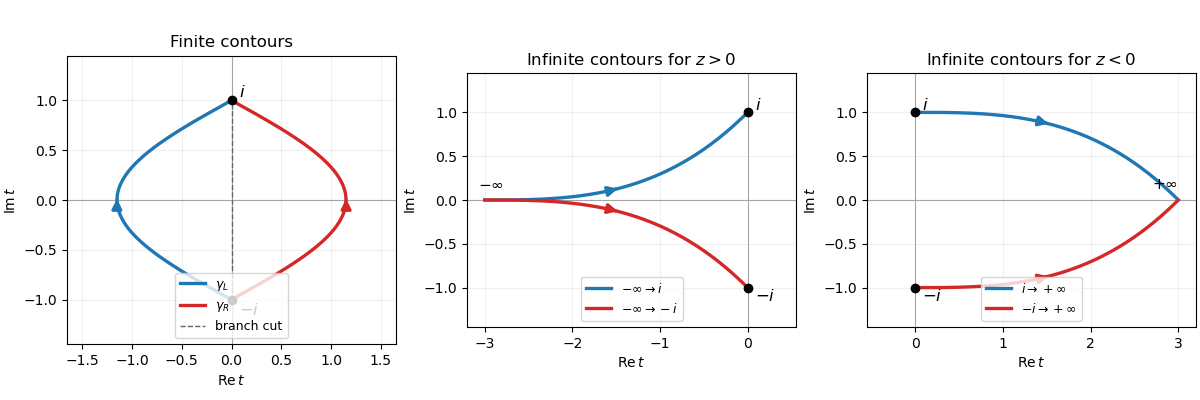
Contour choices for the Laplace transform
. For , is entire, so path independence makes either contour give, up to orientation,Hence a nonzero constant multiple gives the solution
For real , the exponential decays as , so two allowed contours run from to and from to . For real , it decays as , so reverse the construction: run from or to . These are the infinite contours in the diagram.
For their integrals arefor the corresponding orientation changes only an overall sign. Taking the sum of the two exponentials produces a solution independent of :Its nonzero Wronskian with on proves linear independence.
Articles by others on the same topic
There are currently no matching articles.