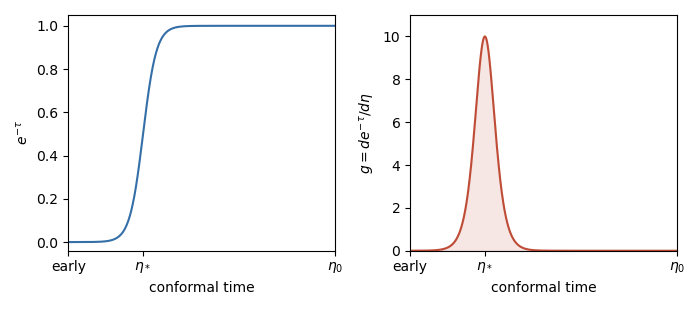
Put , the Thomson scattering rate per unit conformal time. The cosmological optical depth is the integrated scattering rate from emission time to observation, so a Poisson scattering process has survival probabilitySince , the cosmological visibility function isA photon scatters in an interval with rate factor and then reaches us without another scattering with probability , so is its probability of last scattering in that interval. For an optically thick initial epoch,If the initial optical depth is finite, the missing weight represents photons that have already stopped scattering before .
Before cosmological recombination, the optical depth to the present is enormous: , and is also small because almost every scattering is followed by another. Through photon decoupling, rises rapidly and has its dominant positive peak. After decoupling, without reionization, is close to one and reaches exactly one at , while is small because the remaining electron density and scattering rate are small. Residual ionization can give a weak tail; there is no second reionization peak. The peak marks the Cosmic microwave background last-scattering surface.

Let and let differentiate along the unperturbed photon trajectory. Use to decompose the Thomson scattering gain term:The Orthogonality of Legendre polynomials identifies as a pure photon quadrupole. Dropping is an approximation, justified when tight coupling makes the scattering quadrupole small; the supplied unpolarized equation already neglects polarization corrections. The Cosmic microwave background line-of-sight solution requested here omits that quadrupole source.
Set . Adding to the Photon Boltzmann equation with Thomson scattering yieldsAlong , the integrating factor is because . ConsequentlyAn early optically thick boundary makes vanish for finite initial perturbations, and . ThereforeHere and are partial time derivatives, not total derivatives along the ray. We work at first order in scalar cosmological perturbations, evaluate sources along the background radial null geodesic in FLRW spacetime, and ignore observer peculiar velocity. Perturbed paths and lensing affect this first-order source solution only at higher perturbative order. A moving observer adds its local Doppler dipole.
The original PDF, unlike the transcribed TeX, also asks for the instantaneous-last-scattering limit and its interpretation. For with no later scattering, and a matter-era growing mode with constant and , the Integrated Sachs-Wolfe effect vanishes. HenceThe four terms are the intrinsic emission temperature, the gravitational potential at emission, the observer's potential, and the Doppler CMB anisotropy. The two potentials describe the gravitational redshift; the observer term is independent of direction and is absorbed into the measured temperature monopole. The intrinsic temperature and emission potential form the Sachs-Wolfe combination. On superhorizon scales for adiabatic initial conditions in matter domination, , giving the ordinary Sachs-Wolfe effect . The Doppler sign is positive with the paper's propagation direction ; the viewing direction is .
Write and . Under the stated matter-era growing-mode approximation, , and ignoring velocities removes the Doppler CMB anisotropy. The two peaks of the cosmological visibility function give the Cosmic microwave background line-of-sight solutionApply the same solution with observation time , just before the thin reionization screen. Between recombination and that screen there is no further scattering, so free propagation givesA direction-independent potential commutes with the angular average. Thus the incoming photon monopole plus the potential at the screen isSubstitution givesThis derivation inherits the neglected scattering quadrupole and polarization assumptions of part (ii); the screen is an idealized isotropizing approximation.
For a plane Fourier mode , the angular average is explicit:where is the zeroth Spherical Bessel function. The mode's observed transfer isIf , the rescattered monopole is suppressed by at least , because the incoming directions sample incoherent phases. If , and the two propagation phases agree to leading order. The two weights then sum to one. ConsequentlyThese are the small-scale damping and large-scale coherence limits of reionization damping of cosmic microwave background temperature anisotropy.
Each small-scale primary temperature amplitude is multiplied by , so its Cosmic microwave background power spectrum is multiplied by . Holding transfer parameters fixed,Many measured high- modes determine this combination accurately. Their derivatives and are degenerate: a change leaves the leading temperature spectrum unchanged. The undamped large-scale modes can distinguish the parameters, but there are few of them and cosmic variance gives fractional full-sky uncertainty per multipole. This explains the primordial-amplitude–optical-depth degeneracy. Polarization from reionization, lensing, and more complete late-time effects partly break it. The TeX's final is a transcription mismatch; the PDF uses consistently.
Articles by others on the same topic
There are currently no matching articles.