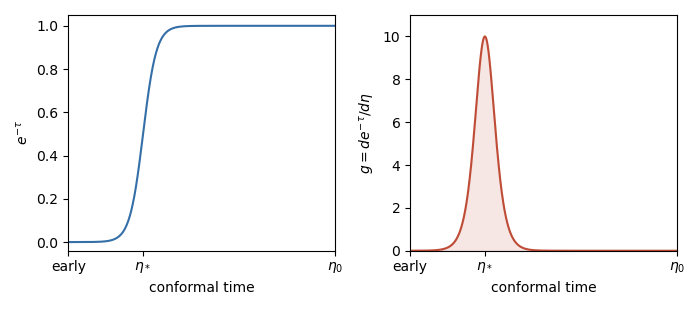
Put , the Thomson scattering rate per unit conformal time. The cosmological optical depth is the integrated scattering rate from emission time to observation, so a Poisson scattering process has survival probabilitySince , the cosmological visibility function isA photon scatters in an interval with rate factor and then reaches us without another scattering with probability , so is its probability of last scattering in that interval. For an optically thick initial epoch,If the initial optical depth is finite, the missing weight represents photons that have already stopped scattering before .
Before cosmological recombination, the optical depth to the present is enormous: , and is also small because almost every scattering is followed by another. Through photon decoupling, rises rapidly and has its dominant positive peak. After decoupling, without reionization, is close to one and reaches exactly one at , while is small because the remaining electron density and scattering rate are small. Residual ionization can give a weak tail; there is no second reionization peak. The peak marks the Cosmic microwave background last-scattering surface.

Articles by others on the same topic
There are currently no matching articles.