Measure angles from periapsis in the direction of motion. The true anomaly is the angle at the stellar focus between the pericentre ray and the star-particle radius vector. Draw the auxiliary circle of radius around the ellipse's center; the point on that circle with the same projected major-axis coordinate as the particle defines the eccentric anomaly at the center.
The mean anomaly is a uniformly advancing time phase, with at pericentre passage . It is the angle swept by a fictitious uniformly moving circular phase marker, not generally the actual position angle. The mean motion is the angular frequencyThe second formula is Kepler's equation, which converts the uniform time phase into geometric position.
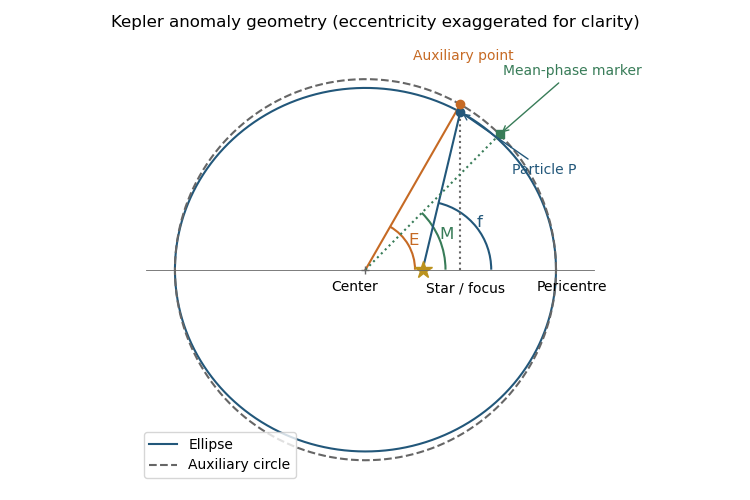

With the ellipse center as origin and its major axis horizontal, the auxiliary-circle construction gives particle coordinates , , while the stellar focus is at . ThereforeSquaring and adding gives . The Kepler orbit radius and the anomaly conversion are consequentlyEquivalently,The sine and cosine formulas, or a quadrant-aware angle function, fix the correct branch when using the half-angle relation.
Iterating Kepler's equation once gives . The exact radius expression then yieldsExpansion of the true anomaly conversion gives , soThe factor of two includes both the nonuniform relation between and and the change from center angle to focus angle .
Choose the common initial longitude of the particle and as zero. Let the fixed inertial longitude of periapsis be , positive ahead of that ray. At release , but the mean anomaly isThereafter , , and the particle's longitude is . The reference ray has longitude .
In the rotating reference frame, the radial axis points outward along the star- ray and the axis points forward. Define . The exact positional relations are
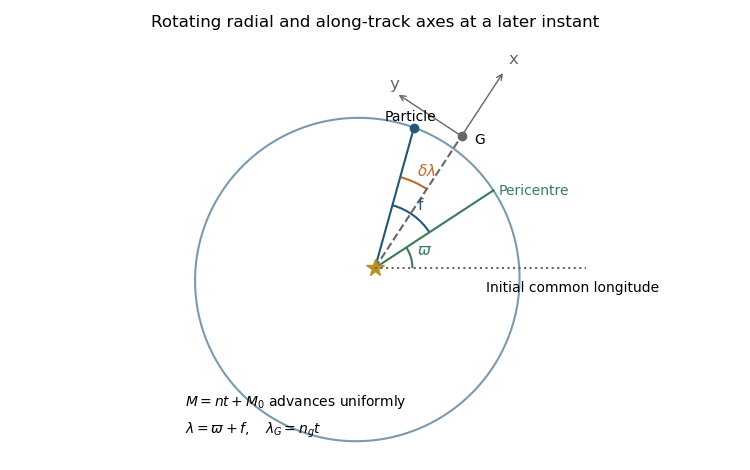

The diagram shows a later instant; initially , so . Retaining the correction in is what will preserve that initial condition in the approximate trajectory.
To first order, the initial-phase correction in can be omitted inside a term already multiplied by . ThusFor and , expand the exact rotating reference frame coordinates. Products of the small radial and angular displacements are second order. This givesAt the two sine terms cancel, as required. Equal mean motion gives a closed local epicyclic motion with radial-to-tangential amplitude ratio ; unequal mean motion adds along-track drift. The local expansion also requires , so small frequency mismatch alone does not justify it for arbitrarily large times.
Write and . The leading Keplerian shear isThe distinction between total mass and the individual planet's two-body central mass is order , below the retained order .
At one common reference epoch, the local Kepler orbit expansion takes the formwhere is the initial mean longitude relative to the rotating reference ray. Comparing its sine and cosine coefficients with the free solution of Hill equations givesThe required orbital elements from Hill coordinates are thereforeThese equalities have the first-order accuracy of the local approximation. If , the longitude of periapsis is undefined. The combination fixes the initial true longitude divided by . The special initial alignment imposed in part v would require , but the general two-planet solution need not impose it.
Substitution also verifies and : these are the unforced Hill equations. Close encounters add mutual-gravity forcing and can change the constants. Replacing by in the oscillation is consistent at leading order over local orbital times; accumulated phase differences must be retained when following much longer evolution.
Articles by others on the same topic
There are currently no matching articles.