For bosonic fields, time ordering places operators with later time arguments to the left:Normal ordering places all creation operators to the left of all annihilation operators and is denoted by colons. A Wick contraction isWick theorem stateswhere each sum runs over inequivalent disjoint pairings and contracted fields are replaced by their Feynman propagator.
Write each free field as creation and annihilation parts, . Moving every annihilation part to the right produces commutators , which are precisely the contractions. Applying the identity once and then normal ordering the remaining field givesNo double contraction is possible for three fields. This is exactly Wick theorem at .
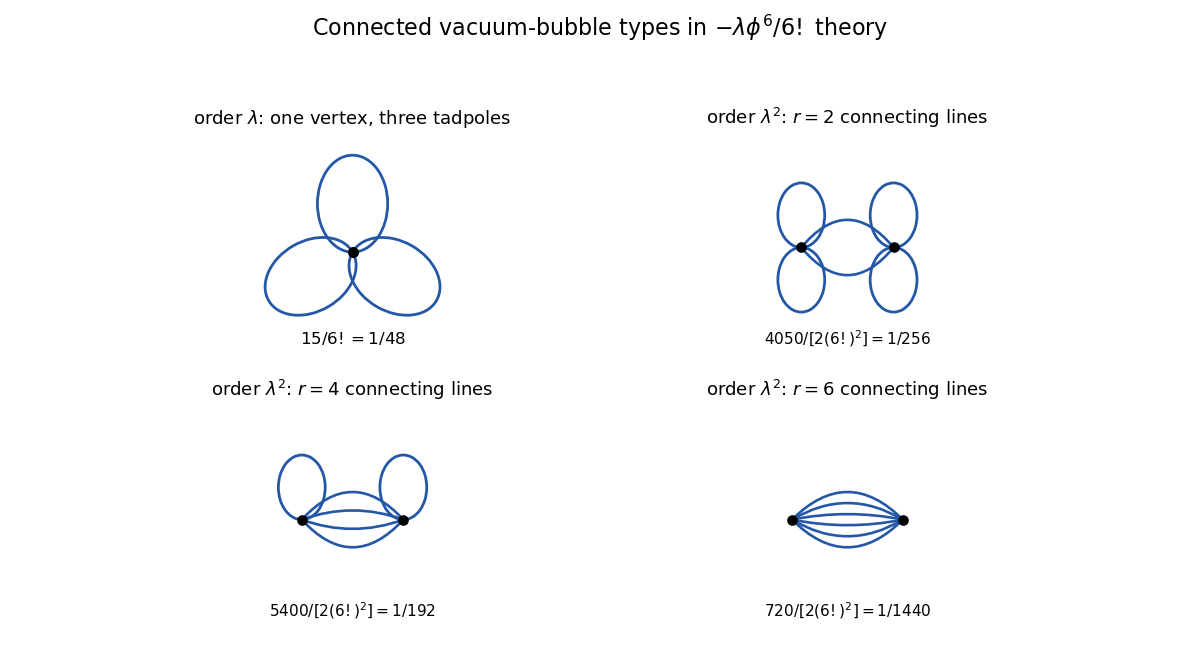
For Phi-six theory, let and . The Dyson series givesAt one vertex, Wick theorem supplies pairings. At two vertices let be the number of propagators joining them. It must be or , and the number of contractions isThereforeThe four Vacuum Feynman diagram types are shown below. The term is two disconnected copies of the order- three-tadpole graph; the other three are connected.

Articles by others on the same topic
There are currently no matching articles.