A spacetime translation gives, by Noether theorem, the canonical stress-energy tensorThe Klein-Gordon equation implies . With canonical momentum , the conserved physical three-momentum isThe minus sign follows from for metric signature .
Insert the mode expansion of a free field into the classical expression for . The and terms cancel after , while the mixed terms give, after the stated normal ordering,Thus the momentum operator counts each occupied mode with weight .
The vacuum has zero momentum and is invariant under translations. HenceThus a one-particle momentum eigenstate remains the same ray and acquires the translation phase appropriate to its momentum.
Similarly . Transforming both terms of the field expansion givesTherefore the spatial translation operator generated by translates the field argument. Equivalently, its action on states translates a wavefunction in the opposite argument convention.
With all momenta incoming and Fourier convention , differentiating the scalar contributes . The sole interaction vertex is thereforewhere enters on the scalar line; reversing the convention reverses the irrelevant overall sign. The free internal lines use the Dirac propagatorand the scalar Feynman propagator . Momentum is conserved at the vertex.
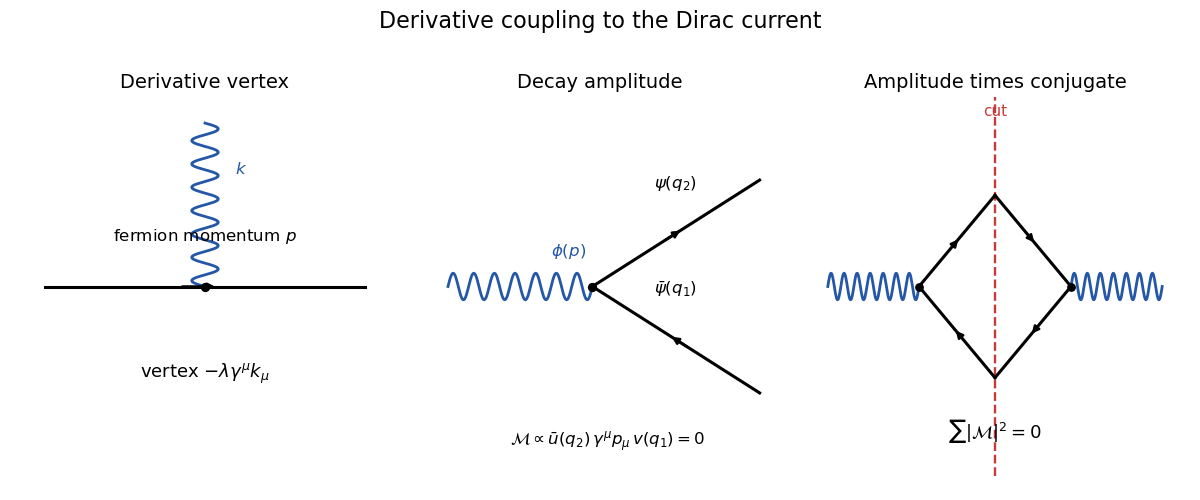
In four spacetime dimensions , , and . HenceThe coupling is an irrelevant coupling by power counting in quantum field theory, so it is a nonrenormalizable interaction that would ordinarily define only an effective theory with a cutoff. Here it is also a redundant operator: integration by parts gives up to a boundary term, and the Dirac current is conserved. This derivative coupling to a conserved current is removed exactly by the local phase redefinition .
The tree amplitude is, up to an overall convention-dependent sign,The Clifford algebra gives the momentum-space Dirac equation and its adjoint:ThereforeAlthough permits the relativistic two-body decay kinematically, the matrix element vanishes. Thus
Every scalar-fermion vertex contracts the scalar momentum with the Dirac current. Between on-shell external spinors,and the analogous particle-antiparticle identity also vanishes. Equivalently, the field redefinition in the previous part turns the theory into a free theory. Consequently every putative tree channel for has zero amplitude and
The required QED Feynman rules are the electron-photon vertex , the internal electron propagatorthe external spinors and , and photon factors and . Momentum conservation is imposed at both vertices.
There are two tree-level Feynman diagrams for Compton scattering: an -channel ordering in which the electron first absorbs the incoming photon, with internal momentum , and a crossed -channel ordering in which it first emits the outgoing photon, with internal momentum .
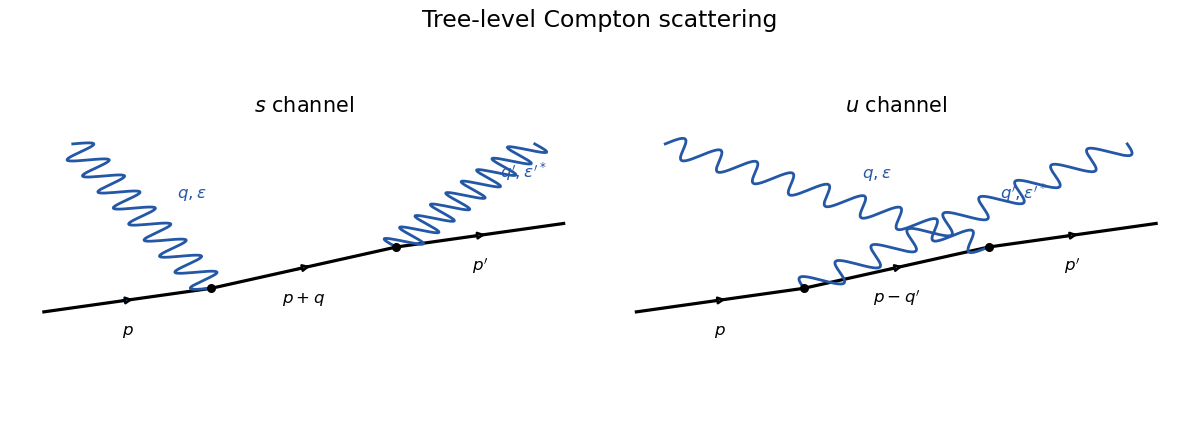
Tree-level Compton-scattering diagrams
. The two orderings of photon absorption and emission give the electron-exchange s-channel and u-channel diagrams. Details.Multiplying the QED Feynman rules in fermion-line order gives, up to the common convention for ,The two terms are both required by the Ward identity; replacing either external polarization by its photon momentum makes their sum vanish after using momentum conservation and the external Dirac equations.
Average over the two initial electron spins and two initial photon polarizations, and sum over the final ones. The supplied fermion spin sum and photon polarization sum turn the result into gamma-matrix traces. The Clifford algebra impliesby anticommuting the outside matrix through the product. Together withthe two channel squares reduce, at , to and ; the remaining cross terms cancel. Thus, in terms of the Mandelstam variables,Physical Compton kinematics has and , so the displayed expression is nonnegative.
For bosonic fields, time ordering places operators with later time arguments to the left:Normal ordering places all creation operators to the left of all annihilation operators and is denoted by colons. A Wick contraction isWick theorem stateswhere each sum runs over inequivalent disjoint pairings and contracted fields are replaced by their Feynman propagator.
Write each free field as creation and annihilation parts, . Moving every annihilation part to the right produces commutators , which are precisely the contractions. Applying the identity once and then normal ordering the remaining field givesNo double contraction is possible for three fields. This is exactly Wick theorem at .
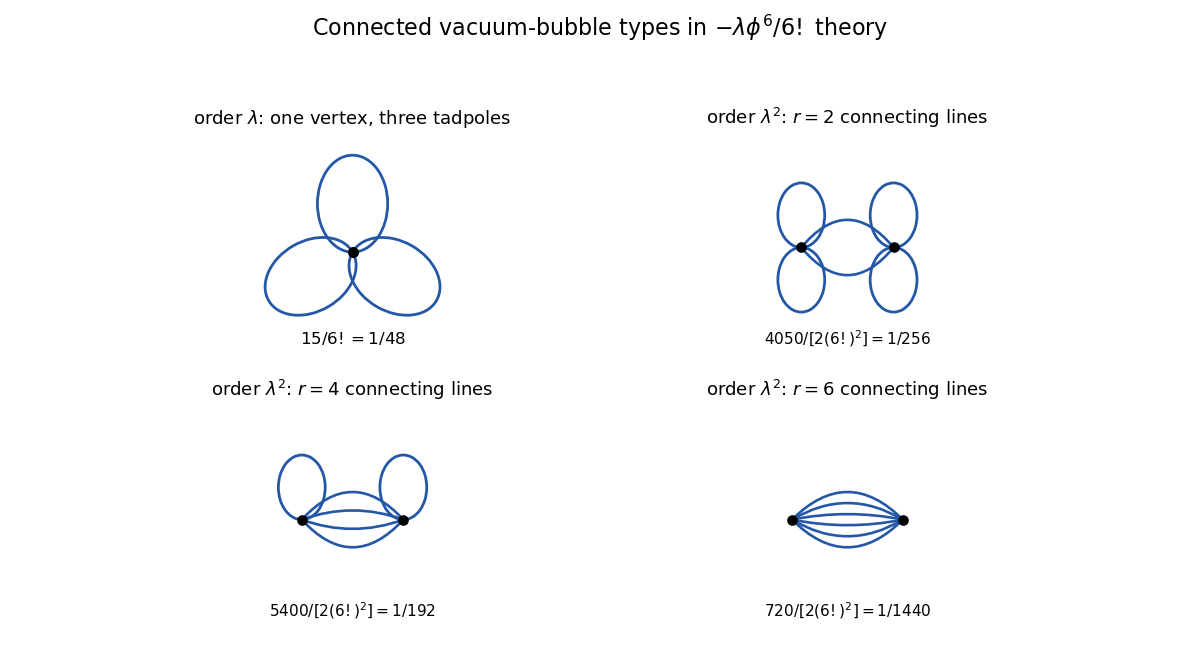
For Phi-six theory, let and . The Dyson series givesAt one vertex, Wick theorem supplies pairings. At two vertices let be the number of propagators joining them. It must be or , and the number of contractions isThereforeThe four Vacuum Feynman diagram types are shown below. The term is two disconnected copies of the order- three-tadpole graph; the other three are connected.


Articles by others on the same topic
There are currently no matching articles.