Expand the secular Poynting–Robertson drag rates using and . Through second order in orbital eccentricity,The second formula follows from . The cubic correction in contributes only at fourth order in .
In resonant trapping of dust, the resonant torque must compensate the inward Poynting–Robertson drag. At the nearly fixed resonant semi-major axis, requiresSince , a necessary torque-balance condition is . When the limiting orbital eccentricity is small, this givesEquality allows only the extreme phase , with no margin for restoring torque; a robust trapped state needs . This is a necessary condition for resonance capture, not a sufficient probability-of-capture criterion for a migrating particle.
Write and use the torque balance from part (ii) to eliminate the resonant argument. The resonant contribution isAdding the Poynting–Robertson drag contribution gives the dissipative resonant eccentricity equilibrium equationwhereFor , integrating with givesHere is the fixed resonant semi-major axis and the expression describes averaged evolution, neglecting the small resonant-argument libration. The physical bound-orbit interpretation also requires ; a quantitatively controlled second-order calculation needs .
At , torque balance givesThe magnitude of the right-hand side must not exceed one. This fixes the dissipative offset of the resonant-argument libration centre.
For , put . The two torque-balanced phases are and , modulo . In the usual weak-perturbation pendulum approximation, and . Restoring libration thus selects , givingIt approaches when drag is weak compared with resonant torque. For , the corresponding restoring branch has and approaches zero. The sine equation is the direct result independent of this leading-order stability approximation.
At periapsis, the particle's mean longitude equals its longitude of periapsis: . Hence the pericentre geometry of an exterior resonance givesThe resonant argument therefore fixes the angular separation from the planet whenever the particle reaches periapsis. With and planetary radius , the actual separation isThus a restricted libration phase can prevent close encounters even when the radial ranges of the two orbits overlap: this is resonance protection.
The specific angular momentum is , so the periapsis angular speed isAt the exterior mean-motion resonance, neglecting radiation pressure, . Thus at the limiting orbital eccentricity ,The condition for overtaking the planet in angle isFor the formal second-order equilibrium, it holds for every physical bound value . To see this, rewrite , so . For , , whileThe instantaneous angular motion is therefore prograde relative to the planet near periapsis, although its mean relative motion is retrograde. The range is the regime where the eccentricity expansion is most reliable.
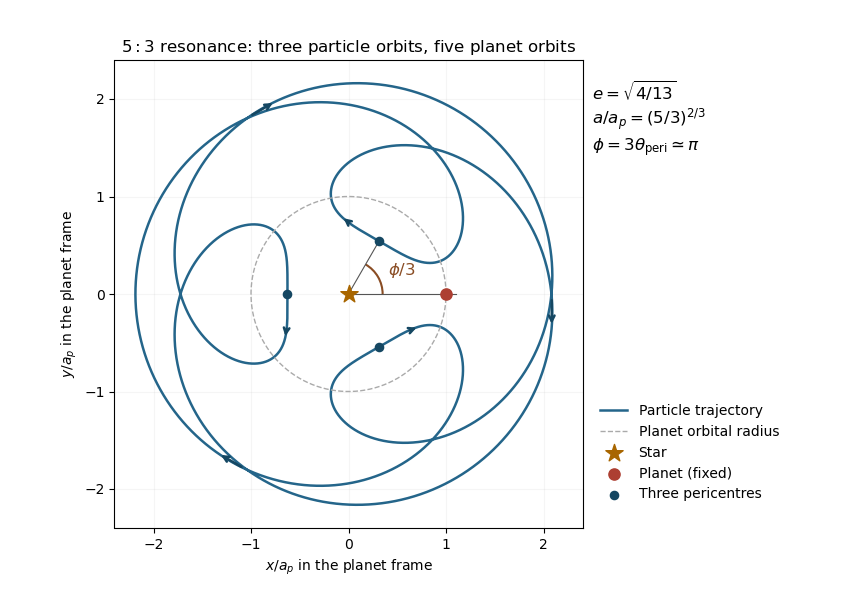
For the exterior mean-motion resonance, , . The truncated dissipative resonant eccentricity equilibrium givesFor weak drag and , take the resonant-argument libration centre . The pericentre geometry of an exterior resonance then places the three pericentres at angles , , and relative to the planet. The trajectory closes after three particle orbits and five planet orbits. It moves retrograde in the rotating frame on average but develops a prograde loop near each periapsis, because the periapsis angular speed exceeds the planet's angular speed.

Articles by others on the same topic
There are currently no matching articles.