The three fixed- estimates below cease to be uniform as the minimum of the phase approaches the endpoint. For the cubic endpoint-to-saddle transition, writeThe Taylor series of the hyperbolic sine gives, for bounded and fixed ,The cubic term controls the tail, so localization of the Laplace integral gives the uniform leading formulaHere is the cubic Laplace transition integral, equal to in terms of the Scorer Hi function.
To recover the endpoint regime, let . Scale in ; the cubic term becomes negligible and . Thereforewhich agrees with part (i) in the overlap . At , the Gamma integral gives , recovering part (iii).
For , set . The exponent has its maximum at , with second derivative . Thus Laplace's method givesand the transition formula becomesFor with , part (ii) hasPutting reproduces both the exponential and its prefactor. For relative agreement of these leading exponentials, one may use the overlap , which makes . Thus the same transition integral connects all three regimes.
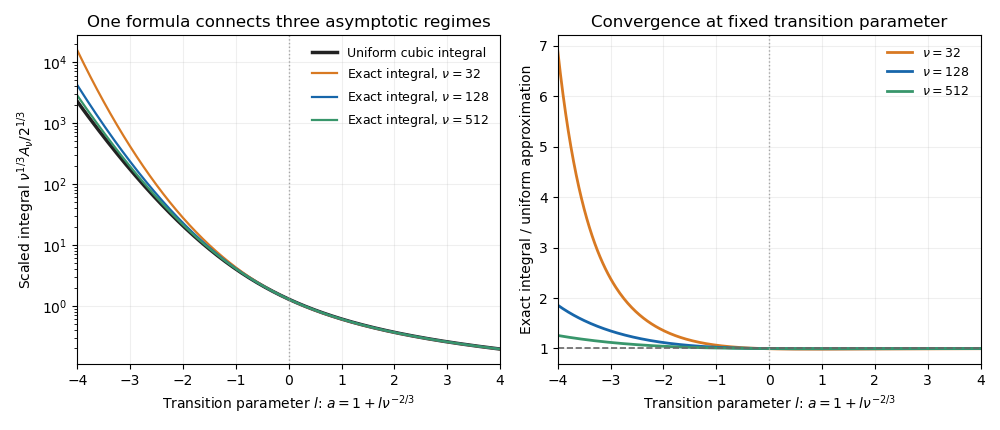
The cubic endpoint-to-saddle transition
. Direct numerical integration of the original phase approaches the same cubic transition function as the large parameter increases. Negative transition parameter places the minimum inside the interval; positive parameter leaves an ordinary endpoint minimum. Details.
Articles by others on the same topic
There are currently no matching articles.