PutThe equilibrium points of a dynamical system form the three branch familiesFor a simple equilibrium, fixed point stability for an autonomous differential equation is determined by the sign of . On the three families,Thus solid branches in the figure are stable and dashed branches are unstable.
If , the pair emerges stably from at in a pitchfork bifurcation. At , the pair meets with unstable nonzero branches; after reversing the parameter orientation this is a subcritical pitchfork bifurcation. At , the two positive branches cross and exchange stability, as do the two negative branches, giving two simultaneous transcritical bifurcations at .
If , every branch meets at . For only the stable trivial branch exists. For , is stable, the inner branches are unstable, and the outer branches are stable. This is a degenerate fifth-order bifurcation rather than a generic pitchfork.
If , a supercritical pitchfork bifurcation occurs at : the trivial branch loses stability and the stable branches emerge. At , the unstable branches meet the trivial branch, which regains stability; this is the parameter-reversed form of a subcritical pitchfork bifurcation.
These cases comprise the bifurcations of the 2020 Cambridge quintic system.
Suppose . Near the pitchfork at , put . Keeping the lowest terms that distinguish the branches givesSince , this is the pitchfork bifurcation normal form: the zero branch changes from stable to unstable and the stable branches appear for .
Near , put . ThenHere , so for the zero branch is stable and the two nearby nonzero branches are unstable. This confirms the parameter-reversed subcritical pitchfork bifurcation.
Finally fix either and putThe two vanishing factors have the leading expansionsWith the parameter-dependent coordinate ,This is the transcritical bifurcation normal form: the branches and cross and exchange stability.
After adding , the equilibrium equation isThe constant term breaks the reflection symmetry . Consequently each symmetry-forced pitchfork becomes an imperfect pitchfork bifurcation, while each crossing that produced a transcritical bifurcation is disconnected. The remaining generic turning points are saddle-node bifurcations. The lower row shows this unfolding for a representative small positive ; the upper row gives the unperturbed diagrams.
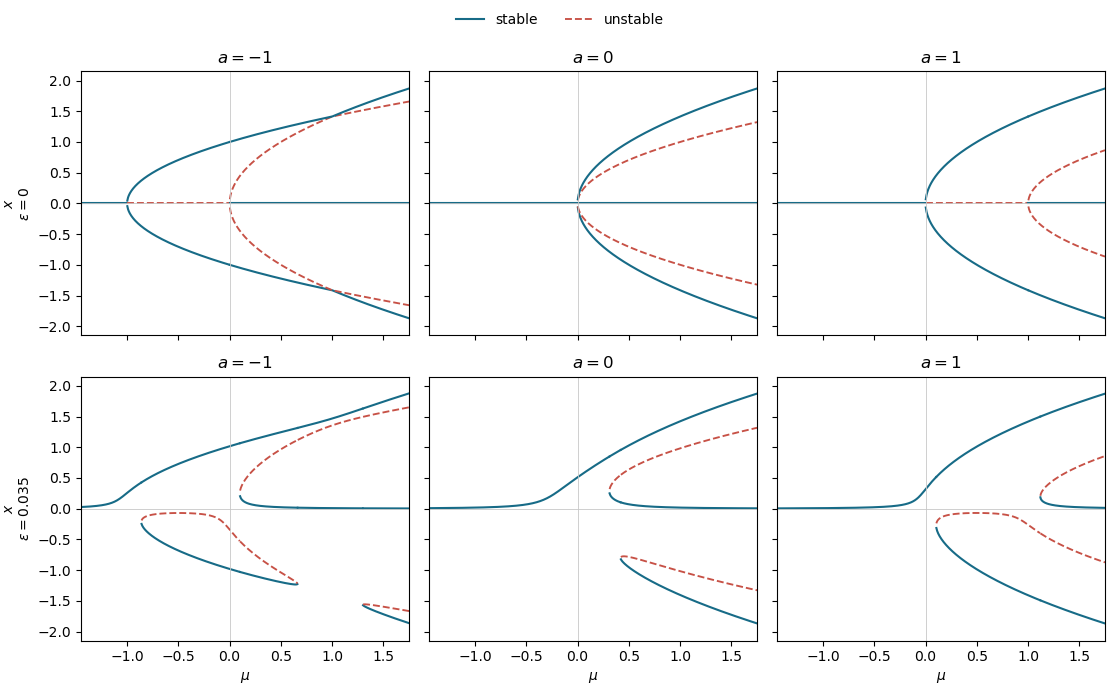
Bifurcation diagrams for the equilibrium branches
. Details. 
For , both pitchforks and both transcritical crossings are destroyed. For , the simultaneous fifth-order meeting splits into separated folds. For , both pitchforks become imperfect. Hence, under the allowed constant perturbation,This is the structural stability of a bifurcation distinction between the nongeneric pitchfork and transcritical diagrams and the generic saddle-node diagrams left by their unfoldings.
Articles by others on the same topic
There are currently no matching articles.