The fundamental theorem of regular space curves states that smooth functions and determine a unit-speed regular curve in with that curvature and torsion, uniquely up to a proper Euclidean motion of Euclidean three-space. Existence follows by solving the Frenet-Serret formulas for an oriented orthonormal frame and then integrating its tangent vector.
The map is a local arc-length coordinate and, when the image is closed, a covering parametrization. The restriction of to the one-dimensional submanifold therefore lifts to a map satisfyingBoth curves have unit speed and is an isometry, so . Continuity makes the sign constant on the connected domain, hence throughout andfor some constant .
A proper Euclidean motion of Euclidean three-space preserves both curvature and torsion. Reversal of an arc-length parameter also preserves them: in the determinant formula for torsion, both the first and third derivatives change sign. Comparing the two expressions for the transformed curve givesand, wherever ,
If the sign is plus and , then fixes every point of the curve. A nonidentity proper Euclidean motion with any fixed points is a rotation, whose fixed set is its rotation axis. Thus lies on that axis and is a straight line.
For , the closed curveis embedded on a torus and satisfiesAfter arc-length parametrization, it meets all the requirements of part (b). Its bending and twisting vary around the two waves, so neither curvature nor torsion is constant.
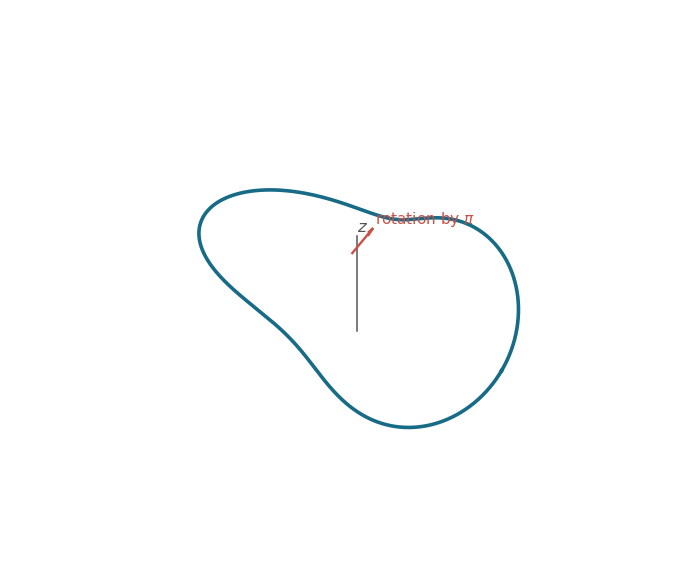
LetThis is another unit-speed embedded curve. The assumed identities say that and have the same positive curvature and the same torsion. By the uniqueness part of the fundamental theorem of regular space curves, there is a proper Euclidean motion such thatSince is a bijection of , this motion preserves .
Articles by others on the same topic
There are currently no matching articles.