Write the continued fraction as and define its convergents byInduction using these recurrences givesIn particular, consecutive convergents have coprime numerator and denominator. The standard best-approximation consequence of the same determinant identity is that, for and ,Dividing by givesThe contrapositive proves that any strictly better approximation has .
For , the continued-fraction algorithm givesand the remainder then repeats. HenceThe convergent supplies a solution of the Pell equation:
The Legendre polynomial is orthogonal on to every polynomial of degree below . Suppose it changes sign at only distinct interior points , and putchoosing its overall sign so that on . This product is positive except at finitely many points, socontradicting orthogonality because . Thus has at least sign-changing roots in ; its degree is , so these are all its roots and they are distinct.
For arbitrary distinct nodes , letbe the Lagrange basis polynomials. Every polynomial of degree below satisfies , so the required weights exist and areThey are unique because applying any such formula to recovers .
Now assume exactness for every of degree below and define . For every polynomial of degree below , the product has degree below and vanishes at every node. ThereforeThere is a unique monic polynomial of degree orthogonal to all lower-degree polynomials, so is the monic normalization of and the are precisely the roots of . Taking givesFinally has degree , so exactness givesThese are the positive weights of Gaussian quadrature.
For a discrete memoryless channel with input and output , its information capacity iswhere is the mutual information and the maximum is over all input distributions. Capacity is measured in bits when logarithms have base two.
With rows indexed by outputs and columns by inputs , the channel matrix isThis is a binary erasure channel with erasure probability . Conditional on no erasure, the input is recovered exactly, whereas an erasure supplies no information. Thuswhich is maximized by the uniform input distribution. Therefore
Let . The merged channel is a Binary Z-channel: its second output occurs with probability , while the output has one bit of uncertainty only when . In terms of the binary entropy function ,At an interior maximum,so and . Consequently
A subset is recursive when its indicator function is a total computable function. It is recursively enumerable when it is the domain of a partial computable function, equivalently when an algorithm can enumerate its members.
If is recursive, its indicator decides both and its complement, so both sets are recursively enumerable. Conversely, suppose programs enumerate and . On input , run the two enumerations in parallel by dovetailing. Exactly one must eventually print ; accept in the first case and reject in the second. This algorithm always halts and decides . Hence
The setis the diagonal halting set. It is recursively enumerable by simulating the coded machine, but it is not recursive by the halting problem diagonal argument.
By contrast, is recursive: decode , reject it if it is not a program code, otherwise simulate the program on input for exactly steps and accept precisely if it has halted. This bounded computation always terminates. Thus
Let be the indicator that man develops heart disease and let . The fitted logistic regression assumes independent Bernoulli responses with
Two packs contain cigarettes. Holding height fixed, increasing average consumption from zero to two packs per day changes the log odds byThe corresponding odds ratio is thereforeThus the model estimates that a two-pack-per-day smoker has about times the odds of heart disease of an otherwise comparable nonsmoker. This is an association in the fitted observational model, rather than by itself a causal conclusion.
Let be independent standard logistic random variables and define the latent variableSet exactly when . If is the logistic cumulative distribution function, its symmetry and the identity givewhich is precisely the fitted logistic regression.
At a nonzero fixed point, both bracketed per-capita growth rates vanish:Hence the coexistence equilibrium of this Lotka-Volterra predator-prey model is
Since , division of each population equation by givesDefine the Hamiltonian functionand the antisymmetric matrixThen
Along a solution, the chain rule and antisymmetry of givebecause for every real vector . ThereforeThe closed level curves around the strict minimum at the coexistence equilibrium are the periodic population cycles of the Lotka-Volterra predator-prey model.
The poles of inside are . Near , write . Its Laurent series beginsso the residue is . The sum of the three residues isThe positively oriented residue theorem now gives
If is measured in the rotating frame, its inertial velocity is . The masses producing the gravitational field are stationary in this frame, so their potential energy is a time-independent function . Thus kinetic minus potential energy gives the stated LagrangianPut . ThenSubstitution in the Euler-Lagrange equation yieldsThe extra terms are the Coriolis acceleration, Euler acceleration, and centrifugal acceleration of a rotating reference frame.
For and , putThe slow-roll approximation gives andTherefore, with ,Since , integration of the Hubble parameter gives
The required identity isthe first exponent in the scanned statement should be . Indeed, changes the parity label from to , while multiplies the component whose first qubit is by , creating the phase label. Equivalently, the hint permits either one-qubit operator to be transferred to the second half of the Bell state by transposition.
This is superdense coding. To send the two classical bits , Alice applies to her half of the shared Bell state , producing , and sends that one qubit to Bob. Bob applies followed by on the first qubit, as in part (i), and measures both qubits in the computational basis. The outcome is with certainty, so one transmitted qubit communicates two classical bits using the previously shared quantum entanglement.
Label the edges so that barycentric coordinates on satisfySuppose for contradiction that . The distance from a point to a closed set gives continuous nonnegative functions . Their sum never vanishes, while at every point at least one of them vanishes because . Henceis a continuous map from to its boundary in barycentric-coordinate space. Moreover, , , and . On each edge, the straight-line homotopy between and the identity remains in that edge, so has winding number one. On the other hand, a map from the whole triangle to its boundary makes its boundary restriction null-homotopic, and hence gives winding number zero. This contradiction proves the three-set covering lemma:
If a retraction fixed every boundary point, choose a homeomorphism from to taking its three edges to three consecutive closed arcs of with empty triple intersection. The inverse images under of those arcs would be closed, would cover , and would contain the corresponding boundary arcs. Transporting them to would contradict the result just proved. Therefore
For the final statement, use compactness of the three closed arcs inside the corresponding open sets. A finite open cover of a compact metric space admits a closed shrinking, and the shrinking can be chosen to preserve specified compact subsets already lying in the respective open sets. Thus there are closed setswhich cover and contain , respectively. The disc version of the three-set covering lemma, obtained from the triangle by a homeomorphism taking its edges to the three arcs, gives a point in . Since these sets lie in the original open sets,
The columns of the parity-check matrix of the binary Hamming code are precisely the distinct nonzero vectors of . If , then is nonzero and differs from both summands, so it occurs as a unique third column .
A word supported on three positions is a codeword exactly when the corresponding three columns sum to zero. Every unordered pair of columns determines one such triple, and each triple is counted once by each of its three pairs. Therefore
Sum all nonzero vectors of . In each coordinate, exactly vectors have entry one, which is even because . The sum is therefore zero, soThus the all-one word belongs to the Hamming code and has Hamming weight .
Adding the all-one codeword is a bijection from to itself, and it replaces every bit by its complement. It therefore sends weight to weight , provingThe code has one word of weight zero and, since its minimum Hamming distance is three, no words of weight one or two. Combining this with part (i) gives
The string is initially at rest, so . Taking the Laplace transform in converts the wave equation intoFor , the solution that decays as is . The transformed boundary condition fixes , and therefore
For ,The Bromwich inversion formula givesWhen , close the contour to the left. The residues at sum to . When , close it to the right, where there are no poles, and the integral vanishes. HenceEquivalently, in terms of the Heaviside step function. The boundary oscillation travels to the right at wave speed without reflection or dispersion; a point at begins moving after the propagation delay .
In the Euler angles for a symmetric top convention, is the inclination of the body symmetry axis from the fixed vertical, is the azimuth of the line of nodes in the fixed horizontal plane, and is rotation about measured from that line:
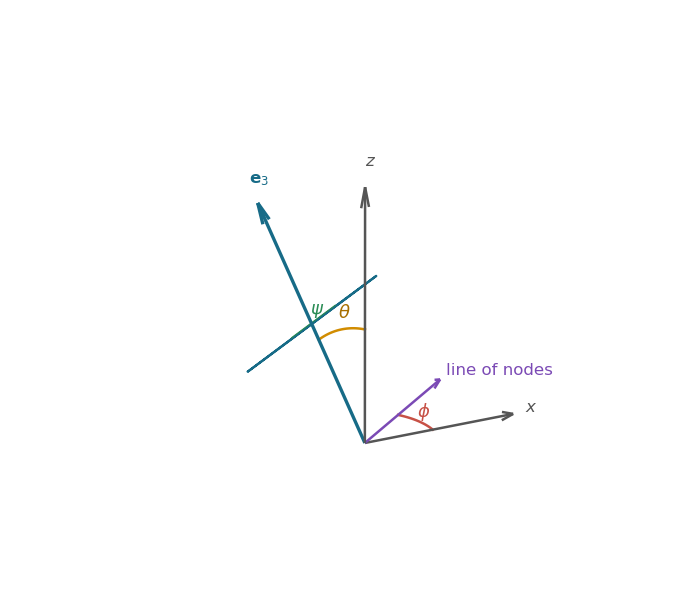
The coordinates and are cyclic, so their canonical momenta are conserved:Because the Lagrangian has no explicit time dependence, the conserved energy isThese are the three integrals of motion requested.
Solving the two momentum equations givesSubstitution into the conserved energy reduces the heavy symmetric top to one-dimensional effective potential motion:whereThis is the heavy symmetric top reduction.
Put and seek . Using and , the -dependent part of the effective potential isIt has a local minimum precisely whenwhich is the gyroscopic stabilization of an inverted symmetric top condition. Differentiating the displayed approximation givesand henceTaking without loss of orientation, the steady precession rate isso
Starting from the -qubit computational basis state , apply one Hadamard gate to every qubit. Since ,Thus parallel Hadamard gates prepare the uniform quantum superposition.
The Hadamard gate conjugates the Pauli X gate into the Pauli Z gate:When the control qubit is , all three circuits act as the identity on the target. When it is , the right-hand circuit acts on the target as . It therefore agrees with the Controlled-Z gate on every computational basis state, provingConjugating both sides by and using immediately gives the reverse identity
The three controlled-NOT gates have directions , , and . On computational basis bits they act asBy linearity, the whole quantum circuit is the SWAP gate. Thereforeso and .
After the first Hadamard gate, the joint state isThe controlled SWAP gate then givesAfter the second Hadamard gate, it is
The Born rule says that each probability is the squared norm of the corresponding ancilla component. Since the states are normalized,Consequently
This circuit is the swap test. If the two pure states are identical up to a physically irrelevant global phase, then and outcome one never occurs. If they are distinct, then and each run produces outcome one with positive probability .
Run the circuit independently on fresh copies. Observing even one outcome one proves that the states differ. If no one occurs in runs, that event has probabilitywhen the states differ, which tends to zero as . Repetition therefore distinguishes equality from inequality with arbitrarily high probability.
Define a valuation on primitive propositions byThe assumptions say exactly that is a maximal consistent set in propositional logic. A structural induction on formulae provesFor example, consistency and the decision property give exactly when , while deductive closure gives exactly when both ; the other connectives follow similarly. Every member of is therefore true under , so
The Godel completeness theorem says that for every first-order theory and sentence ,Together with soundness, this is equivalence; it is also equivalent to saying that every syntactically consistent first-order theory has a model.
The compactness theorem states that a set of first-order sentences has a model if and only if every finite subset has a model. To deduce it, suppose every finite subset is satisfiable but is not. Then , so completeness gives a formal proof . A proof uses only finitely many assumptions, yielding some finite , contrary to that subset's satisfiability.
Introduce a propositional variable for every and . Form a theory containing, for every , clauses saying that exactly one ofis true, and, for every and every , the clauseEvery finite subset of these clauses mentions only finitely many elements, forming a finite set . The assumed coloring gives that finite subset a model. The propositional compactness theorem, equivalently the propositional consequence of first-order compactness, therefore gives a model of all the clauses.
For each , let be the unique for which is true. The edge clauses ensure that whenever . Hencehas the required property.
For nonadjacent vertices , the local connectivity is the minimum cardinality of an - vertex separator: a set such that and lie in different components of .
To prove the vertex form of the Menger theorem, replace every vertex by an arc of capacity one. Replace every undirected edge by directed arcs from to and conversely, each of capacity larger than ; leave unsplit. An integral - flow of value decomposes into paths, and the unit-capacity vertex arcs force the corresponding graph paths to be internally vertex-disjoint paths. Conversely, such paths give an integral flow of value .
Because and are nonadjacent, any finite minimum cut consists entirely of unit-capacity vertex arcs. These arcs correspond exactly to an - vertex separator of the same size. The max-flow min-cut theorem, whose augmenting-path proof also guarantees an integral maximum flow for integral capacities, therefore givesIn particular, contains the required set of paths.
For , choose a cycle for which some -bridge has at least three attachment vertices ; such a choice is always possible in a 3-connected graph. Indeed, every component outside a cycle has at least three attachments, since one or two would form a vertex cut, and if a chosen cycle is spanning, a chord can be used to choose a smaller cycle and expose the remaining bridge. In a minimal connected part of that bridge joining , suppress degree-two vertices. The result has a branch vertex joined to by three paths whose interiors are mutually disjoint and avoid . The three arcs of between , together with these three paths, form a subdivision of the complete graph on branch vertices . Hence
A 3-connected graph need not contain a . The complete graph itself is 3-connected and has only four vertices, so it cannot contain a graph subdivision of . Equally, any planar 3-connected graph is a counterexample because a subdivision of the complete graph would be nonplanar.
Every fixes and permutes the roots of , so it preserves their splitting field . Restriction therefore defines a homomorphismIf is the identity, then fixes both and , which generate ; hence is the identity. Thus is injective, and its image is a subgroup:
Articles were limited to the first 100 out of 266 total.
Articles by others on the same topic
There are currently no matching articles.