Let brackets denote number densities and impose a local photochemical steady state. The atomic-oxygen and ozone balances areSubtracting gives . If photodissociation is the dominant direct ozone loss, , the second balance becomes . Eliminating atomic oxygen yields the Chapman ozone equilibriumHigh in the atmosphere ultraviolet photons make large but the third-body density is small; low down, is large but O2-dissociating ultraviolet radiation has been absorbed. Their product peaks at intermediate altitude, producing an ozone layer.
Comparable hydrostatic thermal escape requires comparable Jeans escape parameter . For the same escaping species and ,Thus Jupiter at 5 au needs an exobase temperature at least about thirty times Earth's at the same irradiation to have comparable Jeans escape flux.
For the inner planet, the usable EUV power is . If the binding energy per unit escaping mass is , energy-limited atmospheric escape givesThe time to lose a fraction of the planetary mass is thereforeThis neglects Roche-lobe reduction, radiative cooling, changes in radius and flux, and the planet's orbital evolution. If the gas is lifted only from , replace in the denominator by .
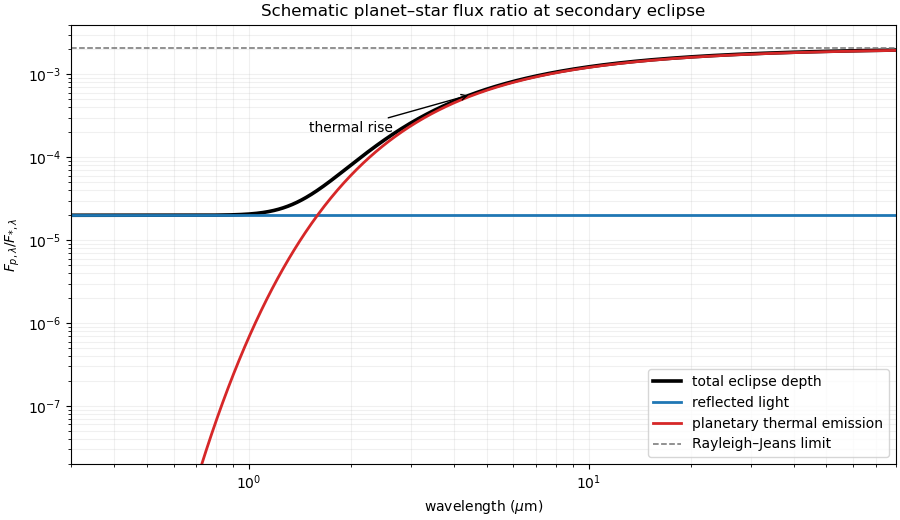
At exoplanet secondary eclipse, the full-phase planet-star flux ratio is the sum of reflected and thermal light. Approximating both bodies as unresolved blackbodies and taking wavelength-independent geometric albedo,The first term is a flat reflected-light level under the stated constant-albedo assumption. At short wavelength the cool planet lies in the Wien limit, so thermal emission is exponentially suppressed and reflection dominates. At long wavelength both spectra enter the Rayleigh-Jeans law, givingThe sketch therefore starts on the reflected plateau, rises where planetary blackbody radiation becomes important, and asymptotically approaches the long-wavelength plateau. This neglects spectral albedo features, phase dependence, stellar lines, and a nonisothermal planetary photosphere.

At fixed temperature and pressure, thermochemical equilibrium minimizes the Gibbs free energy subject to elemental conservation. For every independent reaction with stoichiometric coefficients ,Equivalently, forward and reverse rates satisfy detailed balance. For ideal gases,
Articles by others on the same topic
There are currently no matching articles.