For the plane-parallel radiative transfer equationangular integration gives the zeroth radiation-field moment equationThe net radiative heating per unit volume is thereforeRadiative equilibrium requires it to vanish, equivalently that the frequency-integrated radiative flux be independent of depth:In local thermodynamic equilibrium with coherent isotropic scattering,where is the single-scattering albedo. Since , the condition becomesConservative scattering redistributes directions but contributes no net material heating.
Put . For , the mean intensity isbecause the cubic term is odd. The K-integral, or second angular moment, isbecause the contribution is also odd. HenceThis intensity obeys the Eddington closure approximation even though it is not isotropic.
Deep in an optically thick grey atmosphere, write and retain the first spatial-gradient correction in the transfer equation:Angular and frequency integration then gives the radiative diffusion fluxFor a thin plane-parallel atmosphere, constant Rosseland mean opacity , negligible external irradiation, and radius nearly equal to , radiative equilibrium gives . ThereforeWith hydrostatic balance , the equivalent pressure form iswhere .
Let brackets denote number densities and impose a local photochemical steady state. The atomic-oxygen and ozone balances areSubtracting gives . If photodissociation is the dominant direct ozone loss, , the second balance becomes . Eliminating atomic oxygen yields the Chapman ozone equilibriumHigh in the atmosphere ultraviolet photons make large but the third-body density is small; low down, is large but O2-dissociating ultraviolet radiation has been absorbed. Their product peaks at intermediate altitude, producing an ozone layer.
Comparable hydrostatic thermal escape requires comparable Jeans escape parameter . For the same escaping species and ,Thus Jupiter at 5 au needs an exobase temperature at least about thirty times Earth's at the same irradiation to have comparable Jeans escape flux.
For the inner planet, the usable EUV power is . If the binding energy per unit escaping mass is , energy-limited atmospheric escape givesThe time to lose a fraction of the planetary mass is thereforeThis neglects Roche-lobe reduction, radiative cooling, changes in radius and flux, and the planet's orbital evolution. If the gas is lifted only from , replace in the denominator by .
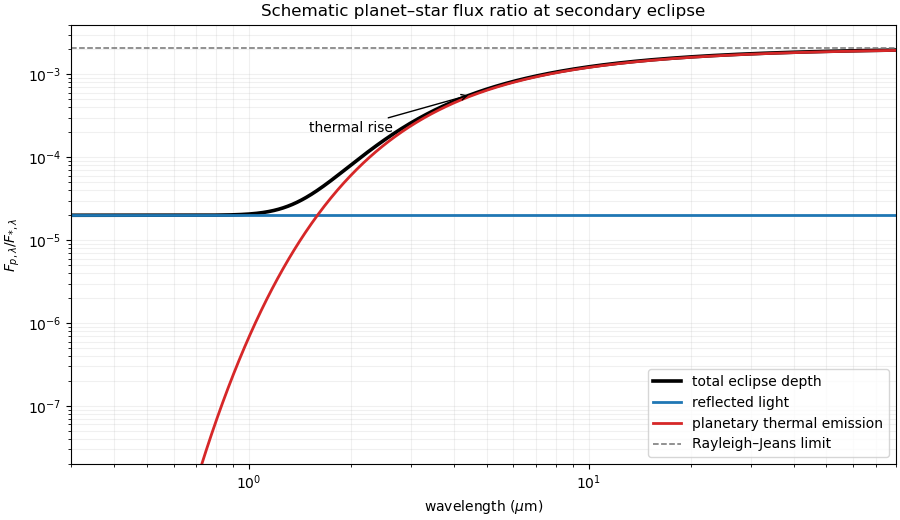
At exoplanet secondary eclipse, the full-phase planet-star flux ratio is the sum of reflected and thermal light. Approximating both bodies as unresolved blackbodies and taking wavelength-independent geometric albedo,The first term is a flat reflected-light level under the stated constant-albedo assumption. At short wavelength the cool planet lies in the Wien limit, so thermal emission is exponentially suppressed and reflection dominates. At long wavelength both spectra enter the Rayleigh-Jeans law, givingThe sketch therefore starts on the reflected plateau, rises where planetary blackbody radiation becomes important, and asymptotically approaches the long-wavelength plateau. This neglects spectral albedo features, phase dependence, stellar lines, and a nonisothermal planetary photosphere.

At fixed temperature and pressure, thermochemical equilibrium minimizes the Gibbs free energy subject to elemental conservation. For every independent reaction with stoichiometric coefficients ,Equivalently, forward and reverse rates satisfy detailed balance. For ideal gases,
For a spherical stellar polytrope with , the Lane-Emden equation givesEliminating the central density at fixed composition and entropy gives the polytropic mass-radius relationAn incompressible rocky body has and . A moderately massive gas giant is approximately an polytrope and has , explaining its weak radius dependence on mass. In a more strongly degenerate nonrelativistic regime, gives .
Assemble a uniform-density sphere from shells. Since and ,Hydrostatic equilibrium gives its central pressureThus, relative to the same uniform-density estimate for Earth,Using gives , while gives . Real central pressures differ because all three planets are compressible and compositionally stratified.
For uniform density, Kelvin-Helmholtz contraction releases binding energy . If mass and luminosity are constant and stellar heating is negligible at 90 au, the contraction age isEnergy conservation, , givesThe virial theorem places roughly half of the released gravitational energy into internal heat. Including that effect gives and .
In an infrared-opaque single-layer greenhouse model, the atmospheric layer obeys . The outgoing planetary flux is , while the globally averaged absorbed stellar flux is . Radiative equilibrium therefore givesHence the orbit at which the prescribed surface temperature can be maintained isThis assumes uniform redistribution, constant Bond albedo, unit longwave emissivity, a transparent atmosphere to starlight, and no internal heat. Without the greenhouse layer, replace by .
In an isothermal hydrostatic atmosphere, pressure falls as . If a water-band line core becomes optically thick at pressure and an opaque cloud fixes the nearby continuum at , the exoplanet transmission spectrum feature spansA two-scale-height feature therefore requiresTaking a representative near-infrared water-band pressure gives , so the appropriate estimate is an exoplanet cloud deck top near . The numerical value scales directly with the assumed line-core pressure.
Other explanations include a high mean molecular weight, subsolar water abundance, a colder terminator, atmospheric haze, patchy two-limb clouds, stellar contamination, or instrumental systematics. Optical scattering slopes, broader James Webb Space Telescope molecular coverage, repeated transits, secondary-eclipse spectra, phase curves, and precise mass and radius measurements can distinguish these possibilities.
Hydrostatic balance and the ideal-gas adiabatic temperature gradient implyThe radiative region is stable while . Equality at the radiative-convective boundary, together with , givesFor radiative diffusion carrying intrinsic flux , , soFor an irradiated hot Jupiter with , , , , and --, this gives roughly --.
Approximate the atmosphere above as isothermal with constant gravity and atmospheric scale height , soVertical transport over one scale height has eddy mixing timeThe chemical quench level satisfies . Since ,Above this level, mixing is faster than reaction and freezes the deeper abundance of A. Larger moves the quench level deeper and raises . Important examples are carbon monoxide–methane quenching and nitrogen–ammonia quenching; phosphine destruction is another tracer of vertical quenching.
Exoplanet clouds and atmospheric haze add scattering and absorption opacity to an exoplanet transmission spectrum. A high opaque deck truncates the slant path and mutes molecular bands, while small aerosol particles can produce a blue scattering slope; patchiness creates mixtures of clear and cloudy limbs. In an exoplanet emission spectrum, aerosols move the photosphere to lower pressure, weaken or reshape molecular features, alter the geometric albedo, and can heat or cool layers depending on their shortwave and longwave absorption.
Observed aspects of exoplanet atmospheric dynamics include eastward equatorial atmospheric superrotation inferred from shifted thermal hot spots, day-night heat transport measured by phase-curve amplitude, and high-altitude winds measured from Doppler shifts of resolved spectral lines. Time-variable phase curves and eclipse maps also reveal changing cloud patterns and storms.
Articles by others on the same topic
There are currently no matching articles.