The centre manifold theorem states that near an equilibrium whose linearization has centre, stable, and unstable spectral subspaces , there is a local invariant manifold tangent to at the equilibrium. It can be written locally as a graph over , and the dynamics on it govern the local nonhyperbolic behaviour. The manifold need not be unique, but its finite Taylor expansion is determined to the required order by the invariance equation.
For a parameter-dependent system, the key step in forming the extended centre manifold is to promote the parameter to a dynamical variable:The parameter direction then has zero eigenvalue and is included in the extended centre subspace.
The Jacobian isAt ,so one eigenvalue crosses zero atwhile the other remains negative. Thus a bifurcation occurs there.
On the -axis the nonzero fixed point isIts eigenvalues areThe second crosses zero atwhich is the second bifurcation value.
SetThenThe extended centre variables are and the stable variable is . Write the centre manifold as . At quadratic order, the invariance equationgivesSubstitution into the equation gives the leading normal formThis is a supercritical pitchfork: the branch loses stability as becomes positive and stable branches emerge. The original system is invariant under , so a pitchfork is exactly the symmetry-forced bifurcation expected. The physical quadrant displays its positive half.
At a fixed point with , the two bracketed factors must vanish:Subtracting givesHence the interior branch isNear , if , thenwhich agrees with both the centre manifold and the positive branch of the pitchfork normal form.
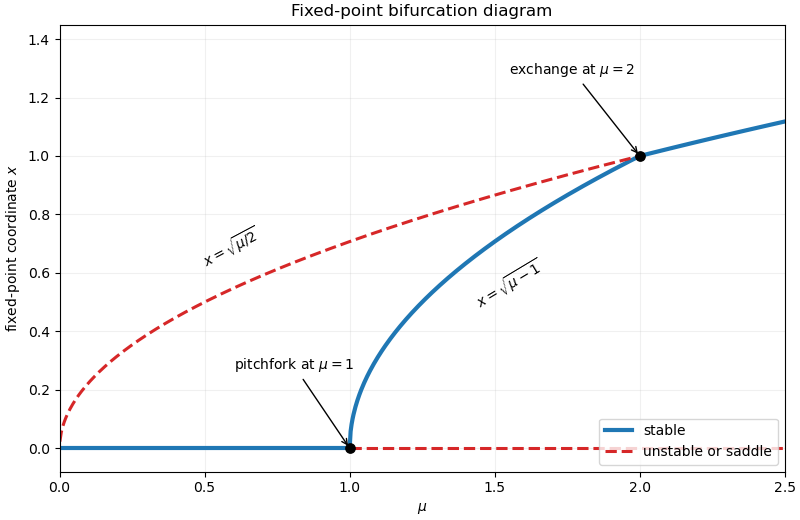
The fixed point branches and their stability are as follows.
- has eigenvalues and , so it is unstable for every .
- has and is stable for , then a saddle for .
- exists for all ; it is a saddle for and stable for .
- exists for . Its Jacobian matrix is
Thus the -versus- bifurcation diagram has the stable branch up to , a stable branch joining the bifurcation points and , and the branch changing from unstable to stable at . The origin branch also lies at but remains unstable throughout.
Articles by others on the same topic
There are currently no matching articles.