The inverse definitions areSubstitution into the hopping and pairing terms expresses the Hamiltonian as a bilinear in the Majorana fermion operators. Hermiticity makes its off-diagonal coefficients purely imaginary in the Majorana bilinear, whileremoves the symmetric part; diagonal terms are constants because . Therefore, up to that additive constant,whereConversely every real antisymmetric makes this expression Hermitian, so this is the general Majorana form of a quadratic fermion Hamiltonian.
DefineBecause is real orthogonal, the are again self-adjoint and satisfy the Majorana anticommutation relations. Using ,Each two-dimensional block contributes twice the same ordered bilinear:Henceup to the original additive constant.
At and , direct substitution ofinto the bond Hamiltonian makes the hopping and pairing terms cancel except forThusThe terms pair disjoint Majoranas, so this is already Majorana diagonal, with nonzero single-particle values . For periodic boundaries the final pair closes around the chain; for open boundaries and remain unpaired.
Two local gapped Hamiltonians are topologically equivalent when a continuous path of local Hamiltonians joins them without closing the bulk gap. The Bogoliubov--de Gennes Hamiltonian has energiesFor , this gap can close only atThe whole region is connected and gapped, so its parameters can be continuously deformed to . Therefore
Writingshows the topological distinction. As crosses the Brillouin zone, traces an ellipse. It encloses the origin once when , giving nonzero winding number of a one-dimensional Bogoliubov--de Gennes Hamiltonian. For it does not enclose the origin and has winding zero. Changing this integer requires the ellipse to pass through the origin, exactly the bulk gap closing.
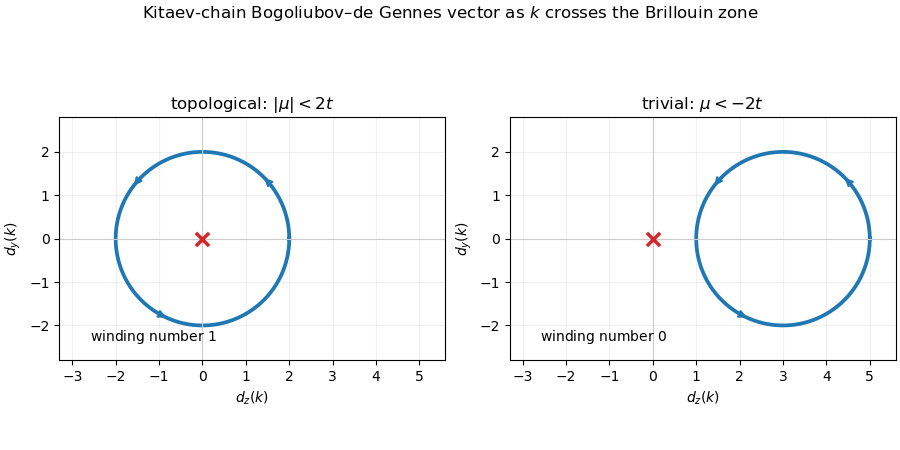
Kitaev-chain ellipse and its winding around the origin
. For chemical potential zero the Bogoliubov--de Gennes vector traces an ellipse enclosing the origin once. For chemical potential minus 3t the translated ellipse misses the origin and has winding number zero. Details.
A Majorana zero mode is a normalized self-adjoint fermion operator localized near a boundary and commuting with the Hamiltonian. With open boundaries,Neither nor appears. Each anticommutes with both factors in every displayed bilinear and consequently commutes with their product. Thusand are Majorana zero modes localized exactly at the two end sites.
Let be the quasi-local unitary carrying the ground space of to that of a topologically equivalent . DefineUnitary conjugation preserves self-adjointness and the Majorana algebra. Quasi-locality spreads each endpoint operator only into an exponentially decaying tail, and the two operators preserve the ground space because preserve the ground space of .
Diagonalize the quadratic Hamiltonian asThe hint gives a real expansion . Any coefficient along a pair with would create or remove a positive-energy quasiparticle and send some ground state outside the two-lowest-state subspace. Ground-space preservation therefore forces and to have support only in the zero-energy Majorana subspace. Hencein the ideal infinite-chain limit, with only exponentially small finite-size corrections. They are the exponentially localized endpoint Majorana zero modes throughout the topological phase.
Articles by others on the same topic
There are currently no matching articles.