Varying the Abelian Chern--Simons theory with respect to givesFor a stationary quasiparticle of charge vector , the time component implies that its enclosed gauge flux isup to the orientation convention. Coupling a particle of charge to this flux produces the full-braid phaseAn exchange is half of the corresponding full braid. Reversing the orientation conjugates the phase.
Under , the Chern--Simons term changes bybecause the contraction with two commuting derivatives vanishes. The source term changes byCurrent conservation removes the last term, so
For a worldline winding once around a noncontractible torus cycle, a large gauge transformation can satisfyThe source action changes byGauge invariance of the path-integral phase for every integer vector requiresTherefore
If , then both andhave integer entries. Thus maps into itself, and the inverse map shows that it maps onto all of .
Substituting into the Chern--Simons term givesThis matrix is integral and symmetric. It is invertible becauseFor and ,Thus every anyon braiding phase is unchanged, and bijectivity of on the charge lattice shows that the full sets coincide. The torus ground-state degeneracy of an Abelian Chern--Simons theory is also invariant:
Forthe two basic particles have bosonic self-statistics and full mutual-braid phase . Moreover . These are the electric and magnetic particles of the surface code.
Forthe first basic particle is a fermion, the second is a boson, and they are mutual semions; again . They can be identified with and , so this is merely another integral basis for the same surface-code phase.
The Knill--Laflamme condition for code projector and errors isFor Pauli errors of weight at most , the product has weight at most . If , such a product cannot be a nontrivial logical Pauli, because every such operator has weight at least the distance of a stabilizer code . It is therefore either a stabilizer, acting as a scalar on the code, or it anticommutes with some stabilizer and maps the code to an orthogonal syndrome space. These are exactly the two possibilities required by the displayed condition, so every error on at most qubits is correctable.
The six displayed generators of the Steane code are independent and commuting, so the common positive eigenspace has dimensionit encodes one logical qubit. The binary columns of the underlying Hamming parity-check matrix are all nonzero and distinct. Hence no weight-one or weight-two Pauli lies in the stabilizer normalizer outside the stabilizer. On the other hand,is logical, and multiplying it by gives the weight-three representativeThe analogous statement holds for , so
Now include both and in the proposed error set. Their product iswhich is non-scalar on the code and violates the Knill--Laflamme condition. Since multiplying by a logical operator does not change commutation with stabilizers, and have the same error syndrome. A decoder cannot know which occurred and may apply a correction that leaves a logical error.
All plaquette stabilizers commute and square to one. Every term inis minimized by eigenvalue , so any ground state satisfiesfor every plaquette.
The R-edge operator commutes with every X-type stabilizer. It overlaps the two endpoint R plaquettes in an odd number of vertices and every other plaquette evenly, so it anticommutes only with the two endpoint Z-type stabilizers. It flips those two eigenvalues to , creating two particles. Multiplying by an adjacent R-edge operator toggles the shared endpoint twice, annihilating that excitation there while creating one at the new endpoint. Repetition forms a string operator in a topological code whose two excitations move farther apart.
An string is a product of X operators, while a string is a product of Z operators. A process that carries once around can be represented by a closed red X string crossing the green Z string once. At the crossing qubit,while all other factors commute. Reversing the order of the two string operators therefore multiplies the state by . The full braid phase isso and are mutual semions.
A green X, Y, or Z string may end on the bottom green boundary without leaving a violated green plaquette beyond the lattice. The top vertex is likewise a zero-length green boundary where such strings can terminate. Thus both locations absorb : they exhibit anyon condensation at a boundary.
A string joining these two green condensers preserves every stabilizer but cannot be reduced to stabilizers, so it is logical. In the pictured lattice the shortest such path contains nine qubits. No shorter nontrivial string connects equivalent condensing boundaries, henceFor example, the product of X operators along any shortest green path from the bottom boundary to the top corner is a logical , and the product of Z operators along a corresponding path is a logical . They may be chosen to overlap on an odd number of vertices, so they anticommute as required for one encoded qubit.
The inverse definitions areSubstitution into the hopping and pairing terms expresses the Hamiltonian as a bilinear in the Majorana fermion operators. Hermiticity makes its off-diagonal coefficients purely imaginary in the Majorana bilinear, whileremoves the symmetric part; diagonal terms are constants because . Therefore, up to that additive constant,whereConversely every real antisymmetric makes this expression Hermitian, so this is the general Majorana form of a quadratic fermion Hamiltonian.
DefineBecause is real orthogonal, the are again self-adjoint and satisfy the Majorana anticommutation relations. Using ,Each two-dimensional block contributes twice the same ordered bilinear:Henceup to the original additive constant.
At and , direct substitution ofinto the bond Hamiltonian makes the hopping and pairing terms cancel except forThusThe terms pair disjoint Majoranas, so this is already Majorana diagonal, with nonzero single-particle values . For periodic boundaries the final pair closes around the chain; for open boundaries and remain unpaired.
Two local gapped Hamiltonians are topologically equivalent when a continuous path of local Hamiltonians joins them without closing the bulk gap. The Bogoliubov--de Gennes Hamiltonian has energiesFor , this gap can close only atThe whole region is connected and gapped, so its parameters can be continuously deformed to . Therefore
Writingshows the topological distinction. As crosses the Brillouin zone, traces an ellipse. It encloses the origin once when , giving nonzero winding number of a one-dimensional Bogoliubov--de Gennes Hamiltonian. For it does not enclose the origin and has winding zero. Changing this integer requires the ellipse to pass through the origin, exactly the bulk gap closing.
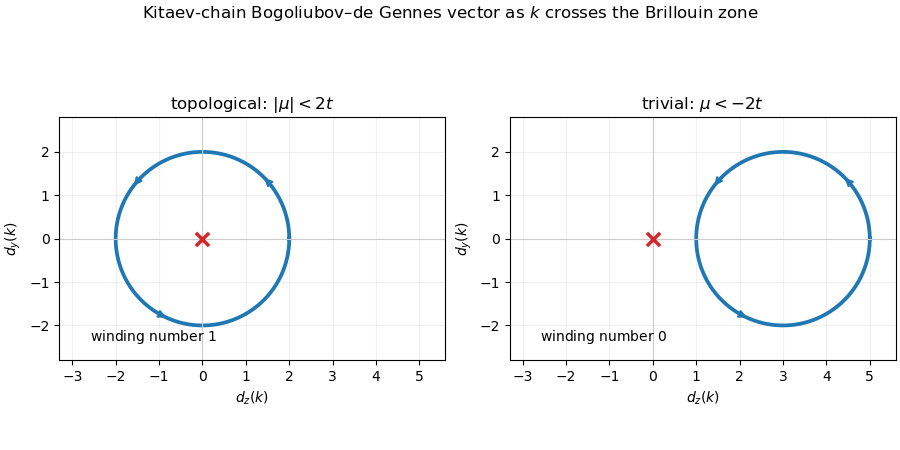
Kitaev-chain ellipse and its winding around the origin
. For chemical potential zero the Bogoliubov--de Gennes vector traces an ellipse enclosing the origin once. For chemical potential minus 3t the translated ellipse misses the origin and has winding number zero. Details.
A Majorana zero mode is a normalized self-adjoint fermion operator localized near a boundary and commuting with the Hamiltonian. With open boundaries,Neither nor appears. Each anticommutes with both factors in every displayed bilinear and consequently commutes with their product. Thusand are Majorana zero modes localized exactly at the two end sites.
Let be the quasi-local unitary carrying the ground space of to that of a topologically equivalent . DefineUnitary conjugation preserves self-adjointness and the Majorana algebra. Quasi-locality spreads each endpoint operator only into an exponentially decaying tail, and the two operators preserve the ground space because preserve the ground space of .
Diagonalize the quadratic Hamiltonian asThe hint gives a real expansion . Any coefficient along a pair with would create or remove a positive-energy quasiparticle and send some ground state outside the two-lowest-state subspace. Ground-space preservation therefore forces and to have support only in the zero-energy Majorana subspace. Hencein the ideal infinite-chain limit, with only exponentially small finite-size corrections. They are the exponentially localized endpoint Majorana zero modes throughout the topological phase.
Articles by others on the same topic
There are currently no matching articles.