For the given wrapped hyperbolic cosine curve,so . The curve makes one full turn around the circular cylinder, descending from to and ascending to its initial point. Its two parameter endpoints coincide; their tangent vectors and do not agree, so the resulting closed curve has a corner there.
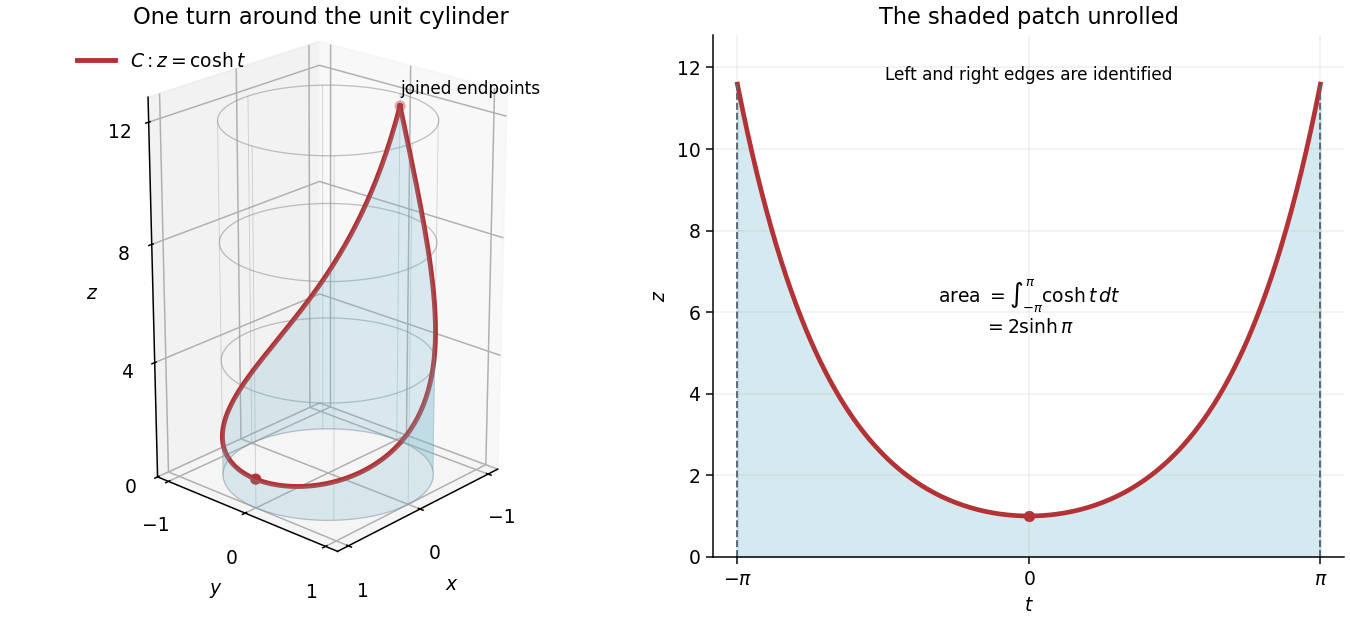

The velocity vector of the parametric curve isIts speed iswhere fixes the sign of the square root. Hence the arc length isThe coincidence of the endpoints does not duplicate any positive arc length.
Parametrize the finite cylindrical surface patch byThe surface area element is . The seam has zero surface area, so it causes no overcounting. ThereforeUnrolling the unit circular cylinder preserves surface area, which explains the equality with the area under the hyperbolic cosine in the figure. The patch consists of the cylindrical surface alone; no flat base is included.
At a fixed , both cylinder inequalities becomeThus the cross section is a square of side and area . Integrating these cross-sectional areas gives the volume of this bicylinder:
For the surface area of a tricylinder, permutation symmetry shows that each of the three cylindrical surfaces contributes the same surface area to the boundary. On the face , put , . The remaining two inequalities requireso . The surface area element on this unit circular cylinder is . There are eight congruent angular sectors, with the minimum equal to for . Thus the area of this face isEvery boundary point lies on at least one of these three cylindrical surfaces; their pairwise intersections are curves of zero surface area. Adding the three faces therefore gives
Articles by others on the same topic
There are currently no matching articles.