In Cartesian coordinates, a parametrization of the curve isDifferentiate using the product rule:Squaring and adding cancels the mixed terms, giving . The arc length is the integral of the speed, soThis assumes the parametrization is piecewise continuously differentiable and counts length with multiplicity if the curve is retraced.
The cardioid has reflection symmetry about the axis because . It passes through at , through at , and has a cusp at the origin when . These points and the following sketch show its orientation.
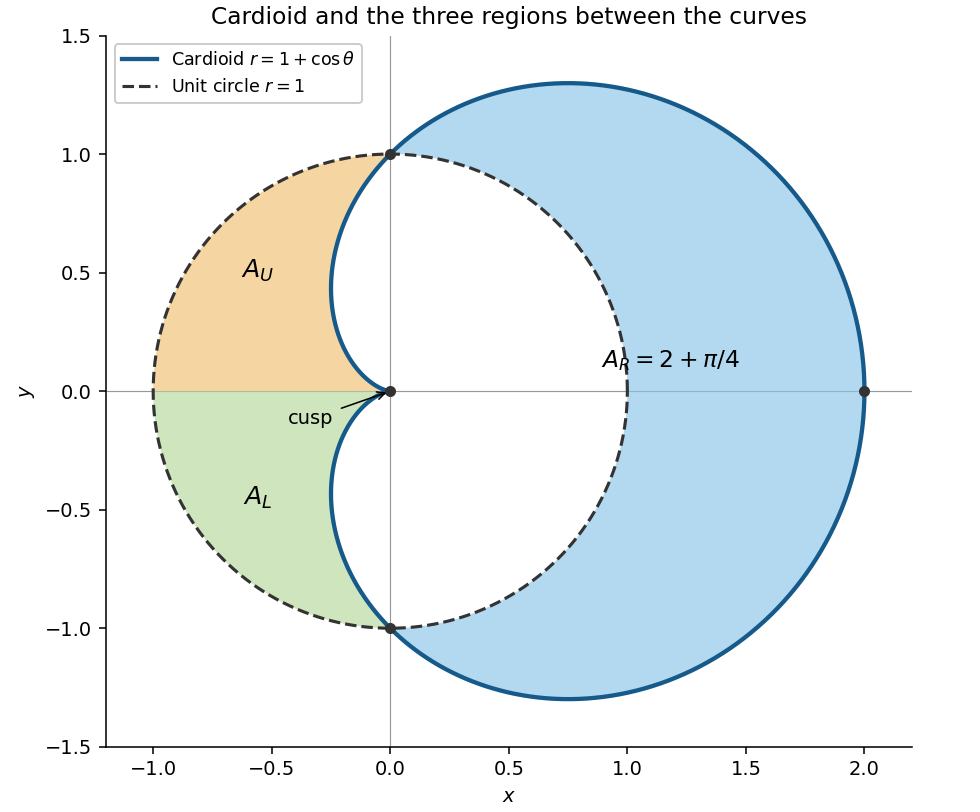
The cardioid and unit circle, with the three regions between them shaded
. Details. 
The cardioid meets the unit circle where , namely at . The polar area formula gives the area between radii as .
For , the cardioid lies outside the unit circle. The right-hand region therefore has areaOn , the unit circle lies outside the cardioid. The upper left region has areaBy reflection symmetry the lower left region has the same area. ThusThe two left regions touch only at the cusp; their interiors are disconnected. As a check, the difference between the cardioid's total area and the unit circle's area is .
Articles by others on the same topic
There are currently no matching articles.