Put . The definitions of the parabolic polar coordinates give and . Subtracting and multiplying these equations yieldsSince , taking the nonnegative square root givesThe Jacobian matrix has columns and . Its Jacobian determinant is thereforeHere the displayed fraction denotes the Jacobian determinant, as in the paper. The change of variables formula consequently gives . The Jacobian determinant is positive except at the origin, and the definitions supply the unique nonnegative inverse throughout the region .
For , the inverse parabolic polar coordinates give and . For , they give and . Thus the requested curves are the upper halves of the parabolasThe first parabola has vertex and opens to the left; the second parabola has vertex and opens to the right. Both pass through and are reflections of one another across the -axis.
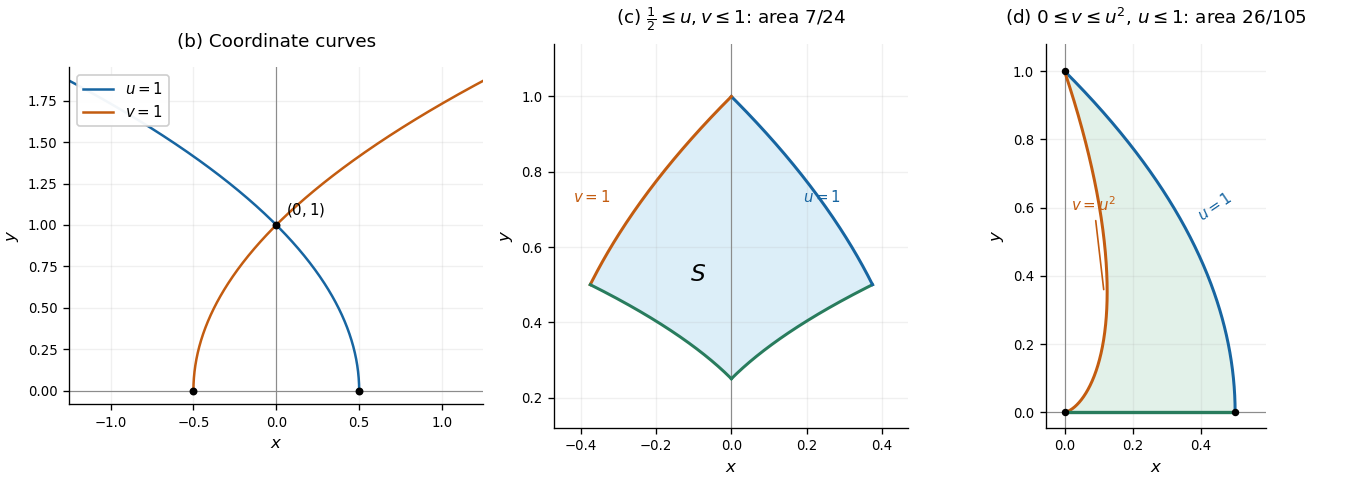

The inequalities become the rectangle , in parabolic polar coordinates. The change of variables formula and the Jacobian determinant from a give the areaThe middle panel in b shows the curved region in Cartesian coordinates; its straight edges in parabolic polar coordinates explain the simple integration limits.
The first boundary is . On in the first quadrant, the inverse parabolic polar coordinates give . To identify the remaining curve, put . Its Cartesian coordinates satisfyHence and , so this boundary is . The condition on this curve requires . Its endpoints are and , while meets at . These three arcs enclose exactlyEvery point in this region has , and therefore , as required. Using the Jacobian determinant, the area is
Articles by others on the same topic
There are currently no matching articles.