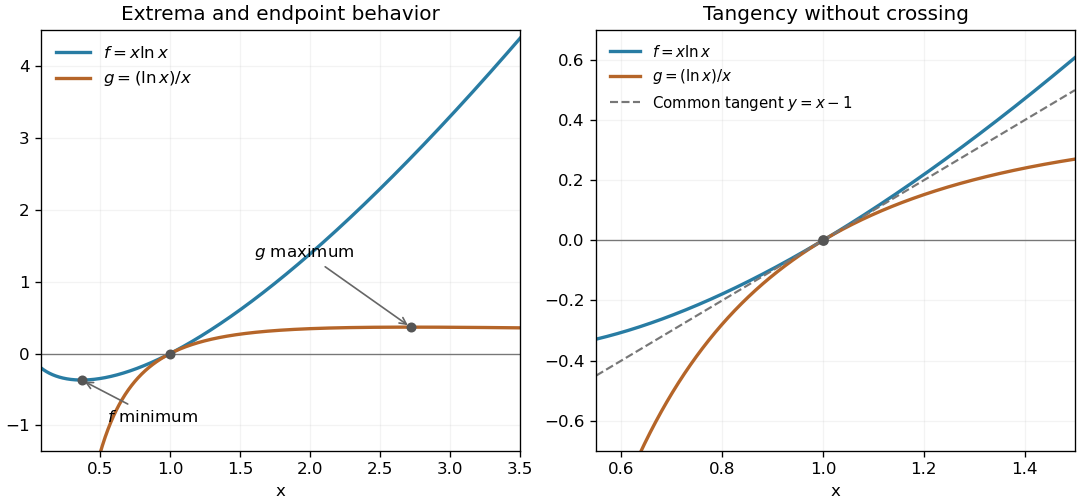
For , the derivatives are and . Its unique stationary point is the global minimum . For , changes from positive to negative at , giving the global maximum . Their endpoint limits areAn intersection requires , and on both factors vanish only at . There and , proving a common tangent line . In fact,because the two numerator factors always have the same sign. Thus the curves touch at without exchanging their order.

Articles by others on the same topic
There are currently no matching articles.