Subtract the two position vectors to obtain the direction . The affine line in a vector space through the points is thereforeThe values recover the two specified points.
A normal vector to the plane spanned by is their cross product:Dividing by this Euclidean norm gives the two possible choices of unit normal,
The two edge vectors based at are and . Their cross product is , with squared Euclidean norm . The triangle occupies half the corresponding parallelogram, so
Use the normal vector found from the edge vectors, rather than the normal vector to the origin-based linear span in part (b). The required plane satisfies . Since ,After dividing by , its equation has a unit normal. Its perpendicular distance from the origin is thus .
On the basic interval the graph is the pair of straight segments joining , and . Its periodic extension is an even triangular wave.
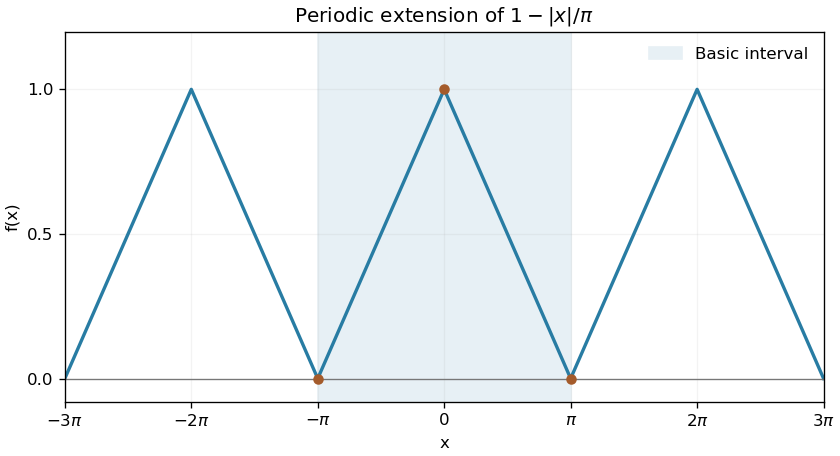
The even triangular wave and its periodic extension
. Original plot marking the basic interval and the repeated linear pieces. Details.
The Fourier coefficients satisfy by evenness, andFor the second formula, integration by parts gives . Only odd indices survive, giving this rescaled Fourier cosine series of a triangular wave:The pointwise convergence of a piecewise smooth Fourier series applies throughout the interval, including the continuous joined endpoints. The coefficients also imply uniform convergence by the Weierstrass M-test. At , the value is one, so
Adding and subtracting the two coordinates shows that and . The normalized eigenvectors can therefore be chosen asTheir inner product is , and their squared norms are one, proving orthonormality. If , every nonzero vector is an eigenvector; this chosen orthonormal basis still works.
If , then . Alternatively, direct matrix multiplication givesThus the normalized eigenvectors from part (b) have respective eigenvaluesIf , then , and the whole two-dimensional space is its eigenspace. This degeneracy includes cases where the two eigenvalues of were distinct but opposite.
The fundamental theorem of calculus differentiates the upper endpoint, while differentiation under the integral sign differentiates the parameter:These formulas hold, for example, when and its displayed parameter partial derivative are continuous on a neighborhood of the integration interval and the parameter value.
Work first with , so the real integrands and their parameter derivatives are smooth on every finite amplitude interval. For the elliptic integral of the second kind,On the other hand, subtracting the integrands of the second-kind and first-kind elliptic integrals givesConsequentlyThis is the modulus derivative of the incomplete elliptic integral of the second kind. At its right-hand side has a removable limit zero, agreeing with . Both and here use amplitude and modulus ; differentiating with respect to the alternative parameter would give a different prefactor.
The fundamental theorem of calculus and part (a) giveThe difference is constant in . Since , the constant is zero, provingThis is simply the chain rule integrated, with itself as the antiderivative of the square-root factor.
For , the derivatives are and . Its unique stationary point is the global minimum . For , changes from positive to negative at , giving the global maximum . Their endpoint limits areAn intersection requires , and on both factors vanish only at . There and , proving a common tangent line . In fact,because the two numerator factors always have the same sign. Thus the curves touch at without exchanging their order.
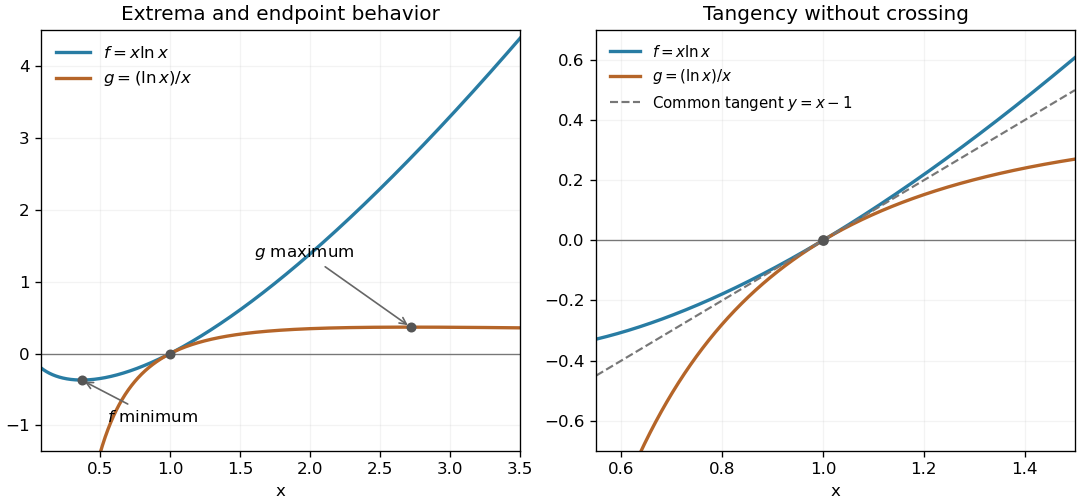
Two logarithmic curves touching at their unique intersection
. Original common-axis plot marking the extrema and the shared tangent at . The curve lies above everywhere else on the positive axis. Details.
Use , so and . Reversing the integration bounds gives, without evaluating either side,For , the same change of variables givesso . These are legitimate transformations of improper integrals: is integrable near zero, and is integrable at infinity. In particular is absolutely convergent, so no cancellation of divergent endpoints is being assumed.
Take the outward orientation of a surface. The divergence is , so the divergence theorem converts the closed surface flux into an integral over the box:Each term separates; for example the term is . Summing givesHere are the box half-lengths. Reversing orientation of a surface would negate the result.
Differentiate the ellipsoidal parametrization. Its outward vector surface element isFor , its dot product with simplifies to . Thus the requested direct surface integral isAs a check, the divergence of is three, and the ellipsoid has volume , so the divergence theorem gives the same value.
Subtract corresponding entries in the two matrices:Both matrices have shape , so this subtraction is defined.
The first matrix product gives the column . Its product with the final row is an outer product, not a scalar:
Row reduction, or the cofactor formula for a matrix inverse, givesMultiplying by the right-hand-side column gives, at ,For general , the coefficient matrix has determinant . Thus other parameter values give a unique solution. If , subtracting the first equation from the second gives , while subtracting it from the third gives , a contradiction. If , subtraction gives and , again inconsistent. Hence
Write and . Away from the origin, and . The product rule givesConsequently the divergence of is zero. For any closed surface bounding a region that excludes the origin, the field is smooth throughout that region, and the divergence theorem provesFor the infinite cylinder, use and outward unit normal . With , , , and . Hence the direct surface flux isThe integrand is odd in and absolutely integrable. This calculation treats the unbounded cylindrical side directly, without applying the bounded-region divergence theorem across the field's singularity.
For an times continuously differentiable function, Taylor's theorem giveswhere lies between and . An infinite Taylor series represents the function when its remainder tends to zero; this holds locally for an analytic function, rather than for every smooth function automatically.
Integrate the geometric series for from zero to . The first three nonzero terms areThe resulting Taylor series converges for .
For fixed real , write the square root as and use the binomial series with exponent :The absolute values are necessary for negative . This Taylor series is valid for . If , the quotient is for ; it has no continuous extension at zero and therefore has no Taylor expansion about zero.
Factor the Gaussian function as . Multiplying the two exponential series givesFor , its first three nonzero terms areVanishing coefficients require separate treatment in this Taylor expansion of a translated Gaussian. If , the first three nonzero terms are . If , they areThe latter expression retains the cubic term because the quadratic coefficient is zero.
Use the real logarithm near zero and subtract its two Taylor series:Thus the first three nonzero terms are
Use the Einstein summation convention, with repeated component indices summed. The following three expressions are listed separately below. For cyclic invariance of the trace,where the middle equality commutes scalar entries, not the matrices themselves. If is invertible, this givesThis is similarity invariance of trace.
The identity matrix has entries given by the Kronecker delta, soEach of the diagonal entries is one.
Expand in components:If , all powers for vanish. The matrix binomial theorem, valid here because commutes with , therefore yieldsThese powers of the identity plus a square-zero matrix can also be proved by induction: . For the displayed example, directly, andThis is the repeated function composition of a shear mapping. The argument gives every nonnegative integer ; since , the same formula also holds for negative integers.
The number has modulus one and argument modulo . Therefore its complex logarithm has valuesEvery value has real part zero. For the principal complex logarithm, choose the unique integer giving imaginary part in . The unwrapped value is the principal imaginary part only when it already lies in that interval.
In polar form, a cube root of one has modulus one and argument . The three roots of unity areThey are equally spaced on the unit circle.
Write . Its cube roots have modulus two and arguments , for . ThusEach cube equals , and a cubic polynomial has no further distinct roots.
For , write . The equation becomes , whose roots are , both of modulus one. Hence . If , the double root is , giving the same relation. Therefore
For a probability density function , the mean and variance areThese formulas assume the required moments are finite; finiteness of the second moment ensures a finite mean as well.
The triangular probability density function is normalized because . It is even, so the mean integrand is odd and . Its variance is consequently its second moment:
The standard normal density is even, so is odd. Since Gaussian decay dominates every power, the integrand is absolutely integrable. Therefore
For the standard normal density, . Using integration by parts,The boundary term vanishes because Gaussian decay dominates every power. Since the given mean is zero and variance is one, , yielding the Gaussian fourth moment
Separate the variables in this first-order ordinary differential equation:Integration gives , so . On the interval containing the prescribed point , we have . The initial condition therefore gives , hence . Choosing the positive square root to match that initial condition yieldsThe maximal interval containing on which this solves the explicit ordinary differential equation is . At the left endpoint , the original denominator vanishes and the derivative becomes unbounded. Directly, and , verifying the equation throughout this interval.
Recognize the left-hand side as a product rule derivative, and use :At , both and equal , so . ThereforeDividing by first obtains this solution on , the interval containing the initial condition. The explicit expression is smooth on the entire real line and satisfies the original, undivided differential equation even where .
Articles were limited to the first 100 out of 188 total.
Articles by others on the same topic
There are currently no matching articles.