For , the product rule gives , so the stationary points occur at . Its sign is negative for and positive for . ConsequentlyThey are also the global extrema, since the function tends to zero at both infinities and is a monotone function on the intervals just identified. At zero the derivative does not change sign. Since , is a stationary inflection point, not an extremum.
The function is odd, with a horizontal tangent line at the origin and tails approaching zero from below on the negative side and above on the positive side. It decreases to its negative minimum at , rises through the stationary inflection point at zero to its positive maximum at , then decreases toward zero.
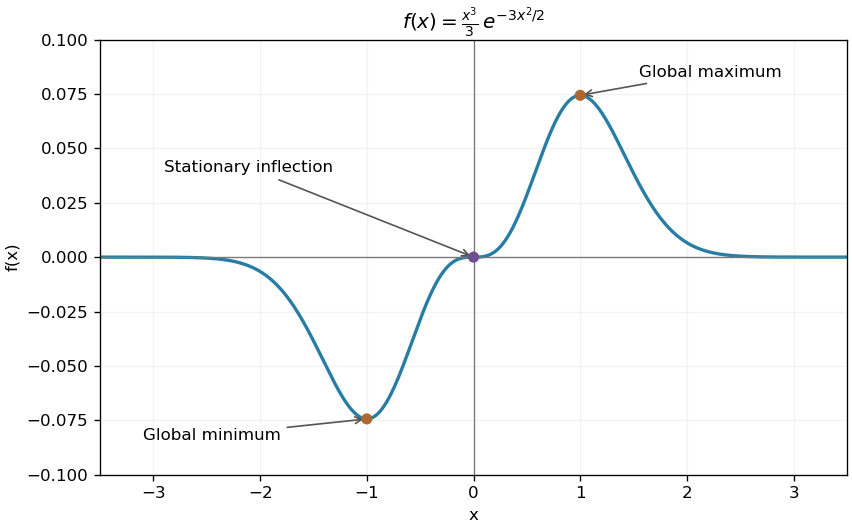
An odd cubic Gaussian profile with two extrema and a stationary inflection
. Original function plot with the three stationary points marked. The near-zero cubic behavior explains the flat crossing without an extremum. Details.
The Gaussian decay makes the integral absolutely convergent, so odd symmetry gives . On the positive half-line substitute , so . ThusThe last integral is , an instance of the odd Gaussian moments on a half-line.
Articles by others on the same topic
There are currently no matching articles.