Put . The scalar triple product is unchanged by cyclic permutation, soThese are the diagonal pairings of a reciprocal basis.
The cross product is orthogonal to both factors. Division by the nonzero scalar preserves that perpendicularity, giving . Cyclic permutation gives the other off-diagonal pairings needed for the reciprocal basis.
Suppose . Take its dot product successively with . The reciprocal pairings give . Thus are linearly independent and therefore noncoplanar in three dimensions.
For the numerical vectors, and , proving noncoplanarity. The reciprocal basis isReciprocal dot products extract the coefficients of any vector in the original basis. Here , , and , soSubstitution in Cartesian components recovers .
Write . This rational function is continuous at both finite points because its denominator is nonzero there. Substitution gives the first two limits; at infinity divide numerator and denominator by and use their leading coefficients. Therefore
For fixed real , the base is positive for all sufficiently large positive . Take its logarithm and use the Taylor expansion :Continuity of the exponential function then gives . This includes .
The numerator and denominator both vanish at zero. The fundamental theorem of calculus differentiates the numerator, while the denominator derivative is nonzero near zero. L'Hôpital's rule therefore gives
Both numerator and denominator have a double zero at one. Applying L'Hôpital's rule twice givesAlternatively and , giving the same result from a Taylor expansion.
For , the product rule gives , so the stationary points occur at . Its sign is negative for and positive for . ConsequentlyThey are also the global extrema, since the function tends to zero at both infinities and is a monotone function on the intervals just identified. At zero the derivative does not change sign. Since , is a stationary inflection point, not an extremum.
The function is odd, with a horizontal tangent line at the origin and tails approaching zero from below on the negative side and above on the positive side. It decreases to its negative minimum at , rises through the stationary inflection point at zero to its positive maximum at , then decreases toward zero.
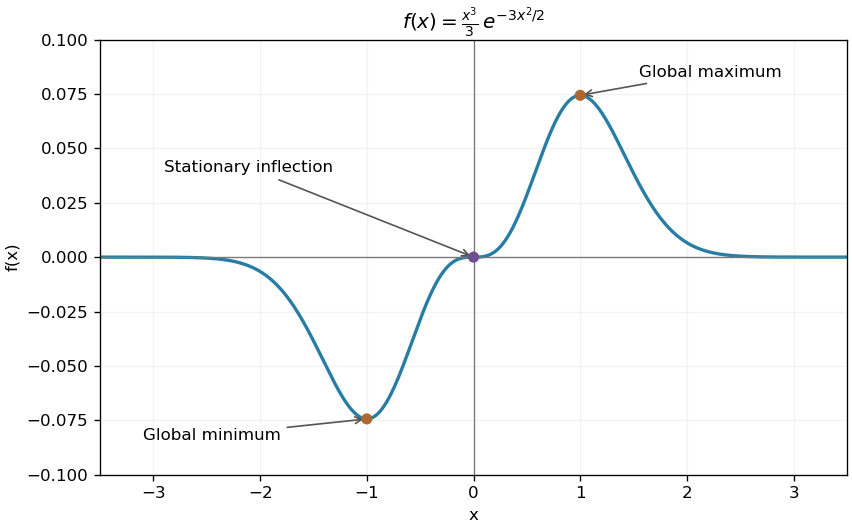
An odd cubic Gaussian profile with two extrema and a stationary inflection
. Original function plot with the three stationary points marked. The near-zero cubic behavior explains the flat crossing without an extremum. Details.
The Gaussian decay makes the integral absolutely convergent, so odd symmetry gives . On the positive half-line substitute , so . ThusThe last integral is , an instance of the odd Gaussian moments on a half-line.
Use integration by parts with and , giving . The remaining integrand simplifies because :The real formula is valid for every real number .
Put , so . The integral becomes , givingFor the real logarithm, choose an interval in or ; the original integrand is singular at one and undefined for nonpositive .
The two-by-two matrix inverse formula givesMultiplication in the reversed order givesThe order reversal is needed because applying the inverse undoes the original two linear maps in reverse sequence.
Take , which are invertible matrices. Then , whereas . This proves that the determinant is not additive. Being a multilinear map of separate columns does not imply additivity in the entire matrix.
Again take . Their sum is also invertible, but , while . Thus matrix inversion is not additive, even when every inverse in the proposed identity exists.
Use and from part (a). The proposed unreversed product iswhich differs from the actual inverse . Both original matrices are invertible matrices, so this is a valid counterexample. The universally valid order is .
The product of a matrix with another matrix requires its inner dimensions and three to match. Thus is necessary and sufficient for to be defined.
The shapes in are , whose inner dimensions always match. Hence every positive integer is allowed, and the resulting matrix is .
A two-sided matrix inverse requires a square matrix, so is necessary. It exists only if that square matrix is also an invertible matrix, equivalently ; choosing the dimension alone does not ensure invertibility.
For a nonzero separated solution , separation of variables gives . The zero Dirichlet boundary conditions force , , with integers ; the time factors are . Expanding the initial profile in this Fourier sine series requires only the two already displayed spatial modes. ThusBoth terms individually solve the heat equation, vanish at the endpoints and give the required initial profile at . The initial function is also on the bar; the later solution stays nonnegative and tends to zero as heat leaves through the fixed-temperature ends.
Parametrize the line by , . Its tangent vector is . On this line the three force components sum to . Therefore the line integral is for every parameter choice.
The field is smooth on the simply connected domain . Its curl is , so a necessary and sufficient condition for a conservative vector field isAt those values it is explicitly the gradient of . Equality of the two previous path integrals would impose only , which is weaker: coinciding path integrals need not imply a conservative field. For example makes those two integrals equal but leaves nonzero curl.
The identity makes the lower-order cancellation explicit. Expand the two sines through degree seven:These are the first three nonzero terms; there is no linear term.
Write and multiply by . The product equals one, so its coefficients give , and . Since ,This is the initial part of the general reciprocal of a power series recurrence.
The exponential function definitions of the hyperbolic functions and Euler's formula giveDividing these identities wherever gives . The two undivided identities hold for every complex number ; the quotient identity excludes its poles.
Adding and subtracting the exponential function power series cancels the appropriate odd or even terms:Both series converge absolutely for every complex number , as follows from the ratio test.
Two applications of integration by parts give and . Thus an antiderivative is . Evaluating its endpoints gives
For and , monotonicity gives . Integrating over each unit interval and summing proves the integral test tail boundsThe inequalities remain strict because the very first rectangle already has a strictly positive difference from either bounding integral.
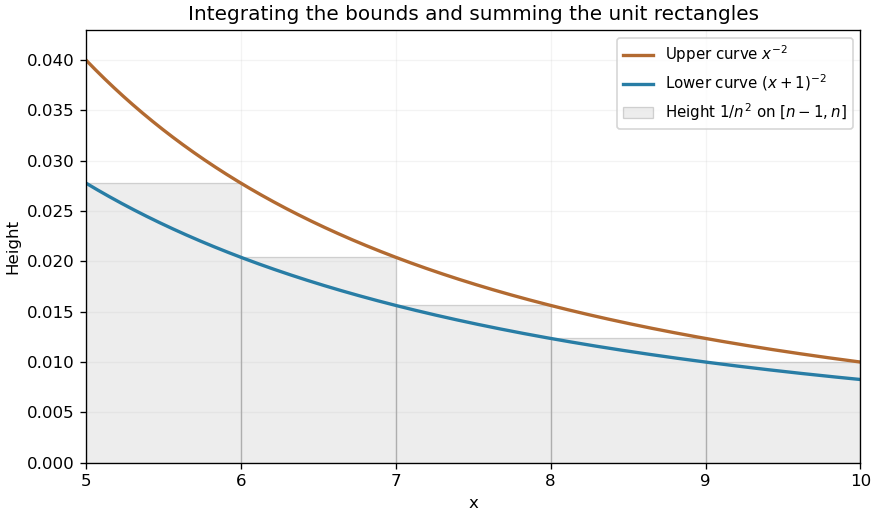

Add the supplied five-term partial sum to each side of the tail inequality. Since and ,Numerically this is approximately .
Apply the integral bounds for a finite harmonic sum to the omitted terms from thirteen through one hundred:Adding the given gives . Both bounds lie between and , so every value they permit rounds to the same two significant figures:The rounding follows from the bounds, without computing all the intervening terms.
For a nonzero solution, separation of variables gives , so . Restoring the zero solution by allowing an arbitrary real multiplicative constant givesIt is valid for all real numbers , including the constant solutions when .
Use integrating factor for this first-order linear differential equation. Then . Integrating givesThis includes the constant particular solution when .
Use the slope substitution for equations involving x y'-y: put on the positive interval containing the initial point. Then , so . Near , separating variables gives . Integration yields . The initial value fixes the sign and constant, givingChoose the inverse cosine branch that agrees with . The solution isOn this interval the argument lies strictly between zero and one and the original cotangent is defined. At the finite lower endpoint, and the cotangent becomes singular, so that endpoint is excluded from the maximal interval of the initial value problem. The slope substitution here is valid without classifying the original equation as homogeneous in the usual sense.
Articles were limited to the first 100 out of 162 total.
Articles by others on the same topic
There are currently no matching articles.