The modulus equation says that has fixed distance eight from . Thus its locus is a circle of radius eight centered at , with Cartesian equation .
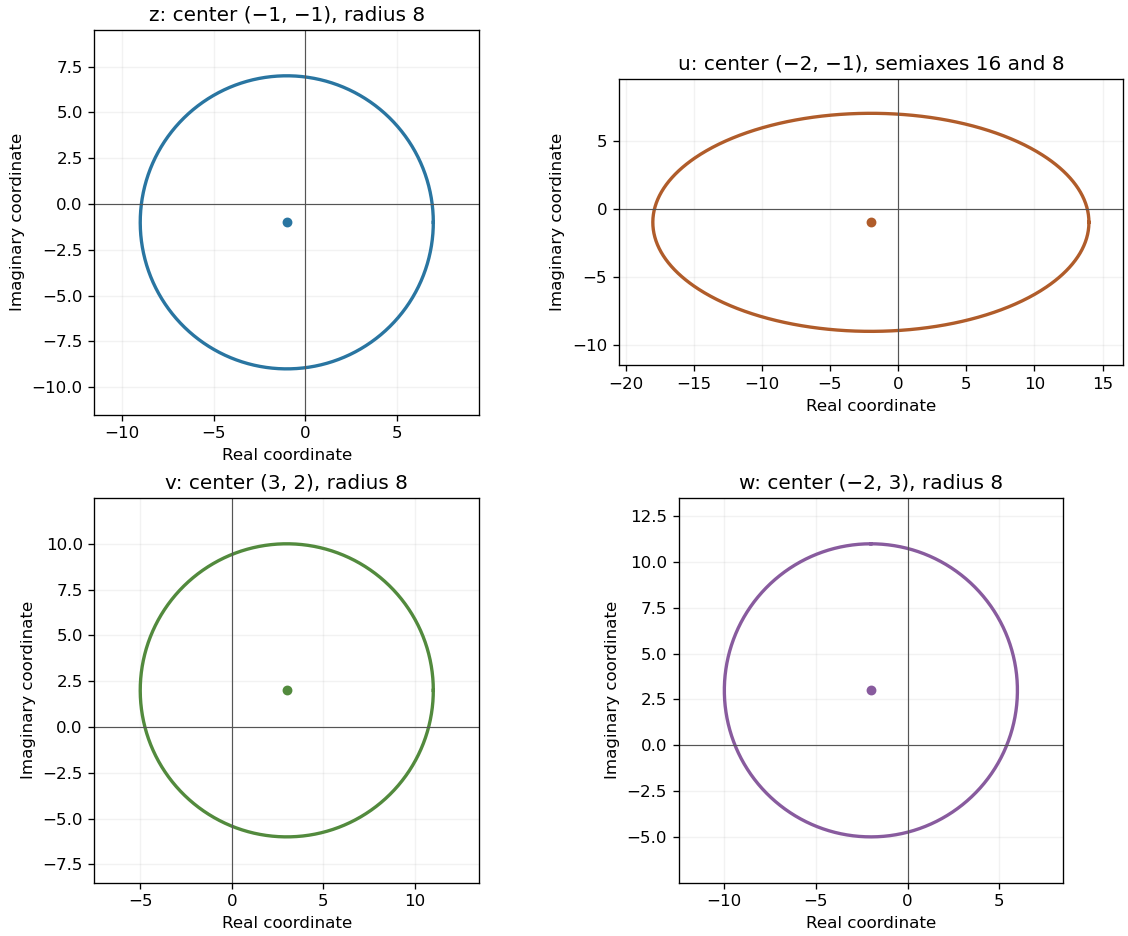

Writing gives , . Substitute , into the original circle equation. This affine image of a circle is the ellipsecentered at with horizontal semiaxis sixteen and vertical semiaxis eight. The map covers the whole ellipse as covers the circle.
The complex translation adds four to the real coordinate and three to the imaginary coordinate. The locus is therefore a circle centered at with radius eight:
Multiplication by rotates the plane counterclockwise through . The center maps to , while distances are preserved. Thus the locus is a circle centered at with radius eight:
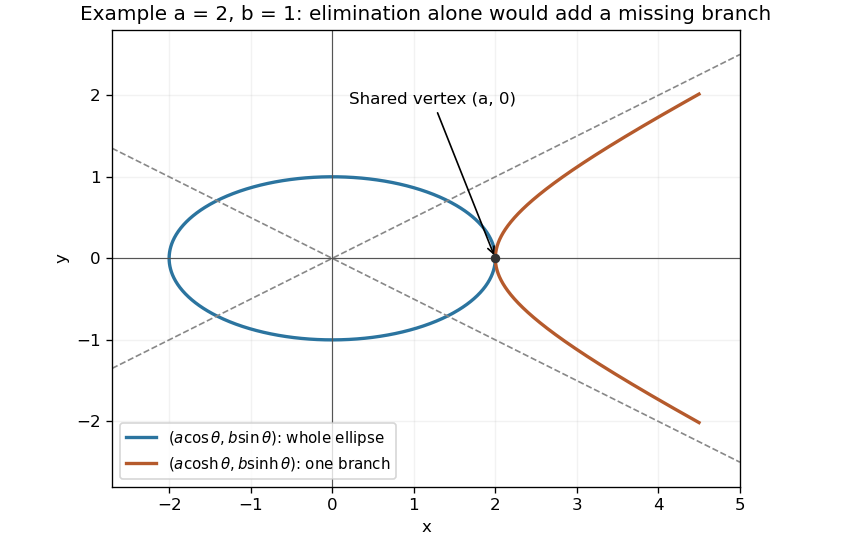
For , elimination of the trigonometric parameter givesAs real varies, the whole ellipse is traced, with semiaxes . Signs of affect the traversal direction but not the set. If , the locus is the vertical segment , ; if , it is the horizontal segment , . Both zero give only the origin.
For , the hyperbolic identity gives . The hyperbolic parametrization of a hyperbola also imposes , so the exact traced locus isIt is only one branch: the right branch for and the left branch for . Its vertex is and its asymptotes are . If , , the entire vertical axis is traced. If , , the locus is the ray , . Both zero give the origin.

Articles by others on the same topic
There are currently no matching articles.