In components, the scalar triple product isIt is the determinant with rows . A cyclic permutation of the rows has positive sign, so . Equivalently the Levi-Civita symbol expression is unchanged by that cyclic relabeling.
Take , and . The two plane directions are and . Their cross product is , so a normal vector is . The Cartesian equation of a plane is thereforeEach given point satisfies it, and the nonzero cross product confirms that the points determine a unique plane.
The volume of a parallelepiped is the absolute scalar triple product of its edge vectors. HereThe absolute value removes the orientation of the chosen edge ordering.
The comparison test for series says that eventually and convergence of imply convergence of . Conversely, an eventual positive lower comparison with a divergent positive series proves divergence. The ratio test uses : proves convergence, proves divergence, and is inconclusive. Removing finitely many initial zero terms does not affect these conclusions.
For , and . Hence . The comparison p-series has exponent two and converges, so the series converges by the comparison test.
The summand tends to one rather than zero. The term test for divergence therefore proves the series diverges. A ratio limit equal to one would be inconclusive and is unnecessary here.
For , the ratio of positive terms isThe ratio test proves the series converges. Its zero term at has no effect.
For an oriented piecewise smooth surface with boundary and a vector field with continuous first derivatives near , the Stokes theorem statesHere is the chosen unit normal vector, the positive area element, and the oriented tangent line element. The traversal of follows the right-hand rule relative to the surface orientation.
Orient the three faces outward from the tetrahedron. The two coordinate-plane faces have normals parallel to or , so their flux of the curl is zero. On the inclined face , its upward vector area is , with , . Thus the direct surface integral isThis surface induces the counterclockwise boundary viewed from above, where and . At , . On , take , giving integral . On , take , giving . On , and the integral vanishes. ThereforeBoth sides have been calculated directly, verifying the Stokes theorem with consistent orientations.
Use and the derivative of the tangent:The antiderivative applies on each interval avoiding the poles of .
For , the natural logarithm satisfies . Squaring therefore decreases its value, while . Pointwise comparison gives , soAs a check, integration by parts gives , and , consistent with this order.
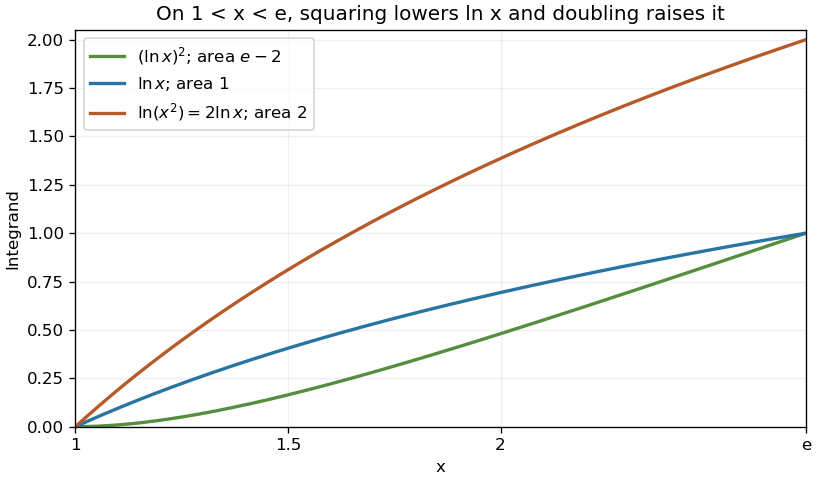
Pointwise ordering of the three logarithmic integrands
. Original plot on . The natural logarithm rises from zero to one, so its square lies below it, and twice the logarithm lies above it. Integrating preserves the strict order. Details.
The cumulative distribution function must tend to one at infinity, so . Differentiation gives the probability density function for and zero for ; there is no atom at zero. This is an exponential distribution of rate one. Its first two moments are and , so
The continuous nonnegative part has total mass . The remaining mass is at , giving . This is a mixed probability distribution, specifically a mixture of a point mass and an exponential distribution; its atom must be included in normalization.
The conditioning event selects the exponential component: and . Thus conditional probability givesThe atom at is excluded by the conditioning event.
The determinant is , so for the inverse matrix isThe specified equations use , with right-hand side . Multiplying by givesIn particular the parameter in the inverse formula must be set to four, not left arbitrary for this numerical system.
For , the required right-hand matrix has twice the first row of , the same second row, and twice the third row. Left multiplication scales rows, soEquivalently, right multiply the given equation by to obtain the same answer.
At , the second row is twice the first. The independent equations are and . Therefore the null space isIt has dimension one, consistent with matrix rank two.
The trace is unchanged by transposition and is cyclic under a product. With and ,Thus . In components this is the vanishing contraction of a symmetric tensor with an antisymmetric tensor.
The Levi-Civita symbol vanishes when two indices coincide, so
The antisymmetric contribution is the negative of twice the cross-product matrix for :The cross-product matrix spectrum is , so has eigenvalues . Multiplication givesDirect expansion of the displayed matrix yields the same real positive determinant.
Use index contraction:The last term vanishes because is symmetric in the contracted indices while the Levi-Civita symbol is antisymmetric. Hence .
Taking determinants in gives . Here because , so . This also agrees with being an outer product of rank one.
For , the velocity is . Because throughout this path, both fields again agree pointwise, now as . ThusThese equal values alone do not establish path independence for either field on all of space.
Direct differentiation gives with , so is a conservative vector field and its integral depends only on the endpoints. In contrast,is nonzero, for example at . Thus is not conservative. Both earlier paths lie in the surface , where the two fields happen to coincide. This illustrates why coinciding path integrals need not imply a conservative field.
Using a value of the complex logarithm, . Thus every logarithmic-branch value is real and positive:The principal value is .
Differentiating the exponential definition gives .
The fifth power of the odd function is odd and continuous. Its integral over the symmetric interval is therefore .
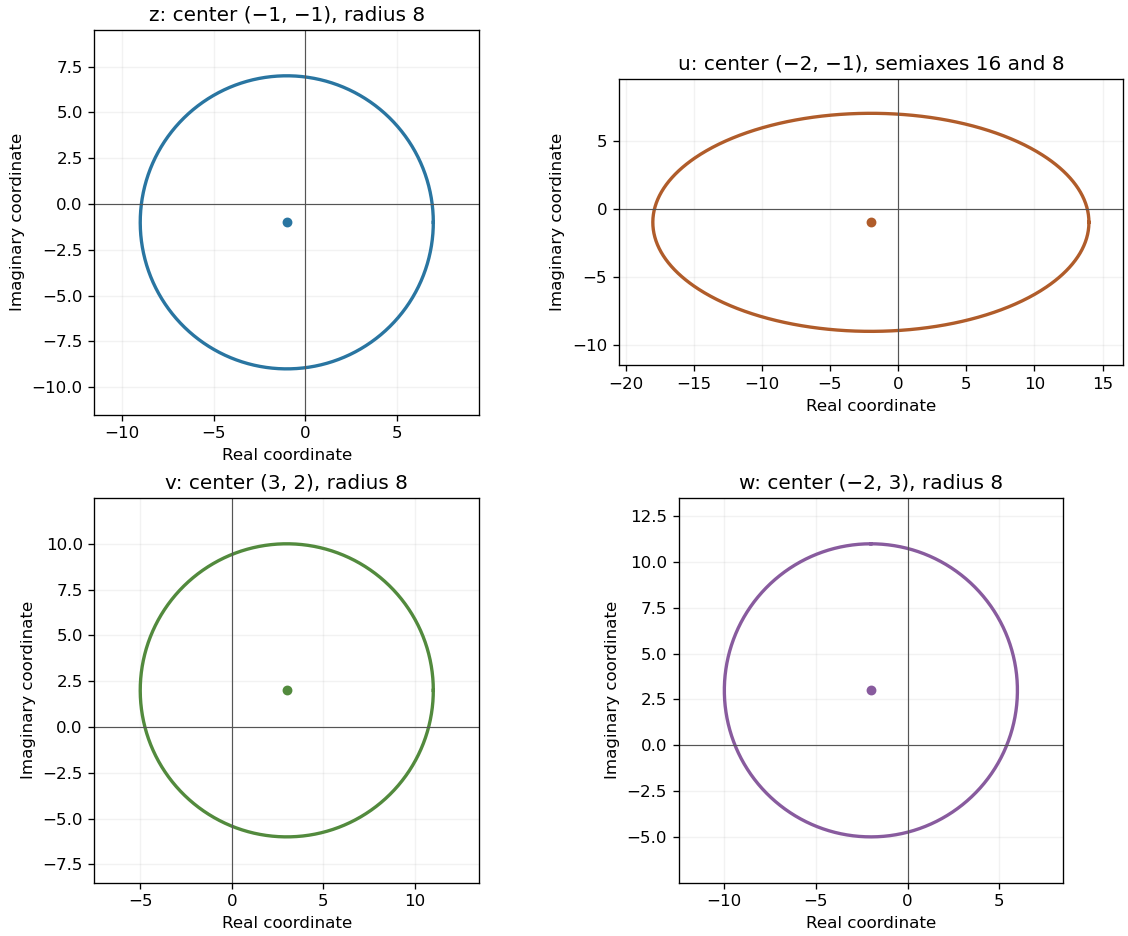
The modulus equation says that has fixed distance eight from . Thus its locus is a circle of radius eight centered at , with Cartesian equation .

Articles were limited to the first 100 out of 117 total.
Articles by others on the same topic
There are currently no matching articles.