The function is strictly decreasing for positive . On , this gives . Integrate across that unit interval to obtainApplying this to every integer and summing proves the integral test tail boundsBoth remain strict: the sum of the positive differences between rectangles and integrals is already bounded below by its positive first difference. Convergence of the integrals and the p-series makes the passage to infinity valid.
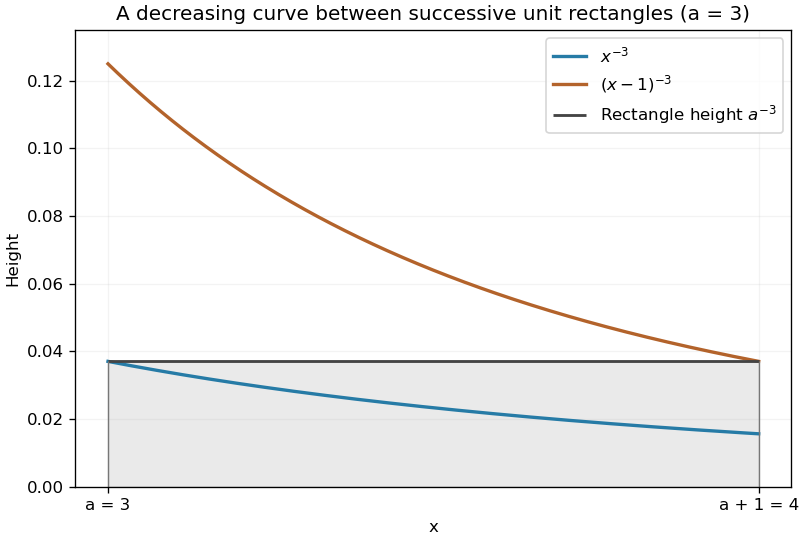

The shifted integral representation of a p-series tail evaluates the defining integral asIt is strictly increasing in , since . From the bounds just proved with , . Since the middle expression equals , monotonicity proves
Subtract the first four terms from the given full p-series sums. WriteandSolving yields . ThereforeThe unrounded shifts are approximately and .
Use the stipulated interpolation . The unrounded values give , and henceThus a sensible reported estimate isUsing the rounded shifts from part (ii) instead gives and a sum about , with the same six-significant-figure estimate. The interpolation of shifts is an assumption of this approximation; the integral test bounds alone do not prove that many digits of accuracy.
Articles by others on the same topic
There are currently no matching articles.